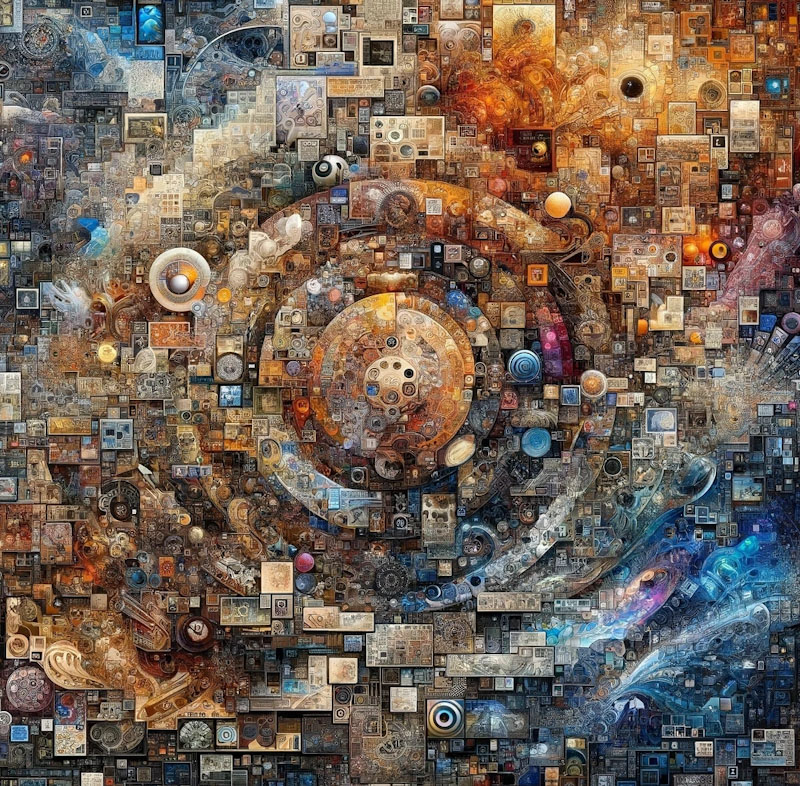
Imagine navigating a vast, intricate landscape where every path intertwines, yet no single route offers a complete journey. This is the realm of (a) global systemic discontinuity, a concept that transcends traditional logic and has the potential to reshape our understanding of complex systems.
Envision this discontinuity not as a singular, isolated anomaly but as a binding fabric woven throughout the entirety of a complex system. It is distributed and global, manifesting not in pockets or fragments but as an inherent and irreducible characteristic of the whole. This kind of pervasive nature and omnipresence suggests that our more common linear, directed and compartmentalised approaches to understanding complex systems might resemble trying to comprehend a vast and turbulent ocean by studying a single drop of water.
The rules of conventional logic and communication undergo significant extension and metamorphosis in this adaptive landscape. The discontinuity is logical and abstract in nature, yet it defies the simplicity of binary truths. It embodies a form of paradoxical coherence, where opposing forces and contradictory elements coexist, cultivating and sustaining a dynamic equilibrium. This is the dance of complexity, where the sum is not merely greater than its parts but is fundamentally different in essence.
By acknowledging the possibility of this distributed discontinuity, we open our minds to new paradigms of understanding and engagement with complexity, with technology and with ourselves. It challenges us to embrace complexity, to recognize the limitations of our linguistic constructs, and to appreciate that insight often lies in the spaces between our words and theories. This is not just an exercise in theoretical abstraction but also represents a journey towards a deeper, more nuanced appreciation of the intricate web of systems and dependencies that constitute our shared, collaborative and contested realities.
In this kind of exploration, our minds become more agile, capable of holding multiple perspectives simultaneously. We learn to navigate paradoxes of self-reference and to appreciate the beauty of complexity. As we ponder this concept, we’re not just expanding our intellectual horizons; we’re engaging in a transformative process that enhances our cognitive flexibility and enriches our understanding of and engagement with the world around us.
 Daedelus Kite