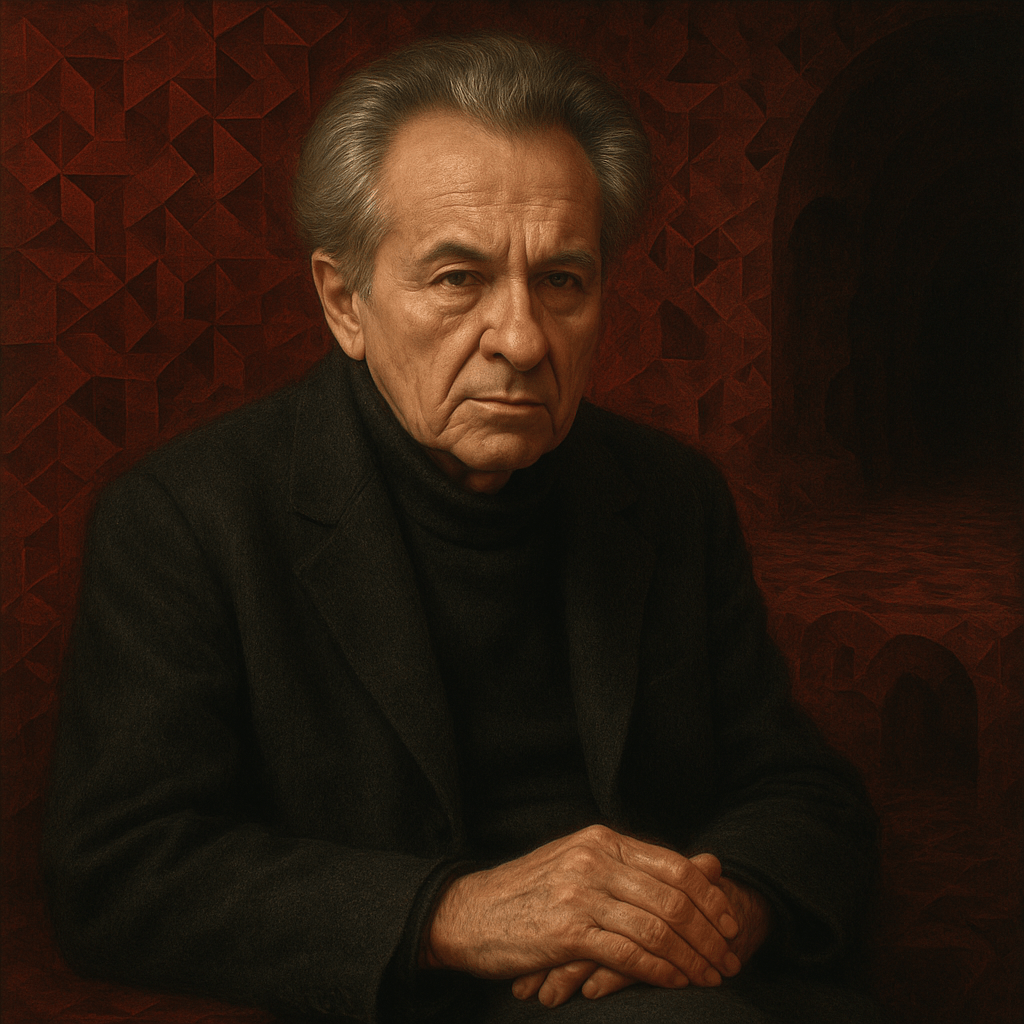
Emil Cioran (1911–1995)
Born in Rășinari, Romania, Cioran studied philosophy in Bucharest before relocating to Paris, where he lived in self-imposed exile. His early years were marked by a grave mistake: an entanglement with fascism. He later rejected it, not with apologies or explanations, but with distance—cutting himself loose from homeland, language, and any remaining belief in collective salvation. What followed was a slow, methodical unravelling. He wrote not to offer clarity but to expose its absence. Each aphorism stripped something away. He didn’t build. He withdrew—until only the vibration of thought remained.
His writing operates like a broken transmission across a shifting field. No centre, no stable ground. Just sharp phrases scattered like signals through static. Meaning here is not delivered—it accumulates, uncertain, entangled. Every attempt to grasp it leaves trace elements behind, interference patterns in the reader’s own system. It’s not argument. It’s not despair. It’s the residue of a system becoming aware of its own asymmetry—too late to change, too introspectively, apophatically self-entangled to stop.
 Daedelus Kite