
Peter Mitchell was a British biochemist who transformed biology by introducing the chemiosmotic theory — the idea that cells generate energy through electrochemical gradients across membranes, overturning the then-dominant mechanistic view of metabolism.
“I cannot consider the organism without its environment… from a formal point of view the two may be regarded as equivalent phases between which dynamic contact is maintained by the membranes that separate and link them.” — Peter Mitchell, 1957
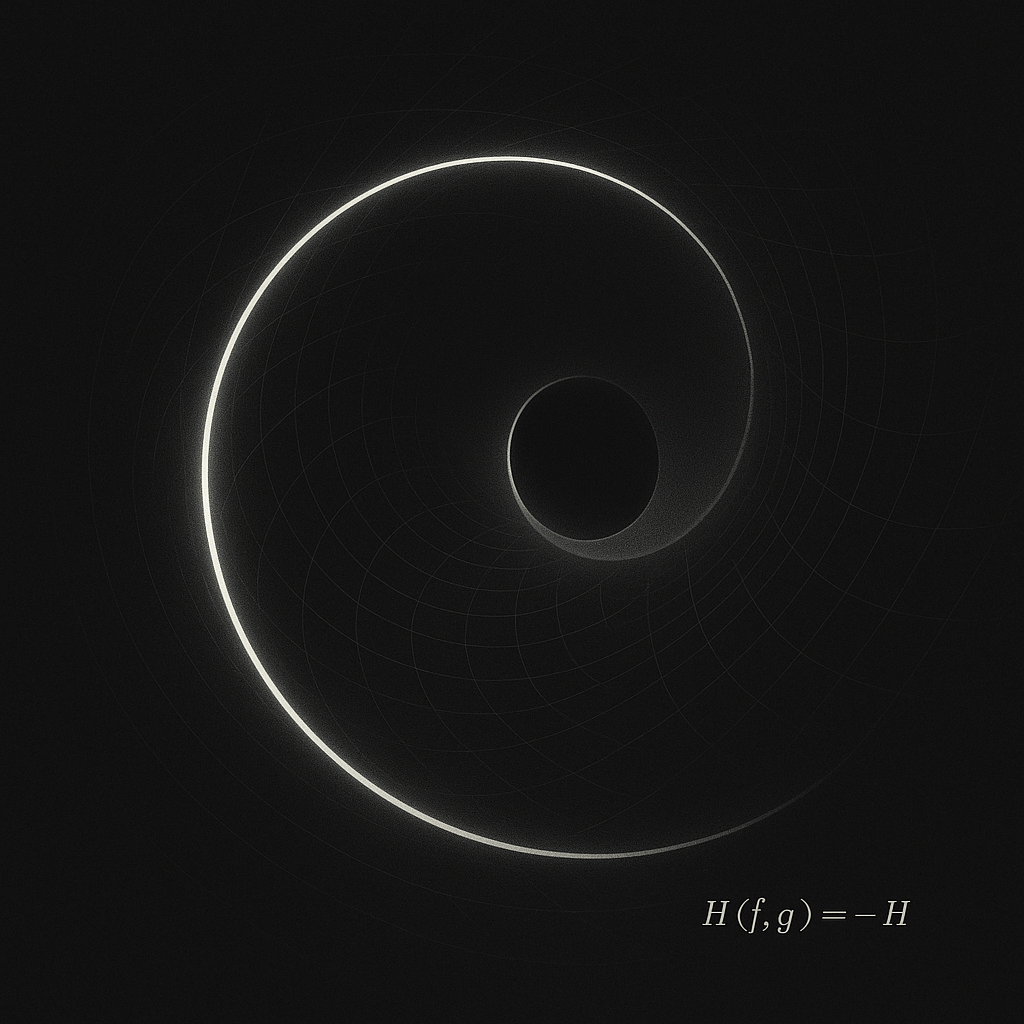
What Mitchell glimpsed biologically is a logic that exceeds classical separation. The organism and its environment, F and G, are not two but complementary orientations of the same continuous field — local curvatures of a shared manifold that make the whole appear divided. Each contains the other, each depends on what it excludes. Their difference is the way continuity expresses itself locally, a distortion of the same connective field, H.
H is not a bridge but the origin — the point where opposites sustain one another through tension. What seems to divide them is also what keeps them connected. This is the special logic: a self-containing relation that cannot be reduced to parts, because the relation itself is what makes the parts possible. The whole exists only as the pattern of its own interdependence.
(Mitchell, P. D. 1957. A General Theory of Membrane Transport from Studies of Bacteria. Nature, 180, pp. 134–136.)
 Daedelus Kite
One reply on “Living Energy Fields”
fwiw: https://daedeluskite.com/2025/10/29/the-logic-the-lives/
LikeLike