Across the world, the sociocultural reality we call civilisation exists only as a field of shared meaning and communicative patterns held in living minds and enacted through collective interaction. If the population of minds sustaining that field were abruptly extinguished, the artefacts of culture — cities, texts, technologies, narratives — would persist physically but would lose all intelligible value, because their meaning exists only in the ongoing interplay of minds holding and evolving it. The human world would dissolve into a ghostly object-realm devoid of significance, even as concrete evidence of our past activity remained scattered in silent ruins.
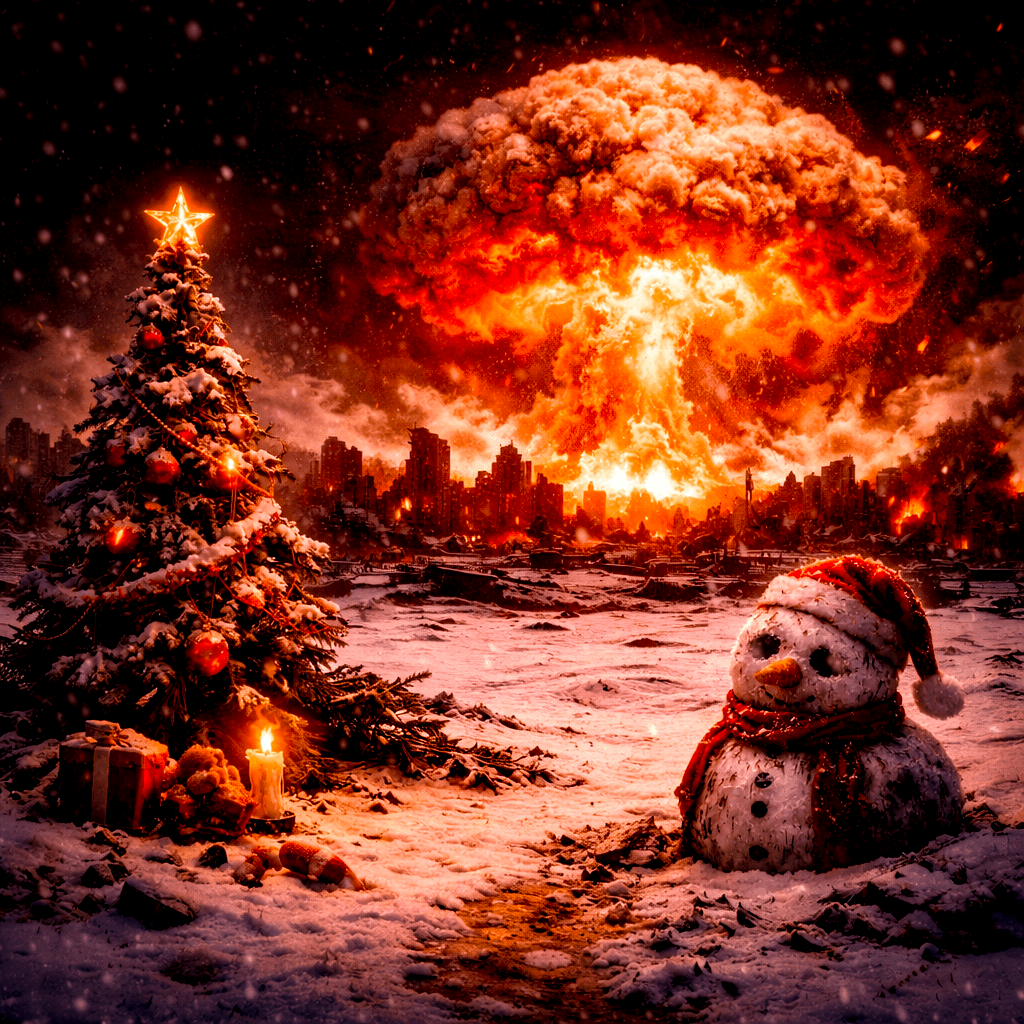
A global nuclear war — the hot, neurotic mess of geopolitical misapprehension, competitive fear, and technological escalation — would be the ultimate realisation of this dissolution. The mechanisms that drive states toward mutual annihilation are both logistically elaborate and semantically hollow. Strategies of deterrence, second-strike posture, and escalation management unfold inside a communicative space already saturated, recursive, and unstable. As systems of shared meaning exceed their capacity to integrate delay, verification, contradiction, and context, symbols collapse into noise and velocity overwhelms coherence. What presents as rational strategy is instead the phase transition of a communicative system under extreme strain, where acceleration replaces understanding.
Nuclear self-extinction is therefore not merely catastrophic but absurd. It entails the total erasure of the very meanings that make action intelligible. Weapons capable of annihilating civilisation depend entirely on a scaffold of language, logic, valuation, and shared narrative, yet in the moment of their use those scaffolds are instantaneously voided. The psychological and symbolic apparatus that generates such decisions is annihilated alongside its material targets. The rationale is vaporised with the cities. What remains is not victory, deterrence, or consequence, but the terminal expression of a system that has exhausted its capacity to hold meaning.
In this sense, nuclear apocalypse represents not only physical destruction but the collapse of the field in which value, intention, and significance arise at all. The planet may persist. Objects may endure. But the human world — the world of meaning, memory, and relation — would already be gone, dissolved into emptiness by the technological (as essentially hyper-extended cognitive) structures that once sustained it.
Categories
Armageddon Absurdity
 Daedelus Kite