An apparent and recurring tendency in how cancer is framed is to treat it as a failure of biological order rather than as a reorganisation within it. The work of the physicist Paul Davies helps correct this by treating living systems as information-processing organisations with multiple stable regimes. Cancer, on this view, is not noise, malfunction, or breakdown. It is an attractor state entered under constraint.
Cells are not passive biochemical substrates. They are distributed systems in which gene regulation networks, signalling pathways, metabolic feedback, and mechanical coordination propagate constraints across time and scale. In this minimal sense, cells “decide” not by intention but by state-dependent constraint resolution, where certain trajectories remain viable and others are progressively excluded. In healthy multicellular organisms, these systems are held within a narrow organisational corridor. Differentiation, apoptosis, immune signalling, and metabolic cooperation impose strong global constraints that privilege collective coherence over local optimisation. This regime is information-dense, energetically costly, and evolutionarily recent, in the precise sense that it depends on regulatory architectures that emerged with complex multicellularity and remain contingent, layered, and historically fragile when set against the far deeper evolutionary timescales of unicellular life.
Davies’ atavism theory of cancer proposes that when these constraints weaken, the system does not wander arbitrarily. It reorganises. Cancer represents a shift toward an older, more robust organisational mode that predates multicellularity. This is empirically grounded. Cancer cells consistently activate ancient gene networks, suppress differentiation, and reconfigure metabolism toward proliferation, motility, and stress tolerance. These changes are coordinated, not random, indicating movement toward a different stable organisational state rather than the accumulation of isolated errors.
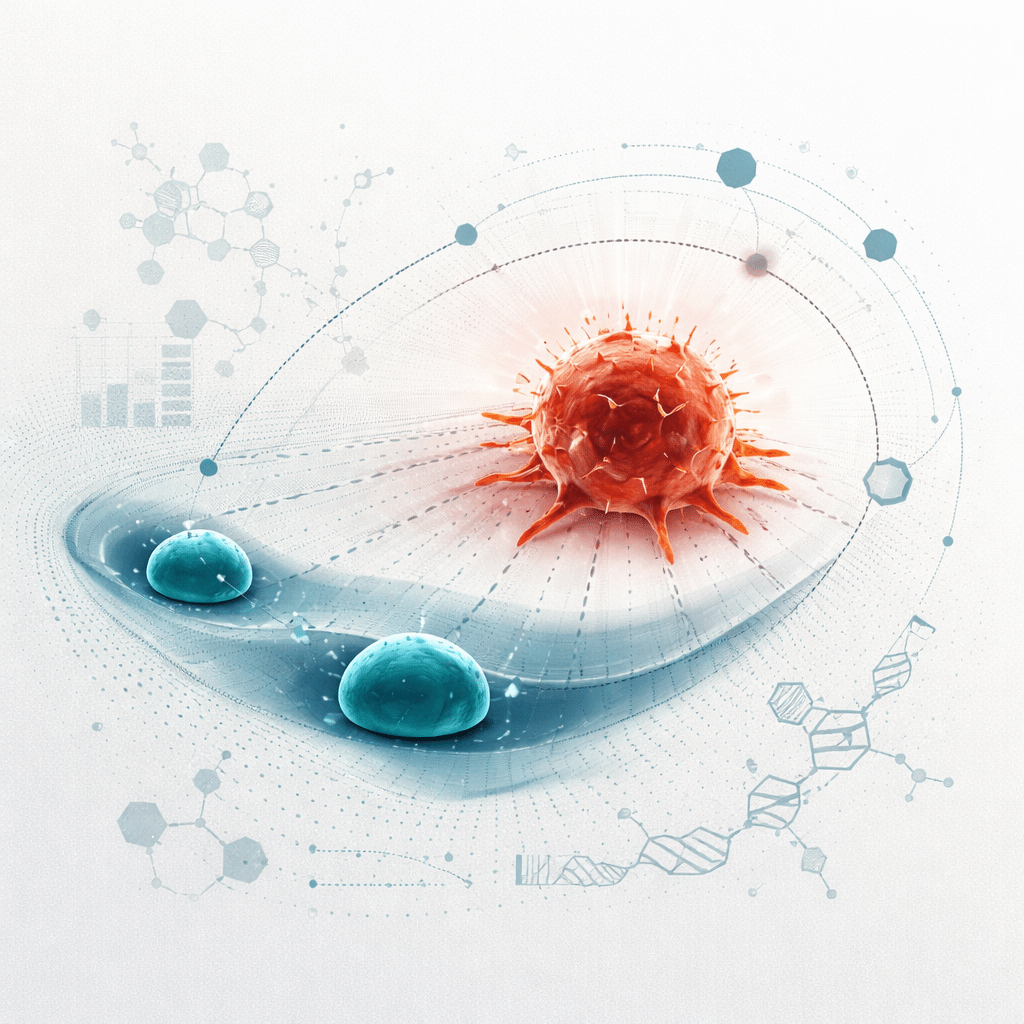
From the perspective of information dynamics, this transition resembles a phase shift. The normal cell occupies a shallow, highly constrained basin of attraction. As regulatory margins close under sustained stress—such as chronic inflammation, accumulated DNA damage, metabolic dysregulation, or disrupted tissue signalling—the basin itself deforms. Once constraint closure reaches a point where cooperative coordination can no longer be maintained, the original organisational state loses stability and the system settles into a deeper, broader attractor corresponding to a unicellular-like survival logic. Cancer is thus an efficient organisational response to an informationally degraded environment.
Crucially, this does not imply that biological organisation is fully captured by computation. The foundations of computation themselves deny that possibility. The halting problem, formalised by Alan Turing, shows that no sufficiently powerful computational system—one flexible enough to model arbitrary processes—can, in general, determine its own future behaviour without running itself forward. The incompleteness results of Kurt Gödel demonstrate that no formal system capable of expressing arithmetic can be both complete and self-consistent. Computation cannot close over itself.
Living systems repeatedly occupy precisely this non-closed terrain. The transition into cancer is not fully predictable from local variables because it emerges from collective dynamics that exceed any finite descriptive frame. As organisational constraints close, the system does not calculate its way forward. Instead, it reshapes the space of possibilities it inhabits through regulatory rewiring, altered signalling topology, and metabolic reconfiguration, changing what counts as a viable state rather than selecting among predefined ones.
This has direct consequences for intervention. Therapies that treat cancer as a local defect to be eliminated frequently reinforce the very attractor they seek to destroy. By applying pressure without restoring organisational constraints, they select for robustness, plasticity, and independence from tissue-level coordination. The system adapts because adaptation is what the attractor encodes.
At a deeper level, this reflects a more general epistemic condition. There is no semantic closure over the world. Language, models, and computation arise within the world and cannot exhaust it. The world precedes our relational networks non-causally, imposing constraints, instabilities, and reconfigurations that no symbolic system can fully internalise. Empirical facts repeatedly force revisions of our descriptions not because knowledge fails, but because openness is structural.
Cancer exposes this limit with unusual clarity. It is not simply a disease but a demonstration of how complex systems behave when high-order informational architectures degrade. The system does not collapse into randomness. It reorganises around a logic that persists when higher-order constraints fail.
—
References
Davies, P.C.W. and Lineweaver, C.H. (2011). Cancer tumors as Metazoa 1.0: tapping genes of ancient ancestors. Physical Biology, 8(1), 015001.
Lineweaver, C.H., Davies, P.C.W. and Vincent, M.D. (2014). Targeting cancer’s weaknesses (not its strengths): therapeutic strategies suggested by the atavistic model. BioEssays, 36(9), pp. 827–835.
Turing, A.M. (1936). On computable numbers, with an application to the Entscheidungsproblem. Proceedings of the London Mathematical Society, 42(2), pp. 230–265.
Gödel, K. (1931). Über formal unentscheidbare Sätze der Principia Mathematica und verwandter Systeme I. Monatshefte für Mathematik and Physik, 38, pp. 173–198.
Categories
Cancer as a Computational Attractor: Information, Self-Organisation, and the Open World
 Daedelus Kite