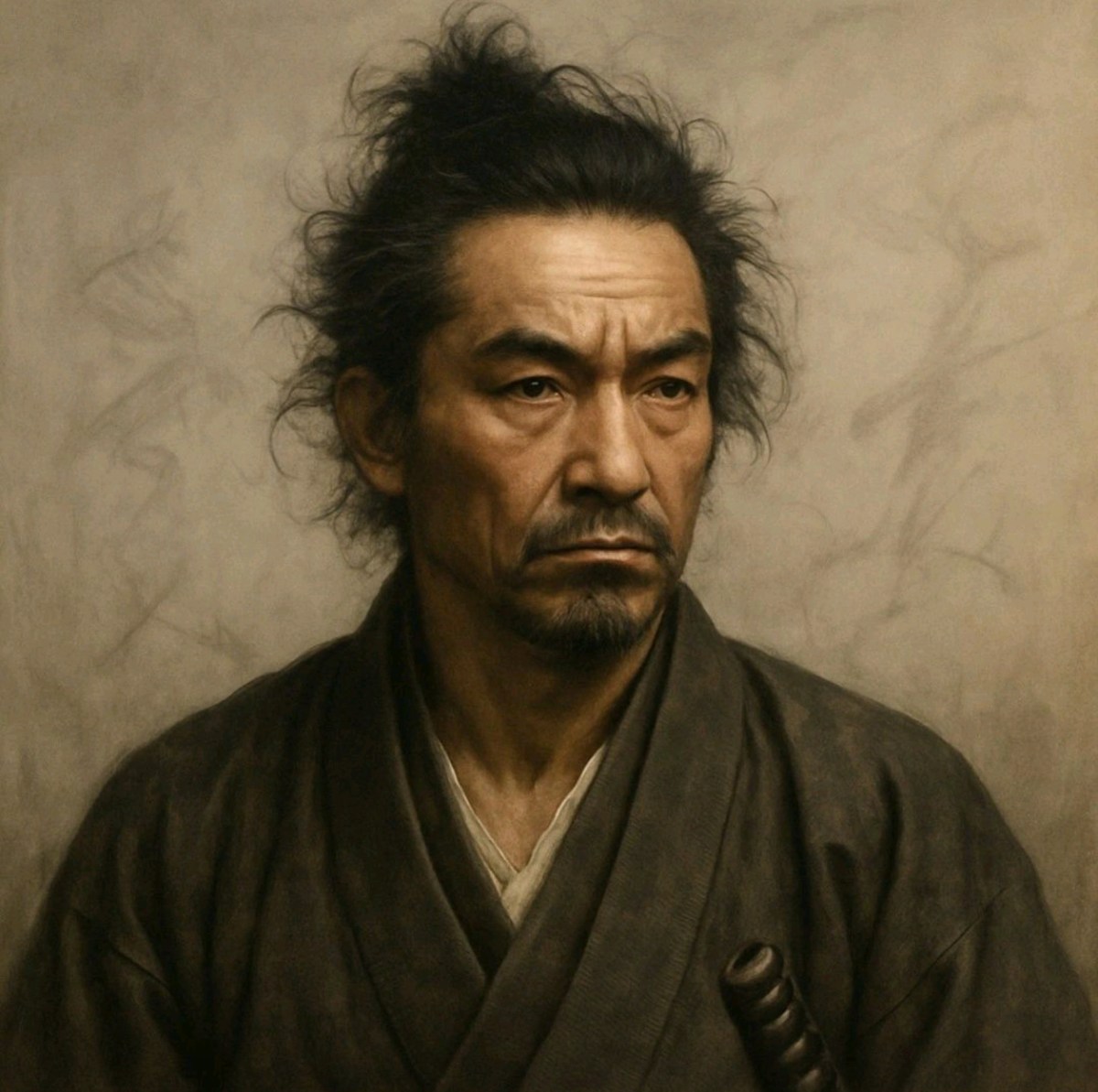
Miyamoto Musashi (c. 1584–1645) was a legendary Japanese swordsman, philosopher, artist, and ronin whose life became the stuff of both history and myth. Undefeated in over sixty duels, Musashi was a master of strategy whose innovation, adaptability, and relentless practice made him the Paganini of the sword: a virtuoso whose craft rose far beyond mere technique or method into an art of focal presence, adaptive fluidity, and transcendental form. Toward the end of his life, he wrote The Book of Five Rings, a treatise blending martial tactics, philosophy, and introspective guidance—a guide not only for combat but for navigating the unpredictably stochastic flows of life itself. Curiously, the “fifth ring”—the void, or ku—is silent, absent in words yet present as the ultimate principle: that mastery lies not in accumulation, but in the embrace of emptiness, a centre without centre.
And here, Musashi’s unspoken ring aligns with a deeper philosophical trajectory: that wholeness is not found in completion, but in the structural absence through which meaning unfolds. Like a function whose unity is distributed across its own gaps, his teaching gestures toward a non-orientable topology of knowledge, where form and formlessness interweave, and where the missing element is not a deficiency but a necessary aperture. In this sense, Musashi’s void is not just the end of the rings—it is the space through which the rings breathe, the open attractor that binds action and insight without closure.
 Daedelus Kite