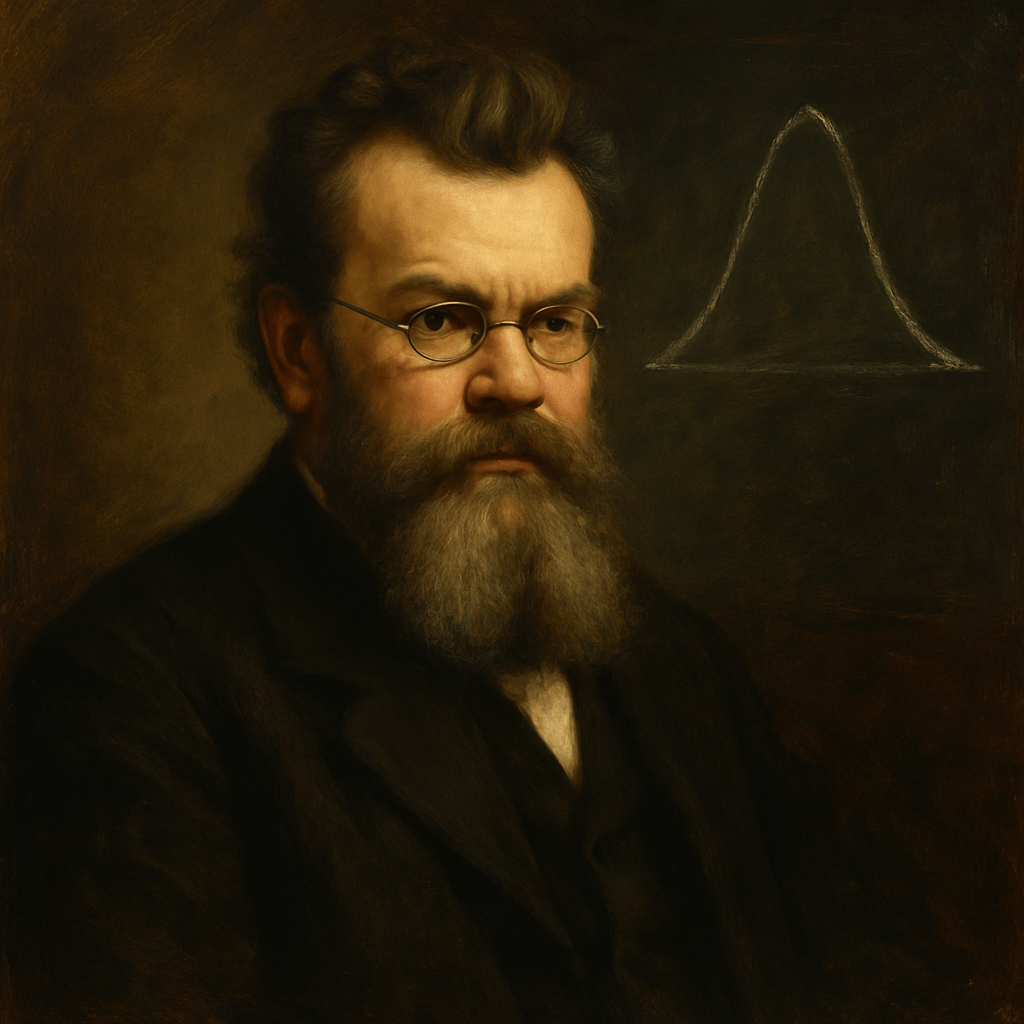
Ludwig Boltzmann (1844–1906) laid the foundations of statistical mechanics, connecting microscopic randomness with macroscopic #order. His equation, S = k log W, showed that entropy measures the number of possible configurations a system can occupy, revealing a profound link between chance and inevitability. Entropy was not merely disorder but a structural principle: a bridge between the chaotic waterfall of particles and the emergent constraints of nature’s large-scale order. His insight hinted at a deeper architecture—a logic not just of outcomes, but of the relational potentiality that shapes both matter and meaning.
Entropy, viewed through a geometric-topological lens, is not simply disorder but a global attractor whose influence quietly shapes every local relation. The manifold itself is this attractor: a topology whose intrinsic tendency toward looping cannot fully manifest at once but must appear, from any lower-dimensional perspective, as a local bias toward recursion, cyclicity, and relational curvature. This looping is not mere repetition but a mode of convergence—while entropy expands the degrees of freedom, it does so under a simultaneous pull toward equilibrium, toward an attractor it can approach but never fully reach. At each point, we encounter not a literal loop but a necessary inflection, a curvature of possibility reflecting the manifold’s global structure. This suggests a quasi-particulate ontology: entities are not discrete points but relational condensations inheriting the recursive, convergent #potential of the whole. Local geometry is neither arbitrary nor entirely free; it is shaped by a patterned resonance, a harmonic unfolding that encodes and instances (a) global topological necessity within every local relation.
Categories
Ludwig Boltzmann: Helical Signals
 Daedelus Kite