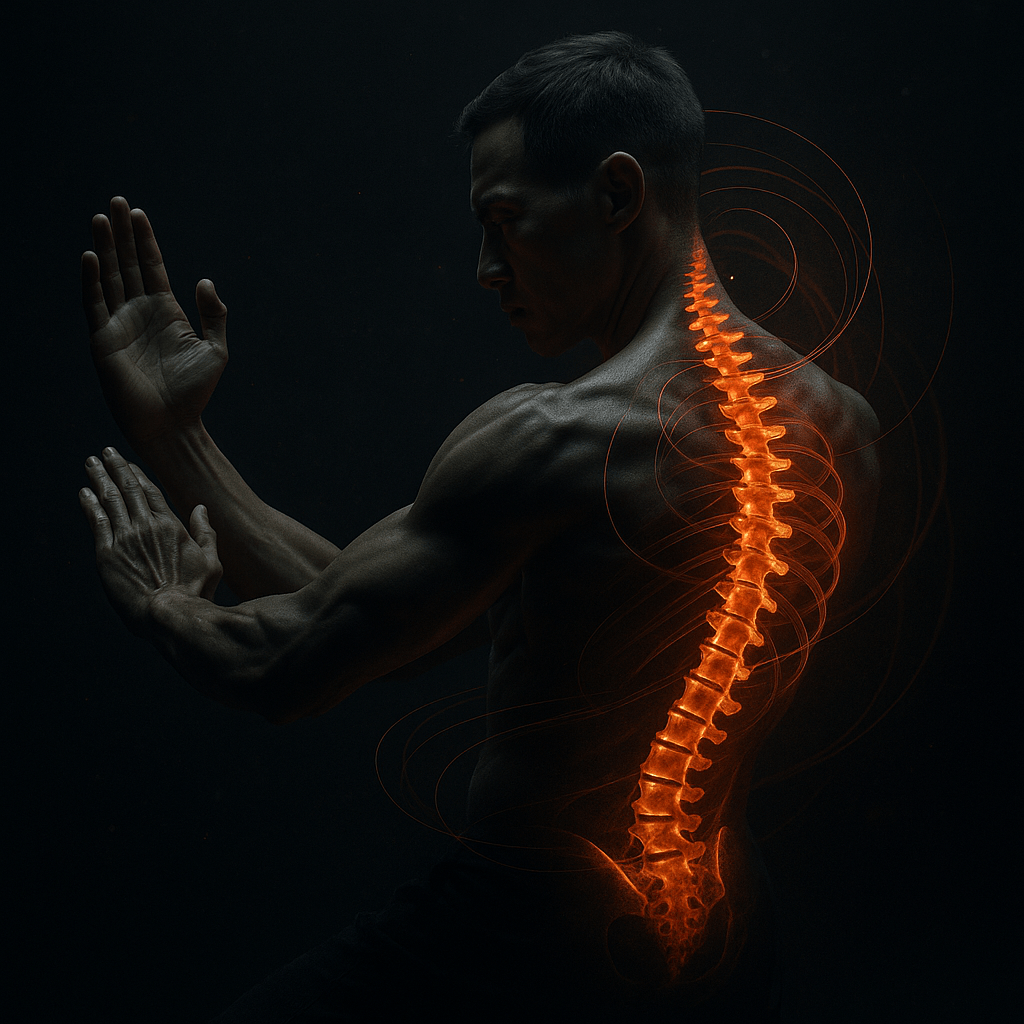
The concept of harmonic structure in kinesiology—particularly in systems like Wing Chun or even in dance—centres on the idea that the body operates not merely in physical space but in a frequency domain. The spine, in this context, is not just an anatomical scaffold but a dynamic thread through which energy is modulated and temporally compressed. Its curvature is not incidental; it is an encoding of stored potential energy. Curvature implies tension, readiness, the possibility of transformation—just as a bent bow holds the promise of release.
In harmonic terms, the spine becomes the fundamental frequency, with limbs and joints as higher-order resonances or overtones. Motion, then, is not initiated at discrete points but arises from waveforms propagated through the body’s internal geometry. This structure allows for both explosive decompression and subtle adaptive control. Whether in combat or dance, the system is not linear but phase-aligned—actions are timed releases of previously stored tension, navigated through curvature and coordinated through the frequency logic of the whole organism.
Categories
Spine
 Daedelus Kite