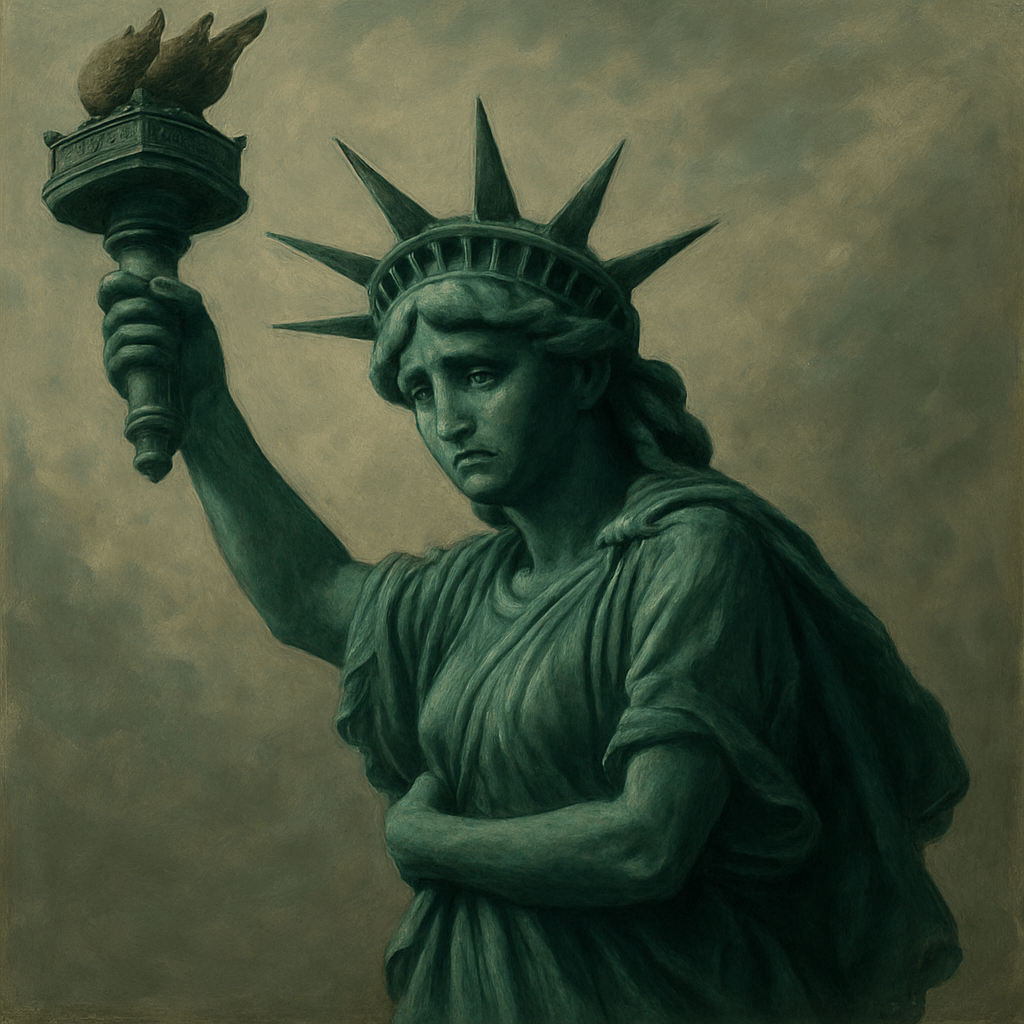
Would a political figure—such as Donald Trump—intentionally provoke or escalate a conflict to divert attention from legal, moral, or reputational collapse, and what does this reveal about the international system of power, perception, and control in a hyper-mediated world?
The international system sustains itself through relatively well-managed dysfunction. What appears as failure—supply chain collapse, diplomatic incoherence, unstable alliances—is often a tolerated consequence of deeper strategic rhythm. Historical examples echo this pattern: the Falklands conflict papered over Argentina’s economic unraveling; the Gulf War helped neutralize domestic political instability; Russia’s movements in Georgia, Crimea, and Ukraine all followed periods of internal tension. These moments do not rupture the system—they modulate it.
Figures like Trump serve as exhaust ports for institutional strain. Their unpredictability provides theatre, absorbing public attention while diffusing systemic contradictions. The spectacle is less about action than signal—it indicates that something is working, or rather, still moving. Conflict becomes an acceptable method of restoring semiotic equilibrium: a flash of noise to preserve the illusion of direction.
This is exactly the sort of thing that could happen. The conditions align, the incentives are skewed, and the protagonist is perfectly ill-suited to grasp the magnitude of the consequences. It’s extremely dangerous. And the guy is not well-informed or clever. At all.
War is not an interruption of order but its metabolic process. The system does not purge chaos; it consumes it. Each crisis is digested, patterned, and redeployed to sustain motion. Stability is not the absence of tension—it is its choreography. And this choreography, absurd as it is, may be an unwitting obligation—until, or unless, we develop some way of negotiating the entropic exhaust plume (of us, himans) that keeps the whole thing aloft.
 Daedelus Kite