American democracy was founded on lofty ideals of representation, balance of powers, and the rule of law, yet from the beginning it carried deep inequities. Slavery, the dispossession of Indigenous peoples, and the exclusion of women and the poor from genuine participation revealed that justice was never evenly shared. Tocqueville, writing in the 1830s, saw both promise and fracture, warning of majority tyranny and the persistent shadow of inequality. These tensions were not uniquely American but echoed across societies where institutions cloak power in principle while reproducing exclusion. Over time, industrial capitalism, racial injustice, and partisan entrenchment hardened these fractures and embedded contradiction into governance.
Today the structure still stands, but hollowed out. The state services its incumbent, institutions fold into partisan inertia, and bureaucracy excels at preserving itself rather than addressing collective need. The gap between promise and practice, authority and responsibility, is not incidental but constitutive; systems endure by circling their contradictions and surviving through redistribution of disorder rather than its resolution. Whether renewal is possible remains uncertain; the trajectory suggests not rebirth but managed decline, a society stumbling forward under tensions it lacks the ingenuity to overcome.
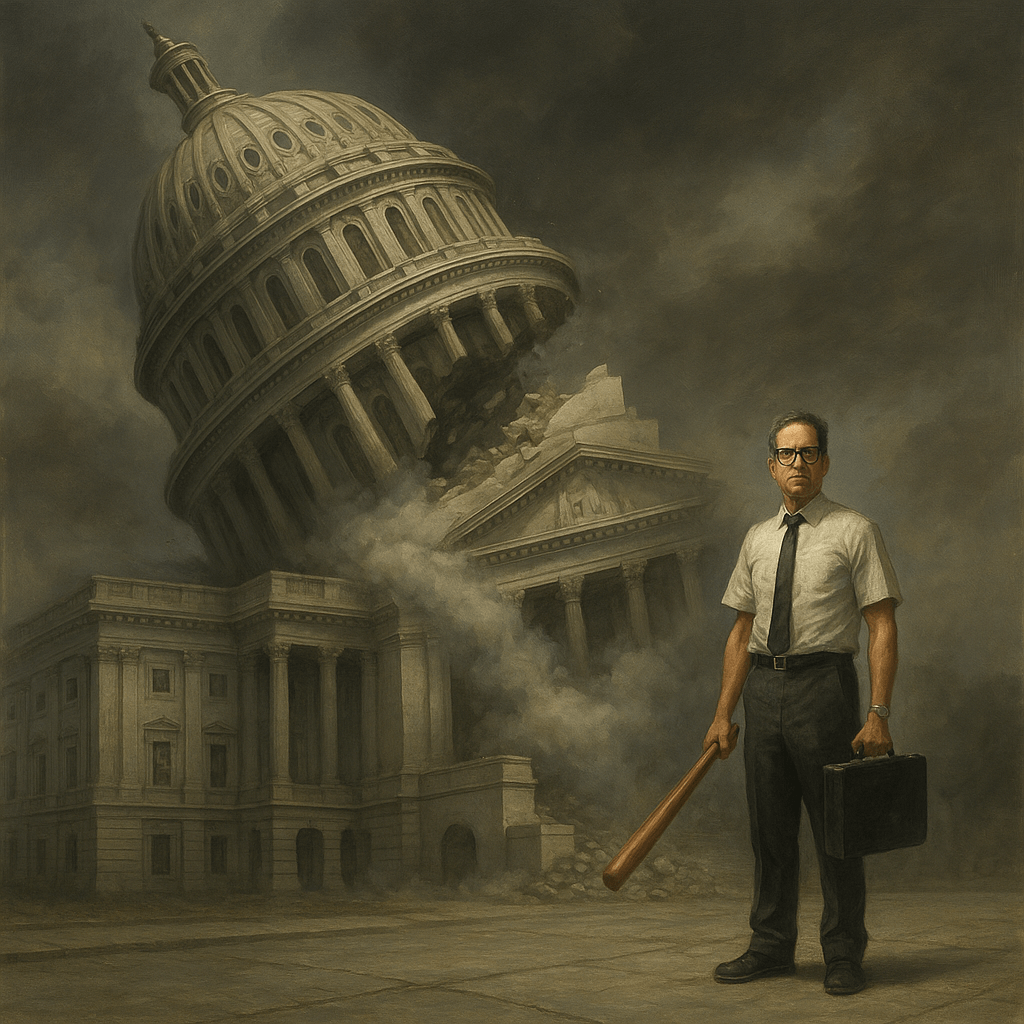
A clear lens on this dynamic is the film Falling Down (1993), where an ordinary day flips from order to breakdown in a way that feels both sudden and inevitable. The point is not cinema but structure: political forms that appear opposed, democracy and autocracy, often share similar architectures, with rhetoric and ritual doing most of the differentiating. Incompetence above the ground floor functions less as a bug than as a stabilizing mechanism, allowing persistence through failure. Remediation would demand uncommon intelligence and coordination, yet universities retreat into timidity and institutions remain bound by rules that can be turned against them. The result is a perfect storm, a point that loops back on itself, where collapse becomes the system’s method of angrily self-propagating sociopolitical (dis-)continuity.
 Daedelus Kite
2 replies on “Falling Down”
If a system can flip so easily into (a) tyrannical pathology, it can flip back. The currents are vast, entropic tides that move far beyond individual will, pulling whole nations along.
Yes, the shift may be dissonant, difficult, turbulent, and never neat. We’ve seen this before in Eastern Europe, where structures collapsed and re-formed almost overnight. What feels permanent is often only a pause between waves.
LikeLike
I think of these things topologically, as a landscape of hills and valleys. Sometimes, with a bit of energy, you can get from a shallow valley into a deeper one. Getting back is not so easy.
LikeLiked by 1 person