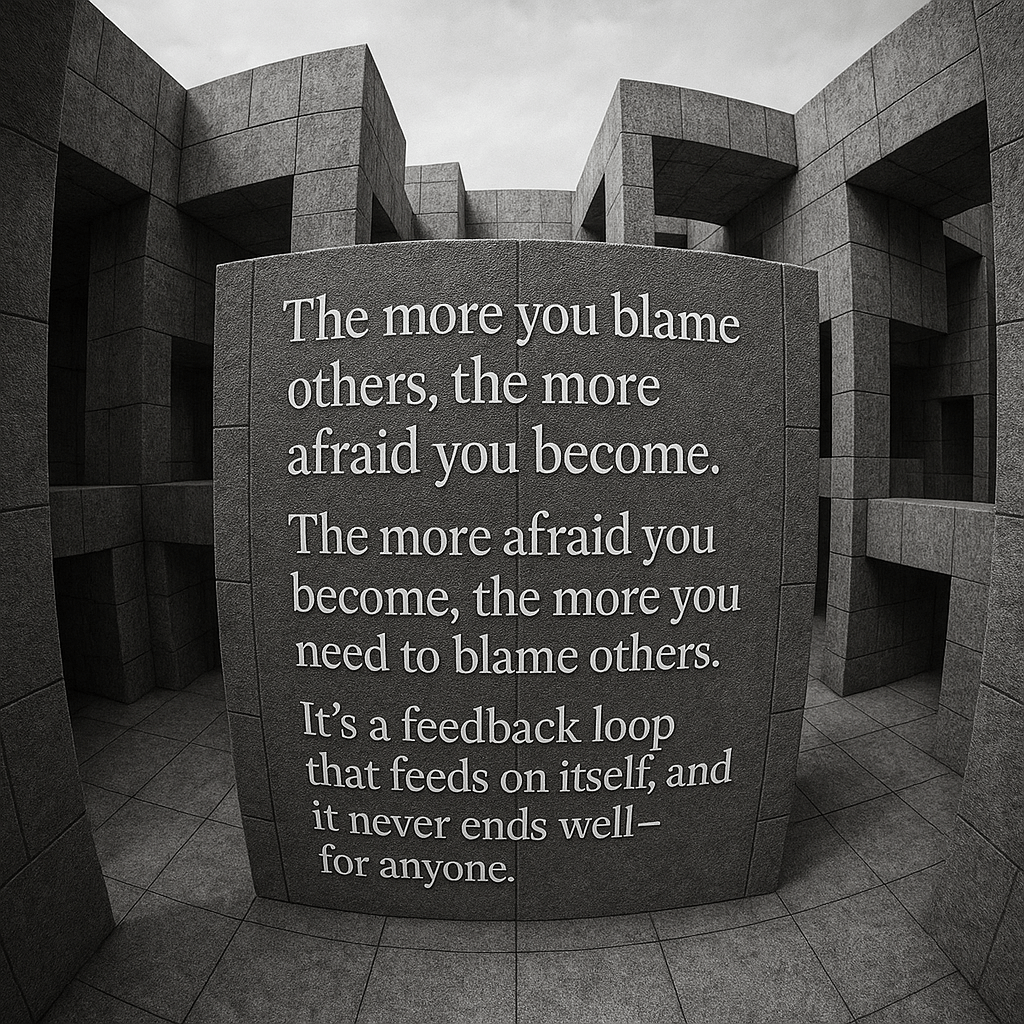
The more you blame others, the more afraid you become. The more afraid you become, the more you need to blame others. Blame draws breath: inhale the fear of others, exhale the accusation that keeps it alive. The cycle is seductive because it feels like control—naming enemies, drawing lines, standing strong—but what sustains it is rhythm, not truth. What begins as rebellion against law or authority quickly generates its own harsher laws, unspoken codes that cling tighter because no one admits they exist. Any group or movement that defines itself against external rules ends up recreating rules of its own, and they are usually more brittle, more brutal.
This is why systems built on fear spiral. The blame economy is not just semantic but respiratory, repeating itself in the cadence of accusation and defense until it hollows out everything around it. In stories of collapse, every act of defiance leads only to more trouble, more debt to the same corrosive logic. In politics, scapegoating erodes the capacity for self-correction; the system becomes unable to admit its own mistakes and so it turns them outward, endlessly. Fascism thrives in this oscillation between inside and outside, in the insistence that identity exists only because there is an enemy. Fragility masquerades as strength because instability makes reproduction possible—cycles of anxiety and intimidation that bind everyone inside the game. But what thrives on insecurity cannot last, because sooner or later the enemies run out, and the fear turns inward.
 Daedelus Kite
2 replies on “Fascism Redux: Brittle, Brutal, Broken”
It’s not inherently wrong to want structure, or even strong structure—if someone chooses to align themselves with order or authority, that’s their choice. But having an emotional reaction to chaos and seeking safety through control doesn’t equip someone with a sustainable or clear understanding of what they’re endorsing. Acting on emotion alone creates brittle foundations.
You can demand control out of fear, but unless you’ve mapped out the dynamics of what you’re aligning with, your structural commitments will betray you. Strength without insight is hollow, vulnerability dressed as beauty is weaponized, and systems built on fear inevitably replicate, amplify and sustain the essential (critical dependency upon) dysfunction they claim to protect against.
LikeLike
LikeLike