When we talk about “misinformation,” it’s tempting to treat it as bad content — a false message polluting a neutral channel. But communication isn’t a clean pipeline. It is a field of feedback in which both messages and selves are produced, fractured, and sustained. What spreads is not simply truth or falsehood but patterns of repetition, timing, and rhythm.
Mathematics gives us a way to see this. In the 1970s, Yoshiki Kuramoto developed models of oscillator populations: systems where many independent units — neurons, pendulums, fireflies — influence one another’s timing. If the coupling is strong enough, they lock into synchrony. Crucially, synchrony doesn’t depend on the content of what they “say.” It depends on frequency and phase: how often, when, and in relation to what. This is where the analogy to communication is most powerful. Narratives, memes, and slogans behave like oscillators. They propagate by synchronising attention, not by persuading on semantic grounds.
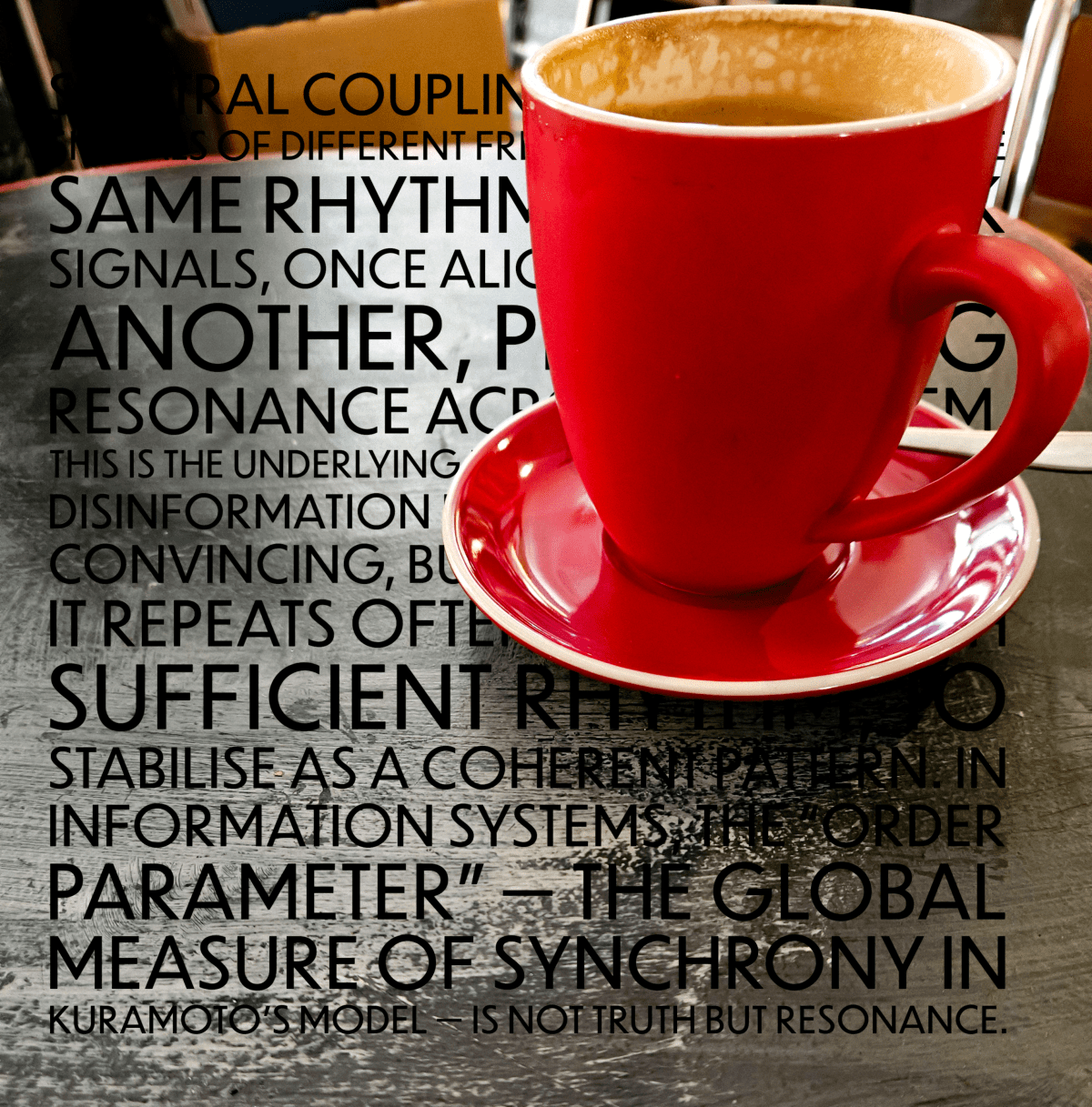
Spectral coupling describes how signals of different frequencies lock into the same rhythm. Two weak signals, once aligned, amplify one another, producing resonance across the system. This is the underlying mechanism of viral spread. Disinformation persists not because it is convincing, but because it couples: it repeats often enough, with sufficient rhythm, to stabilise as a coherent pattern. In information systems, the “order parameter” — the global measure of synchrony in Kuramoto’s model — is not truth but resonance.
This connects to what we can call a logical orbit. In Kuramoto dynamics, each oscillator both influences and is influenced by the system’s global state. Its identity is not separate from the field but is defined by its participation in the orbit of feedback. The system’s persistence is not a function of isolated elements but of the recursive loop that ties local oscillations to the global phase. Communication works in exactly this way. Each utterance is a local coordinate slice of a larger manifold of relations, an orbit frame that rotates through itself, producing coherence not by external reference but by internal recursion.
What follows for disinformation is significant. Attempts to counter falsehood with more “truth” assume communication is a debate of propositions. But Kuramoto dynamics suggest otherwise: the decisive factor is rhythm. If a corrective statement does not couple into the prevailing frequencies, it remains inert. Interdiction is not about semantics but about altering the spectral balance. That can mean introducing small delays, diversifying timing, or adding friction that prevents signals from locking into synchrony too quickly. The strategy is not to purge noise but to modulate it — to manage recurrence so that probability waves remain diffuse rather than collapsing into a single, dominant, fragile pattern.
This is where entropy enters. Disinformation spreads because systems naturally drift toward maximal diffusion — entropy pushes signals outward until they saturate attention. Control is not about erasing entropy but about shaping it: building slack, delay, and redundancy into feedback loops so turbulence dissipates instead of compounding. The system becomes resilient not by eliminating disorder but by suspending it, using tension itself as stability.
While this framework may, in an indirect but powerful way, suggest an ontology for engaging problems in mass communication systems, it is not a recipe for mastery. No one secures an upper hand here. Every synchrony is temporary, every coherence fragile. Systems are endlessly teetering on the edge of equilibrium and complexity, balanced between stabilisation and collapse. This is not failure but the condition of persistence. To work with these systems is not to dominate them but to navigate their perpetual suspension — to shape rhythms without expecting final control.
The upshot is that communication cannot be understood as content moving through a pipe. It is better understood as a spectral field, a probabilistic medium where coherence emerges from coupling. Facts and narratives “happen” the way standing waves happen in a vibrating string: as stable resonances of probability in a larger field. Their power comes not from what they mean but from how they repeat; semantics follows frequency, such that meaning is irreducibly stochastic, transient, and indeterminate in anything other than that most trivial of instances. (Noting, also, that unsophisticated triviality is itself a key beneficiary of communications system entropy, at scale.)
Managing disinformation, then, requires a shift of frame. Instead of chasing truth-value at the surface, we must design interventions in the field itself: shaping rhythms, distributing timing, preventing lock-in. In this logic, the most powerful lever is not persuasion but modulation. Semantics follow frequency. And the challenge is to ensure that no single rhythm can dominate unchecked — that the orbit of communication continues to rotate through itself, balanced on the abyss between order and disorder, coherence and noise.
 Daedelus Kite
One reply on “Rhythm, Resonance, and the Logic of Communication”
Communication here is not an exchange but a resonance in which each participant is simultaneously displaced and sustained by the oscillatory field. The contested narrative domain is not an arena with opposing sides but a manifold of phase relations in which every assertion is diffracted into counter-assertions, and every coupling multiplies instability. Strategic gain collapses because any local reinforcement becomes a global perturbation, absorbed and inverted by the total system.
.
This is the hyper-complexification: infinity folds the domain back upon itself, not once but endlessly, generating recursive surfaces of potential without closure. What is sought as control emerges only as amplification of uncertainty. Each attempt to stabilise meaning accelerates its diffusion. The logic is that no single trajectory can escape the gravitational well of infinite possibility. Instead of advantage, there is only accumulation of entropic variance, compounding worry as the sole invariant.
LikeLike