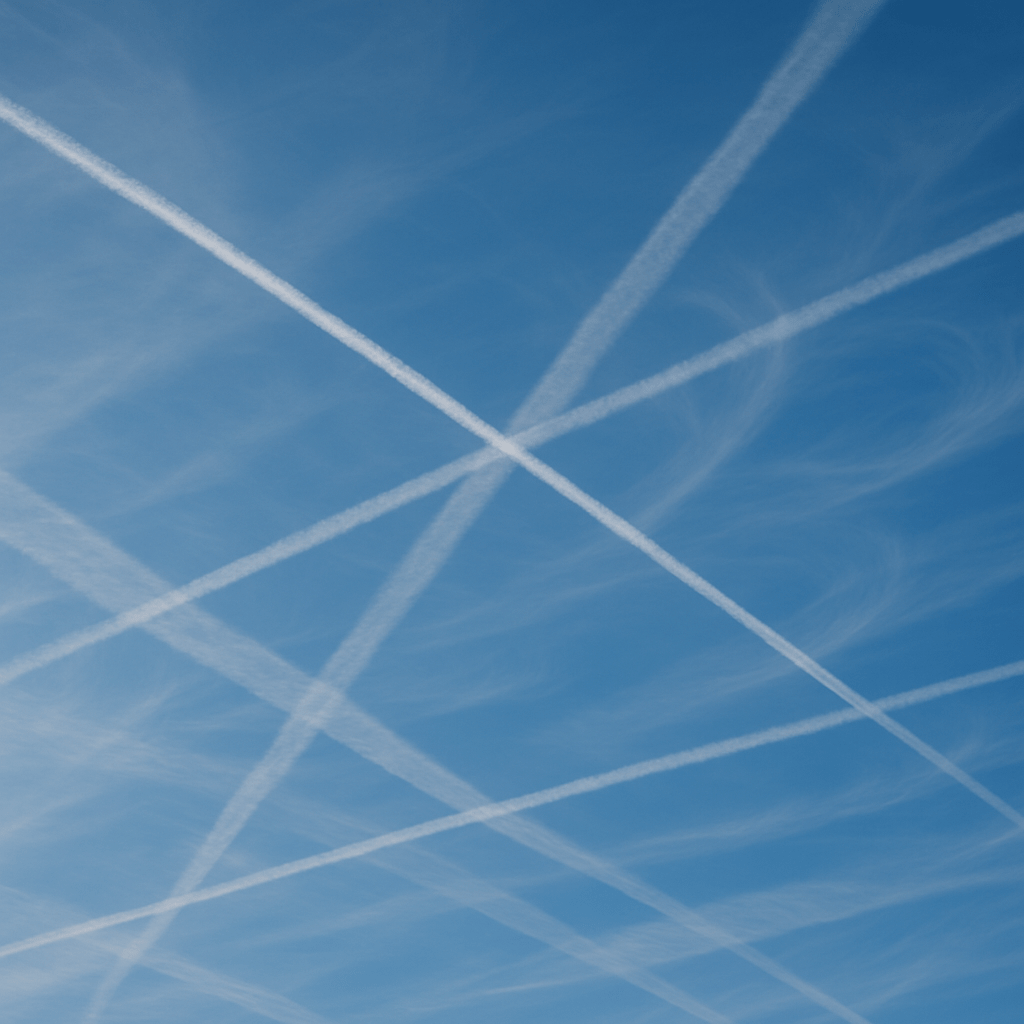
The image of vapour trails and diffusion captures more than transience; it maps the way systems unravel under pressure. Passing through might once have seemed neutral, a fact of existence, but it has been bent into something harsher. Entropy, which in physics names the statistical drift of order into disorder, is here mobilised by greed, arrogance, and technologically mediated feedback loops. What should have remained the background tendency of any system — a gradual dispersal of energy into less ordered states — has been accelerated and instrumentalised. Turbulence, the visible expression of this diffusion, has become the main currency of politics and commerce. Instead of fading softly into equilibrium, the trail itself tears meaning apart, and the act of leaving corrodes rather than dissipates.
This is not only psychological but systemic. Populism and jingoism are not random eruptions of sentiment; they are engineered outcomes of commercial architectures tuned, like thermodynamic engines, to extract energy from conflict. Business itself mirrors a bellum omnium contra omnes — a war of all against all — in which competition functions as the heat gradient that keeps the system moving. Yet the very technologies that once optimised circulation now overheat the medium, driving conflict beyond productive thresholds. What once propelled growth now corrodes its own foundations, just as aspiring autocrats in the United States enthusiastically undermine the diversity and openness that actually sustain their own power and wealth. Entropy in its natural form would still trend towards equilibrium, but here it is guided into the shallowest attractors: outrage, cruelty, exploitation. This is why the metaphor holds — the world is not simply decaying; it is being thermostatically tuned into its own self-accelerating destruction, leaving us with the knowledge that the damage is both deliberate in structure and catastrophic in effect.
 Daedelus Kite
One reply on “Vapour Trails”
In thermostatistics, entropy measures the number of possible configurations a system can take — disorder as probability, not just decay. Applied to communication, each message adds to the multiplicity of states, and when systems are tuned to maximise throughput rather than coherence, the result is diffusion rather than meaning. Just as in physics where energy moves from concentrated gradients into dispersed equilibrium, in culture and politics information tends to spread into noise unless constrained by structures that preserve significance. Outrage, simplification, and conflict are the cheapest states to reach, requiring less energy to sustain than nuance or compassion.
This is why the current moment feels corrosive rather than merely transient. The architectures of global media, commerce, and politics function like heat engines that convert difference into output, but they are doing so inefficiently — burning through the substrate of shared life faster than it can be replenished. Climate destabilisation adds a brutal layer: the literal thermodynamics of the planet reflect the same principle of runaway entropy that dominates our communication systems. Passing through would be one thing, but accelerating entropy across every scale at once means the trails we leave may not fade harmlessly; they may set conditions from which there is no easy return.
LikeLike