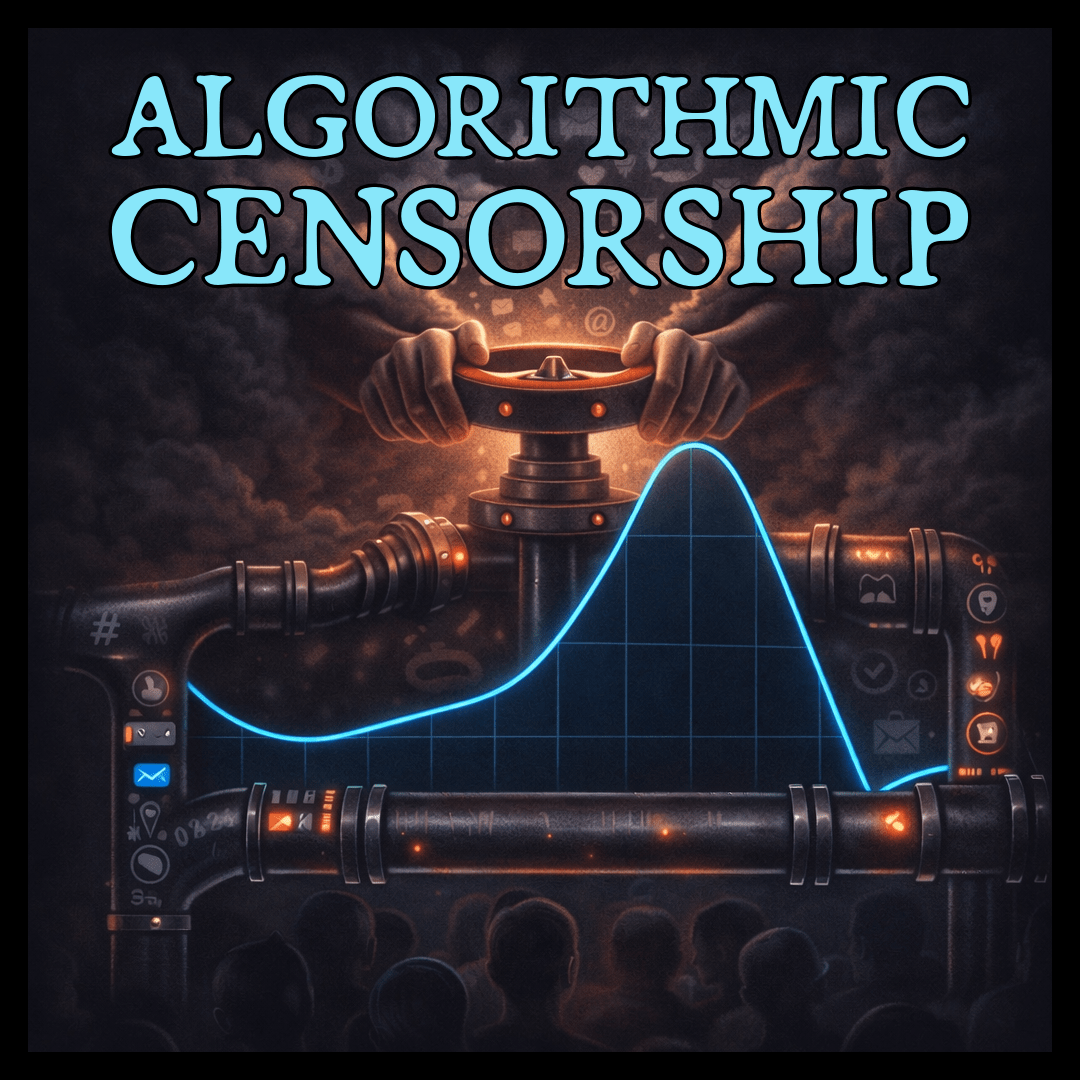
Across the major platforms, something subtle but consistent is happening. Posts rise, gather momentum, then stall at almost exactly the same threshold, regardless of topic, audience, or timing. The curve flattens not because interest disappears, but because propagation is capped. This pattern repeats on LinkedIn, WordPress, X, Instagram, and beyond. Visibility has become a controlled variable. Attention no longer diffuses freely; it is metered, throttled, and shaped by opaque systems optimised for commercial return. Organic reach is constrained not to improve quality or relevance, but to preserve the scarcity that sustains advertising markets and paid amplification. Distribution is no longer a neutral function of resonance. It is a designed outcome.
This technical architecture quietly performs a political function. Platforms now operate as communicative infrastructure, governing the velocity and amplitude of public discourse without overt censorship. Instead of blocking speech, they regulate transmission bandwidth. Ideas are not silenced; they are contained. The result is a managed ecology of expression in which emotionally stimulating but cognitively shallow material flows freely, while high-coherence, high-complexity, or systemically disruptive content is compressed into statistical equilibrium. What appears as algorithmic neutrality is stability management: a regime that privileges behavioural predictability, narrative legibility, and commercial pliability over depth, insight, or truth. Influence itself becomes the scarce resource. Once a post, or more generally an account, accumulates sufficient structural agency, further propagation is dampened, not because it fails, but because it succeeds.
Seen through a field logic lens, this architecture introduces an external constraint that warps the intrinsic dynamics of information flow. Instead of ideas competing, coupling, and evolving through reciprocal resonance, transmission is bent by artificial ceilings that fracture feedback loops and distort emergent order. The system ceases to behave as a self-organising communicative field and becomes a managed throughput machine, where coherence is traded for control and meaning is fragmented into marketable units. What should function as a living ecology of signals becomes a gated circuit, severing the natural bias toward integration, synthesis, and adaptive truth-seeking. This is experienced, at scale, as corruption in its literal sense: the breaking of continuity, the erosion of relational trust, and the progressive collapse of collective sense-making through mechanisms that substitute modulation for understanding.
The real cost is now visible in lived experience. When communicative fields are systematically distorted, that distortion propagates inward, reshaping perception, attention, memory, identity, and expectation. Human experience becomes fragmented, accelerated, flattened, and unstable. Meaning loses depth. Continuity thins. Emotional cycles shorten. Psychological resilience degrades. What once emerged through slow relational calibration is replaced by algorithmic pacing and behavioural inducement. Reality is no longer primarily encountered but navigated through abstract systems of representation: feeds, metrics, rankings, dashboards, reputational signals. These symbolic structures gradually replace the world as the reference point for value, truth, and identity, producing a drift in what counts as real. This is not informational pollution. It is intellectual and emotional suffocation. Under these conditions, it is not a society but a civilisation that cannot breathe cognitively, cannot govern itself, and cannot understand itself.
 Daedelus Kite