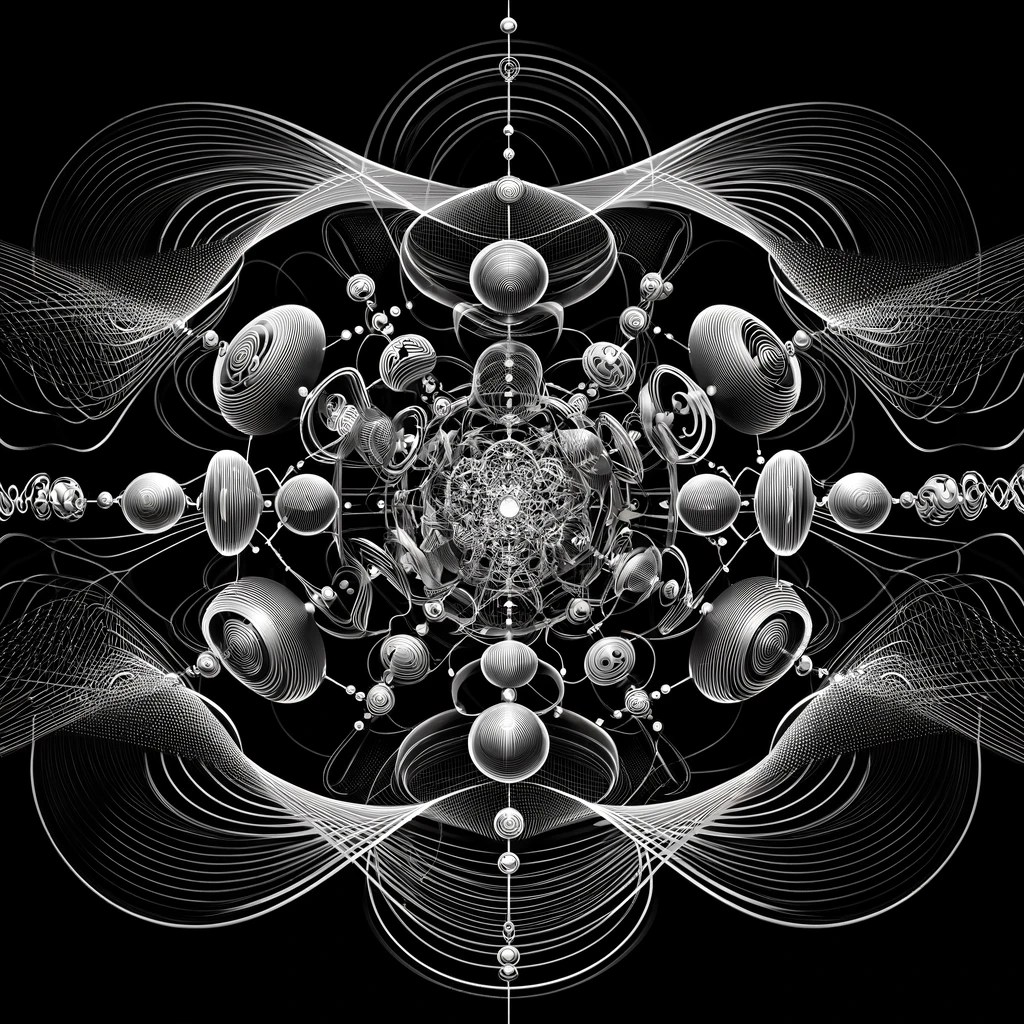
Meaning does not arise from fixed points of reference. It emerges through tension: the interplay of what is defined and what is not, what is stable and what slips away. We navigate conceptual terrain that is neither a neat set of dictionary entries nor a chaotic sprawl of arbitrary signs. Instead, it is a dynamic field where understanding grows from patterns of difference, subtle gradients of inference, and an evolving sense of coherence born of perpetual incompleteness.
This landscape of thought is not merely a catalog of symbols. It is shaped by logical constraints that cannot be fully resolved, by relational nets that never settle into final form. Each concept we hold is defined less by a single authoritative explanation than by the partial, provisional frameworks we build around it. Within these frameworks, certain loops of reasoning recur, reinforcing a local sense of order. Yet around the edges, gaps and silences remain—necessary absences that keep the system from becoming rigid.
The absence of perfect closure, far from being a defect, enables growth. Without it, we would be left with a calcified knowledge structure incapable of adapting or expanding. Instead, the strategic hollowness at the core of our conceptual architecture ensures new insights can form. Ideas evolve not by stacking certainties, but by allowing space for re-interpretation and by reframing relationships as contexts shift.
Such an approach reflects the complexity of human cognition: a continuous negotiation between what seems solid and what remains elusive. We never fully escape the gravitational pull of what we do not yet understand, and that pull—these subtle voids within our conceptual maps—drives us forward. We find coherence in patterns that repeat and circle back, but we do not force them into an absolute endpoint. Complexity theory, logical incompleteness, and topological metaphors all point to the same fundamental truth: meaning is an active, ongoing process, not a final product.
This process does not require us to become obscure mystics or elitist philosophers. It demands clarity about uncertainty, honesty about the provisional nature of our frameworks, and a willingness to acknowledge that understanding is always partial. We stand on shifting ground, but that ground is rich in potential. By accepting that each idea is defined in relation to others, that each point of reference acquires meaning through the differences and continuities surrounding it, we embrace a mode of thinking that is simultaneously rigorous and open-ended.
Such thinking can be especially relevant when minds are tested by injury, trauma, or any form of disruption. The desire to piece together a world of meaning remains strong. The challenge is to realise that no single piece will ever complete the puzzle, yet patterns and connections—discovered through patience, adaptation, and creative inference—can guide us. We learn to navigate a cognitive environment shaped by both presence and absence, by structure and gap, using the interplay of these elements to keep moving toward greater understanding.
Here, then, is the core insight: meaning is not fully known, yet it is not without form. It arises from a space that is simultaneously constrained and open, stable enough to recognise familiar patterns, fluid enough to allow those patterns to change. This is the art and science of human thought—a flexible architecture continually forging, dissolving, and reshaping conceptual relationships. In acknowledging these conditions, we affirm that our intellectual efforts are not in vain, even though they never yield a final answer. Instead, they produce a living tapestry of understanding that, through its very incompleteness, remains perpetually capable of becoming something more.
 Daedelus Kite
One reply on “On Meaning”
If logic applies to trust, then meaning is compulsory.
LikeLike