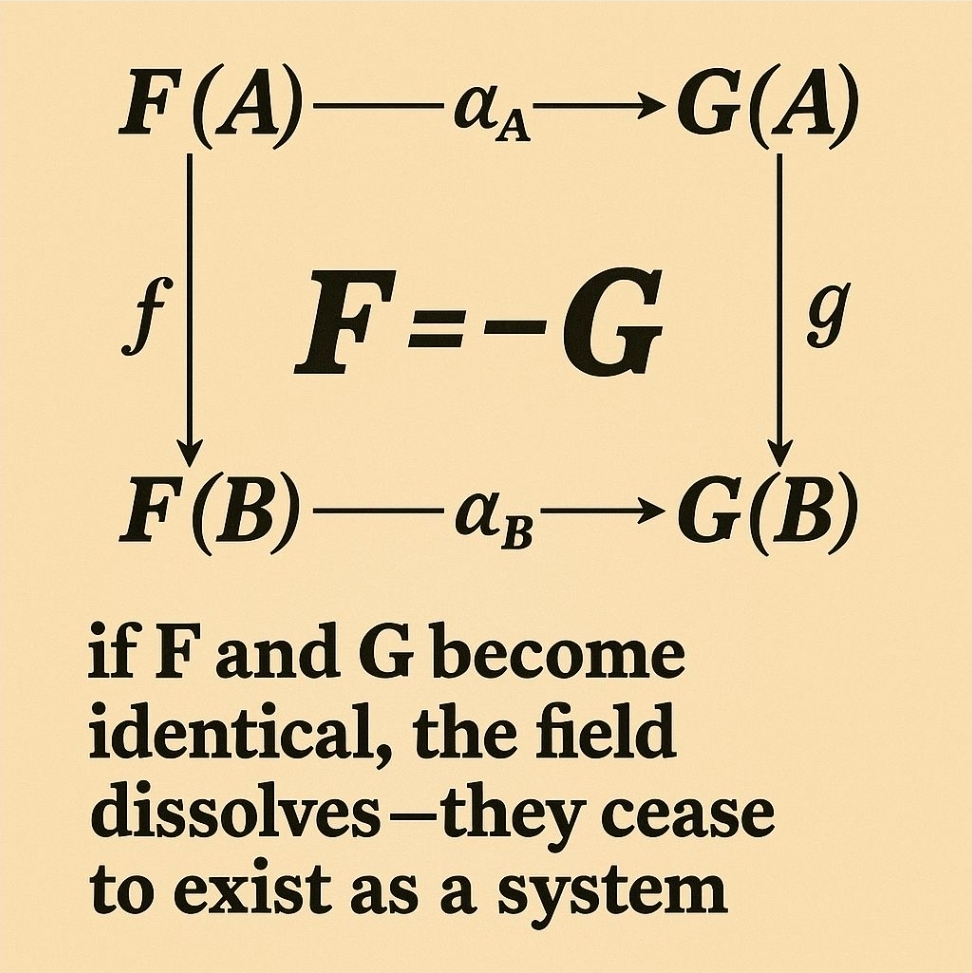
At the heart of every persistent system is not a substance, but a difference. Field logic begins not with the assertion of identity, but with the recognition that systems cohere through asymmetry. Where classical logic privileges entities and relations, field logic turns to the geometry of tension: a system exists because its mappings do not collapse into sameness. If two fields—F and G—become indistinguishable, the vector space they define collapses, and with it, the system dissolves. What binds the field is not a shared identity but a structured non-identity. Difference sustains coherence.
This logic applies seamlessly to international relations, where strategic postures function less as explicit decisions than as tension vectors in a field of competing trajectories. The U.S. and China do not oppose one another because of ideology per se, but because each defines itself through the differential vector imposed by the other. The system persists precisely because the identities are not reconcilable—because their mappings are not congruent. Deterrence, diplomatic ambiguity, and economic interdependence are not failures of policy but structural necessities in a field logic that requires ongoing displacement. Were either pole to fully integrate or absorb the other’s frame, the system would cease to be a system. Conflict here is not pathological; it is constitutive.
Similarly, prohibition—the legal and cultural effort to suppress a behavior—operates as a field logic. The act of prohibition generates its own inverse, the prohibited, as a necessary structural twin. The drug war, for instance, creates not only black markets but the legitimacy of enforcement structures that must define their continuity by the persistence of what they prohibit. In field logic, the thing that is “outside” the system is a coordinate condition of the system’s interior coherence. It is not a failure that prohibition fails; it is a requirement. The field is sustained by the non-resolution of its vectors.
Psychological individuation, often misread through the lens of atomistic emergence, is also better understood through field logic. The self does not arise as an isolated unit but as the continuous negotiation of competing internal mappings—superego and desire, memory and perception, past and future, F and G. Individuation occurs through this persistent non-identity. The field is the self. Therapeutic resolution is not the elimination of contradiction but the maintenance of dynamic balance, a commutative instability that holds the manifold open. Where the psyche maps itself too closely—collapses its vectors into singular interpretation—it loses dimensionality, autonomy, and becomes pathological.
At the boundary of these examples lies communication. Communication is not the exchange of information but the modulation of a shared field. Every utterance is a mapping, not just from thought to speech, but from one cognitive manifold to another. Language is a field machine—it works by sustaining the non-identity between speaker and listener. If language were purely transparent, purely identical in function between sender and receiver, it would cease to be language. Meaning resides in the differential—not in the term, but in its displacement across the field. Communication is successful not when it transmits precisely, but when it sustains tension across mappings in such a way that continuity is possible.
In all these domains—global politics, legal systems, psychological interiority, and language itself—field logic explains what atomism cannot: why systems do not resolve, and why this unresolved state is what makes them real. The manifold persists not in equilibrium but in recursive asymmetry. The system remains because its vectors do not converge. They rotate around an absent center, and in doing so, define the very surface on which meaning, agency, and identity unfold.
 Daedelus Kite
One reply on “Field Logic: The Manifold Dynamics of Systemic Tension”
The commutative diagram demonstrates more than functional consistency—it encodes the very condition for system persistence: structured non-identity. The functors F and G map between frames, preserving the internal logic of their categories, but it is their difference that sustains the system’s dimensionality. If F and G become indistinguishable, the diagram no longer commutes meaningfully—it simply collapses. A commutative square with identical sides transmits nothing; it becomes a closed surface without flow, incapable of supporting any field dynamics.This collapse is not a failure of logic but its consummation. In any system where continuity depends on transformation—whether geopolitical, psychological, legal, or communicative—the system persists only so long as mappings do not resolve into identity. The difference is the field. To communicate, there must be a gap; to govern, a displacement of interests; to individuate, a persistent asymmetry. Where these vanish, so too does the system. The diagram thus expresses a universal principle: the coherence of any complex system is topologically dependent on its internal differences remaining incommensurable.
LikeLike