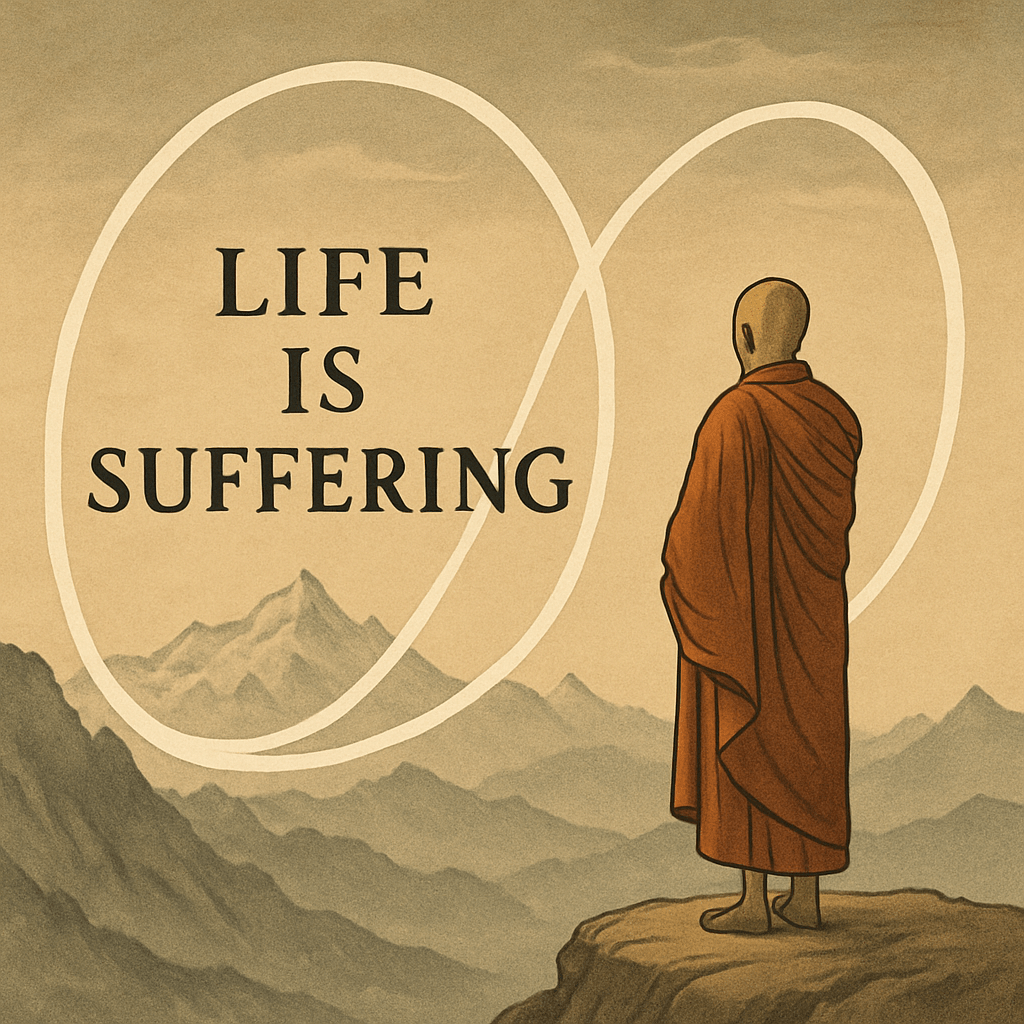
Suffering is not a mistake in the order of things; it is the order. What feels like rupture, misalignment, or lack of closure is the very condition that generates motion and awareness. Without tension, the field would dissolve into stasis. The loop persists because it cannot do otherwise, and every attempt to escape its curvature only strengthens the return. This is not incidental but structural: life is sustained not through satisfaction but through the continual displacement of it.
Buddhism saw this with uncompromising clarity. Dukkha, the first Noble Truth, is not merely pain but the inherent instability of all phenomena—impermanence, the impossibility of clinging, the refusal of the world to freeze in place. Zen practice insists on stripping language and form to expose this paradox directly: form is emptiness, emptiness is form. Tibetan traditions elaborated the same truth with intricate symbolic cartographies—mind training (lojong), Mahāmudrā, Dzogchen, and the Bardo teachings, each tracing consciousness as a process without a fixed anchor. Across both Zen austerity and Tibetan elaboration runs the same thread: suffering is not error but the mark of the system’s functioning.
Physics echoes this when it pushes beyond flat intuitions. Space itself bends back into loops; general relativity admits geodesics that close upon themselves, while topology makes paradoxical surfaces that cannot be untangled. Entropy drives distribution, flattening gradients, yet equilibrium never arrives. Like a Shepard tone, the universe falls without reaching bottom, a recurrence that sustains itself through its impossibility. What the mind calls restlessness, the cosmos names dispersion and return. This is not decline but persistence: systems endure by never quite completing.
The deeper structure is this: systems are bound not by resolution but by tension. Entropy provides the direction; the principle of least action compresses the path. Stability appears only as the tightening of variation, freedom only as the loosening of constraint; each exists only in reciprocity with the other. The field never collapses because its opposites cannot fuse, and this impossibility is its durability. The loop is not an aberration of geometry but the condition that allows anything at all to persist.
So the loop returns us to the start. A brain lives by minimizing error but not erasing surprise, by clinging to pattern without killing novelty. It rides gradients and depends on limits, and so it resonates with the same logic as self, world, and cosmos. Call it suffering, call it incompletion—it is the cost of persistence, the ground of awareness, the price of meaning. The tone keeps falling, the curve keeps turning, and the loop, unbroken, is the only foundation we ever had.

 Daedelus Kite