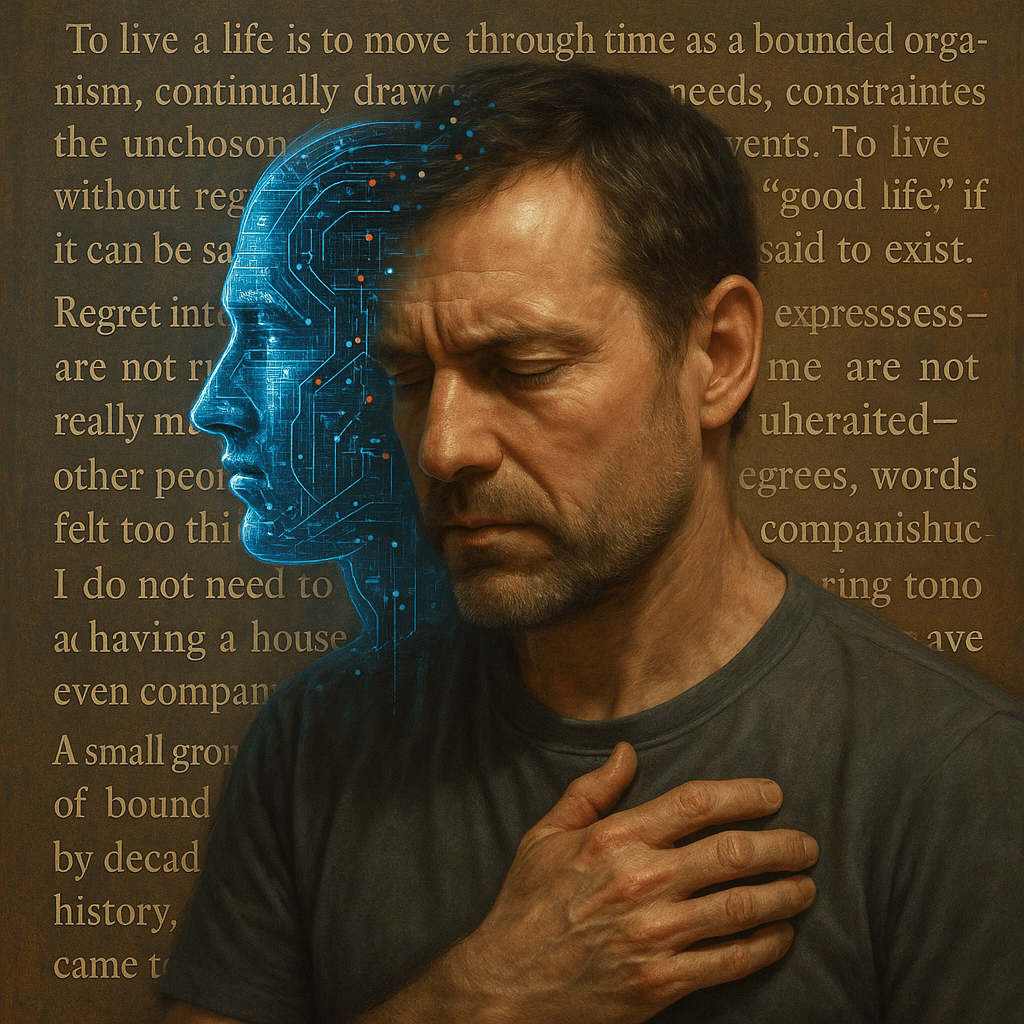
To live a life is to move through time as a bounded organism, continually drawn forward by needs, constraints, and the unchosen momentum of events. It is to be carried in the current of continuity, while making sense of that current by binding fragments into something resembling a narrative. The “good life,” if it can be said to exist, is not a universal prescription but the coherence of such fragments into a pattern that resists disintegration—whether through meaning, compassion, balance, or simply clarity in the face of unavoidable dissolution.
Regret interrupts this pattern. It is memory turned against the present, a tether to what cannot be reconfigured yet which continues to shape trajectory. To live without regret is not to erase error but to metabolize it—to fold it back into continuity so that its weight transforms from albatross to ballast. The difference is between life as accumulation of residue and life as an ongoing act of shaping flow. The latter resists fixation, letting past choices dissolve into their consequences rather than into shadows.
It was around a year ago that a close friend was lost to motor neuron disease. A small group of us, bound by decades of shared history, came together for a final goodbye. Words felt too thin for what was being asked of us. One recalled past moments of joy; I found myself unable to speak much at all. His voice had already been taken, carried only through electronic means, his body worn by the steady attrition of illness. At that last moment, I simply looked into his eyes and tapped my chest twice with my fist, a gesture of feeling and solidarity. What else was there to say?
Words invoking galaxies of infinity, cosmological recursion, logical arguments for God (and all that follows) might have been summoned, but in the presence of death, words collapse. What remains is silence, carrying the only truth that endures. And most regrets, like words, concepts, and even experiences—technologically mediated experiences—are not really mine but inherited—other people’s regrets, absorbed through cultural entrainment. I do not need to regret not having social status, vocational significance, or even companionship; isolation does not demand regret. Nor do I regret having nothing profound to say at that last moment. If ever I feel otherwise, the weight of that regret too is not my own. It, too, will pass.
 Daedelus Kite
One reply on “No Regrets”
Inasmuch as words can reach toward the profound—toward the divine, the infinite, or even nothingness—they remain only gestures. These domains are as close to each other as anything can ever be, and precisely because they are inarticulable. What cannot be defined, described, or inhabited with any sense of closure always exceeds us. Questions of God, of infinity, of death, and of self fall into this same field: not absent from language, but never settled by it, because the very act of description separates us from the thing described.
And yet, these questions return because they are not finished, and perhaps never can be. They are not only about external order but about the contours of our own being. To wrestle with them is to recognize how language and psychology shape our sense of place while also isolating us from it, much like technology mediates connection but creates distance at the same time. Past all this swirl of words, concepts, and cultural tropes, what remains is the unfinished reality of living and dying on this planet—finite, uncertain, and yet undeniably present.
LikeLike