The word wank enters English as a piece of slang with a narrow, blunt function, but its deeper linguistic roots sit elsewhere. In Germanic languages the family points to motion rather than obscenity: wanken, wankelen, a sense of swaying, instability, loss of balance. The sexual meaning is comparatively recent, parochial, and culturally loud, amplified by British class register and insult economy. Outside English, it survives mostly as phonetic coincidence or imported slang, stripped of lineage and context.
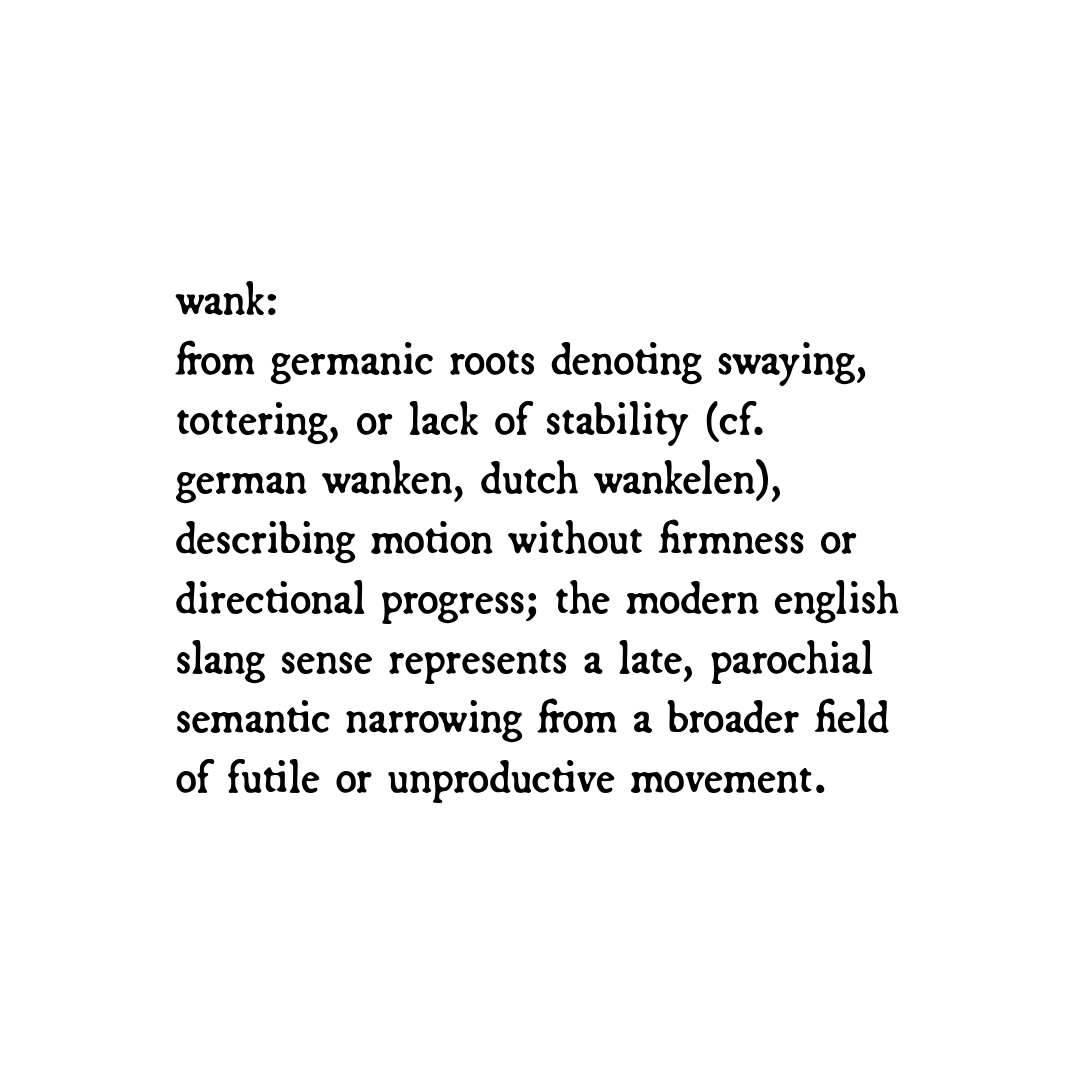
Philologically, wank belongs to an old Indo-European cluster concerned with oscillation, weakness, and unsteady movement. The Proto-Germanic root *wankjaną and its relatives (*wankaz, weak, pliant) describe motion without firmness: bending, tottering, yielding under load. This lineage persists clearly in German wanken, Dutch wankelen, and Scandinavian cognates indicating sway, doubt, or instability, both physical and moral. The semantic field is consistent: lack of fixity, failure to hold form, deviation from uprightness. The later English slang sense is a semantic drift rather than a rupture, a narrowing of a broader metaphor of futile or misdirected motion into a private, repetitive act. What looks crude is in fact a late specialization of a much older idea about effort decoupled from progress.
What is more interesting is how neatly the older meaning shadows the newer one. To wank, in its modern sense, is not only solitary but circular, self-referential, expending energy without displacement. The older sense of tottering captures this perfectly: movement without travel, effort without consequence, rhythm mistaken for progress. Which makes lingering too long on the word itself feel faintly guilty, a little self-indulgent, a bit of a tottering wank.
Categories
Etymology: wank
 Daedelus Kite