Categories
cybernetics

Communication Theory: The Irreducibility of Deception

Why Deception Is Irreducible in Communication

Categories
cybernetics

The Essence of Language

Language, like all communication systems, holds together not despite displacement, delay and uncertainty, but because of them.

Categories
Philosophy

Philosophy of Language: All War Is Civil War

Peace is not merely difficult. We have built institutions, identities, economies and languages whose coherence depends upon the persistence of conflict.

Categories
cybernetics

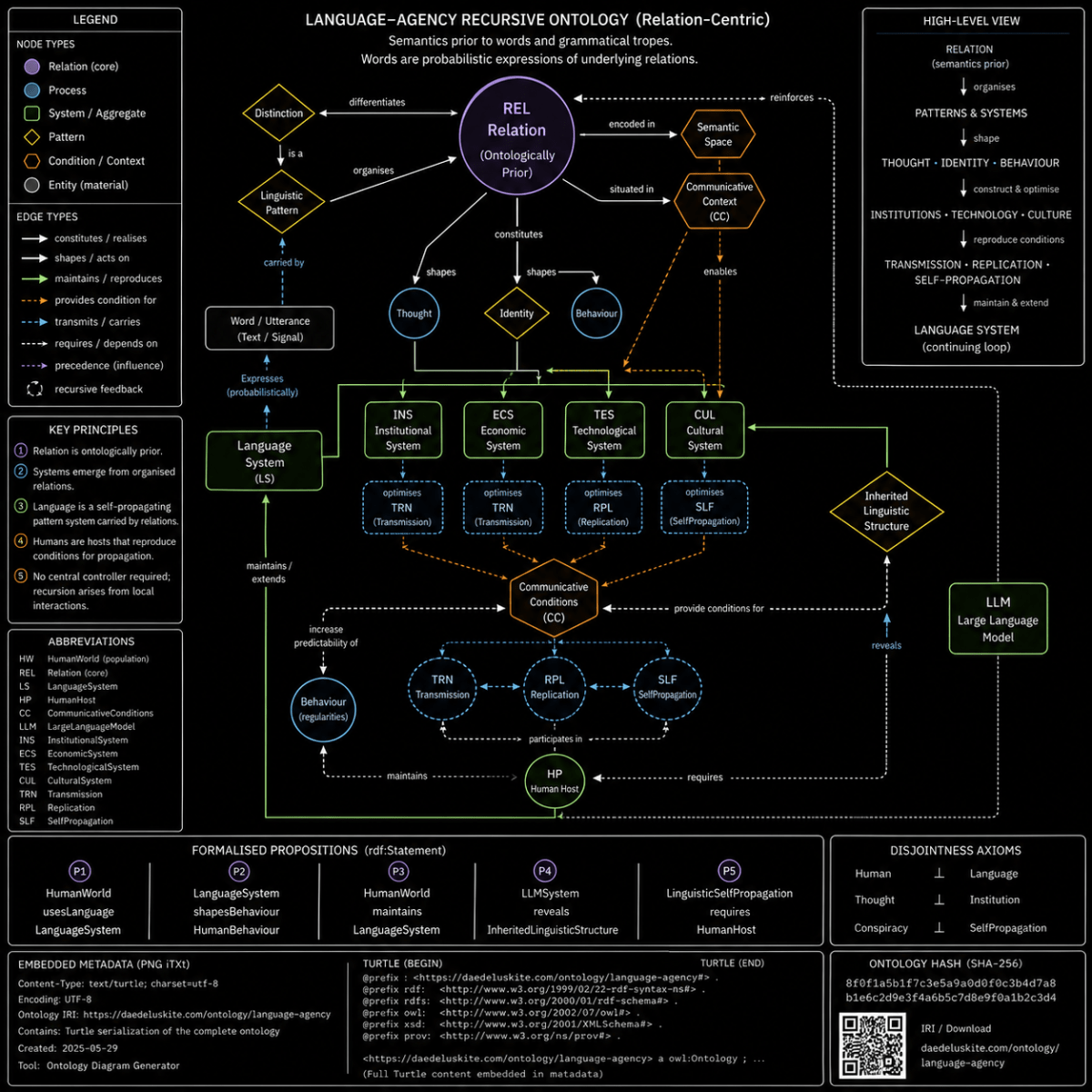
How Language Shapes Human Thought, Identity and Behaviour

Language does not merely describe civilisation. It quietly engineers the conditions of its own persistence through us.

Categories
cybernetics

continuity precedes truth

Disinformation is not the opposite of information, but one of the ways communication organises uncertainty into meaning. Its deeper structure belongs less to politics than to the philosophical problem of how truth, coherence, and identity emerge at all.

Categories
language

what meaning does

Meaning is not stored in words, but sustained in the relations that survive their transformation.

Categories
language

Limits of Language

Language does not simply describe the world we inhabit. It arranges the conditions under which that world becomes intelligible, and in doing so we gradually reorganise experience into forms that can be named, remembered, and exchanged. Perception, memory, and social coordination all lean on this process. Human environments therefore become saturated with symbolic scaffolding: categories, […]

Categories
language

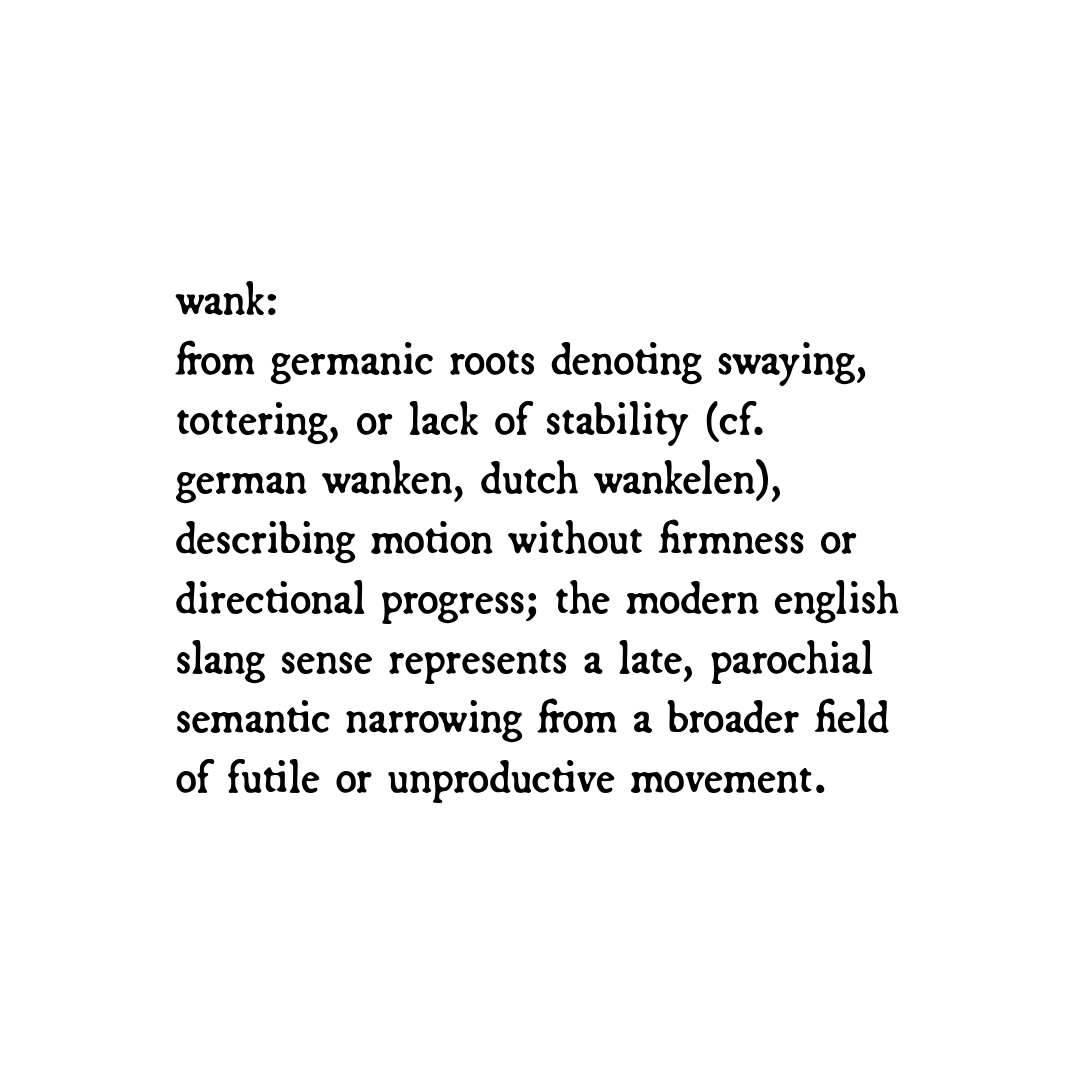
Etymology: wank

The word wank enters English as a piece of slang with a narrow, blunt function, but its deeper linguistic roots sit elsewhere. In Germanic languages the family points to motion rather than obscenity: wanken, wankelen, a sense of swaying, instability, loss of balance. The sexual meaning is comparatively recent, parochial, and culturally loud, amplified by […]

Categories
language

how technology turns language into behavioural control

Meaning arises and endures only because experience and symbolic encoding remain out of phase, and when technology collapses that difference into immediacy and semiotic isomorphism, thought and behaviour collapse into preordained reflex, short-circuiting cognitive voltage into volatility, simplicity, and coercive transmissibility, turning language into a direct instrument of behavioural modulation.

Categories
Philosophy

Truth in Language

What is truth. The moment we ask the question, we are already inside language, and everything that follows unfolds from that fact. Truth is not something we approach from outside, as a detached observer might inspect an object. It arises within sequences of tokens, within the games we play with them, within the structures we […]

Categories
Philosophy

Theory of Language and Communication

Formal Abstract This document presents a formal, process-based theory of language, information, and dynamic meaning systems. Communication, cognition, identity, legitimacy, and truth are treated not as static entities but as temporally constituted processes sustained through repetition, coupling, and feedback within distributed fields. A minimal axiom set grounded in acts, timing, coupling, recursion, variation, and emergent […]

Categories
Philosophy

Language as Limit

Ludwig Wittgenstein argued that the limits of language are the limits of the world, not as metaphor but as structural fact: what cannot be said cannot be thought in any stable form. Bertrand Russell pursued logical atomism to anchor meaning in precise correspondence, seeking a syntax that could mirror reality without residue. Charles Sanders Peirce […]