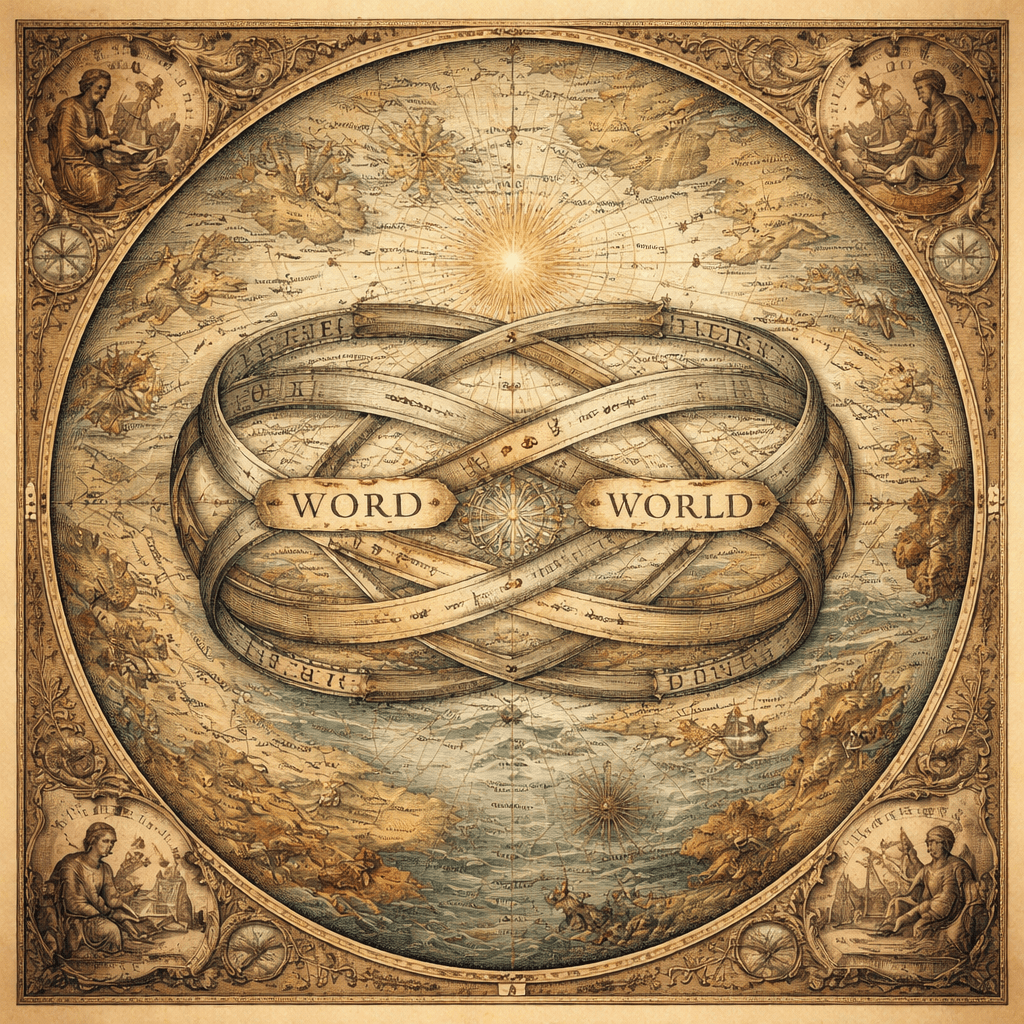
Language does not simply describe the world we inhabit. It arranges the conditions under which that world becomes intelligible, and in doing so we gradually reorganise experience into forms that can be named, remembered, and exchanged. Perception, memory, and social coordination all lean on this process. Human environments therefore become saturated with symbolic scaffolding: categories, stories, legal terms, scientific descriptions, everyday labels. We learn to stabilise reality in ways language can carry, and over time the world that returns to us is one already shaped for articulation. In that sense we become partly compliant to the symbolic systems we generate, because what we recognise as reality is inseparable from the linguistic structures that make it communicable.
Yet description and reality never coincide. Between the event and the word there is always a delay, a small but persistent phase difference in which the world exceeds what is said about it. Communication moves through that gap, constantly circling between what exists and what can be stated. Meaning arises from the tension between those poles rather than from either one alone. Awareness therefore settles around workable approximations that allow coordination and continuity, while the deeper mismatch between description and reality quietly sustains the motion of thought itself, keeping interpretation in continuous orbit around a world that can be approached but never fully captured.
Categories
Limits of Language
 Daedelus Kite