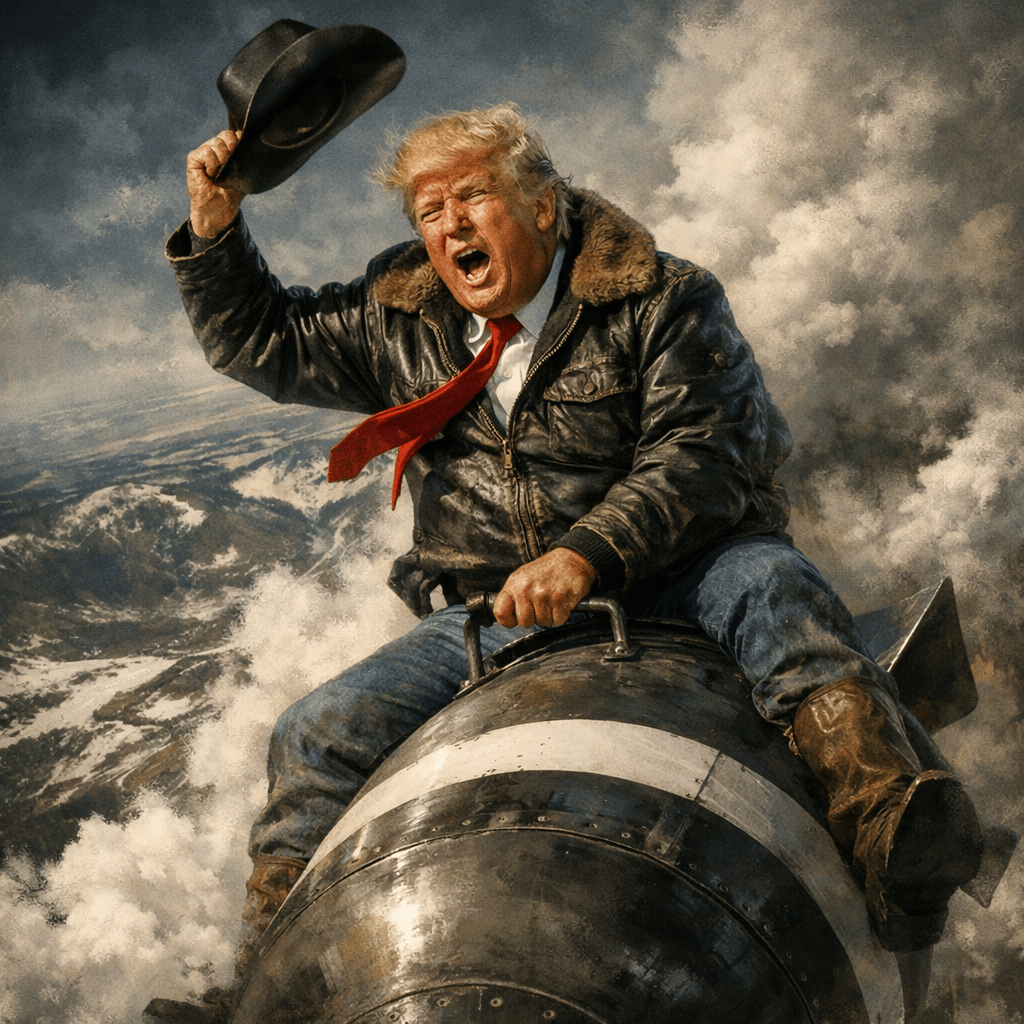
For years, he sold himself as the man who could end wars through instinct, pressure, spectacle, and personal dominance alone, yet the deeper problem now emerging in the Middle East is not merely strategic failure but the exposure of an intellectual and moral vacuum at the centre of that performance. Peace is not a television negotiation. It is not branding. It is not the reduction of history, religion, trauma, logistics, energy systems, military doctrine, economics, nationalism, and human suffering into the psychology of one domineering individual demanding loyalty from the room. Durable diplomacy requires patience, ambiguity tolerance, institutional continuity, memory, restraint, and the capacity to understand that other actors possess motives and identities irreducible to one’s own appetite. Trump appears constitutionally incapable of this. Every interaction collapses into transaction, dominance ritual, grievance performance, or self-reference. The consequence is that once conflict exceeds theatrical management and enters genuine historical complexity, he has nowhere to go.
What becomes visible in moments like this is not merely incompetence, but civilisational illiteracy masquerading as strength. A man who does not understand diplomacy cannot produce peace because peace itself is a highly sophisticated communicative achievement. It depends upon delayed gratification, reciprocal recognition, symbolic credibility, institutional trust, and the careful modulation of hostility without total humiliation. Trump’s political identity is built almost entirely against those very principles. He does not arbitrate complexity; he simplifies it into enemies, winners, weaklings, betrayal, and spectacle. Even language, in his hands, ceases to function as a medium of understanding and instead becomes a tool for emotional coercion, branding, distraction, and self-preservation. The result is that crises do not stabilise around him. They amplify.
This is why extraction now appears so difficult. To withdraw gracefully from escalation requires grace in the first place. It requires the capacity to acknowledge limits, redistribute authority, negotiate appearances of mutual dignity, and speak in terms larger than personal survival. Trump cannot do this because his political machinery was never designed for reconciliation or wisdom. It was designed for perpetual motion through outrage, symbolic aggression, and the conversion of public attention into personal insulation. Even the moral vocabulary surrounding freedom, patriotism, strength, or justice often appears less like conviction than monetised stage-prop language deployed in service of power accumulation. Whether one calls that corruption, opportunism, grift, or theft is almost secondary to the broader pattern: institutions, alliances, and crises become raw material for self-extension.
The deeper horror is that this did not emerge from nowhere. Trump is not an alien intrusion into American culture but one of its recursive reflections: celebrity fused with capital, entertainment fused with politics, wealth mistaken for wisdom, aggression mistaken for competence, and publicity mistaken for truth. He did not invent those values. He concentrated them. And now, in a region where history does not bend to branding exercises, the limits of that concentration are becoming visible in real time.