When we speak, think, or write, it feels like we’re exchanging units of meaning—words, symbols, concepts—as if they were coins passed from hand to hand. But look closer, and something else is happening. Meaning isn’t a thing we hold. It’s a pattern of difference that holds us in structure.
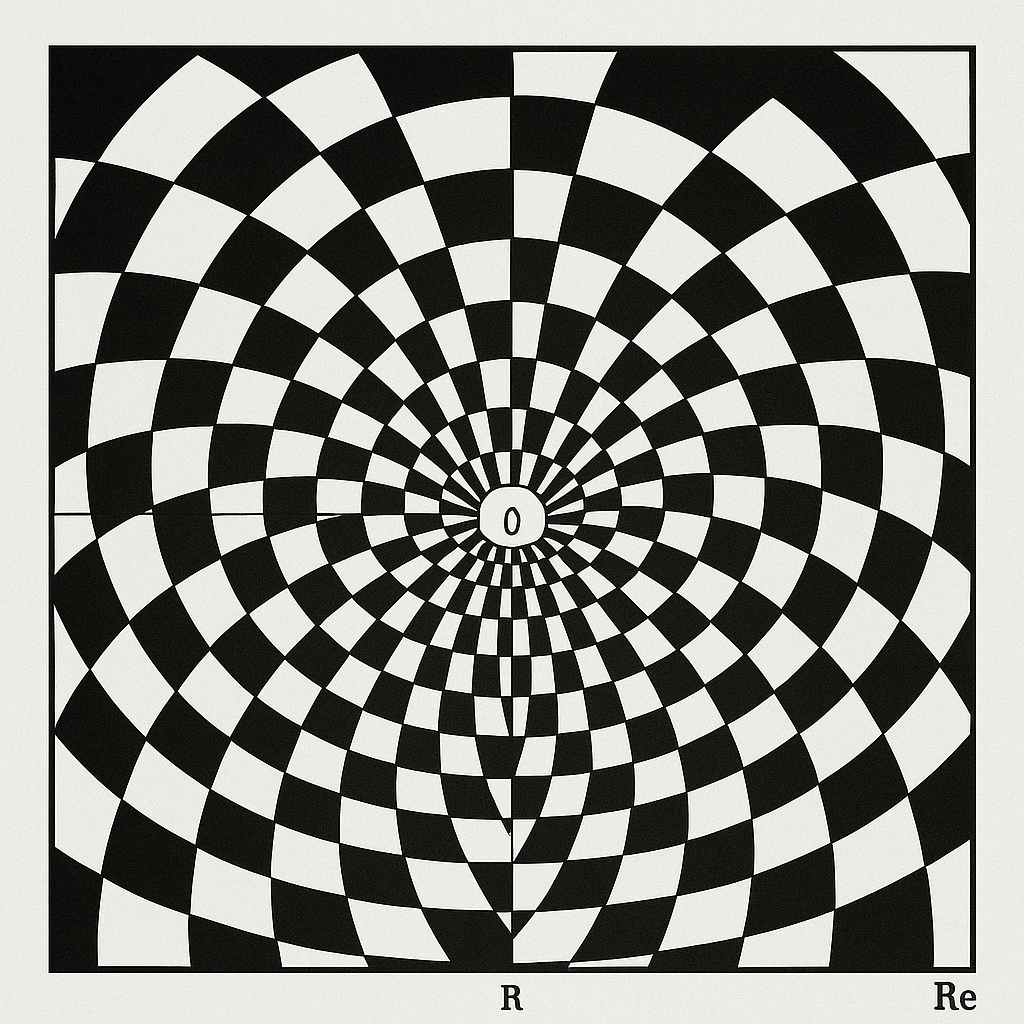
Consider two basic ways to move something in space: translation and rotation. A translation slides every point in a system the same distance. A rotation pivots points unevenly around a center. These aren’t just geometric tricks—they’re formal operations that preserve something deeper. In both cases, displacement occurs. What matters is not that something moves, but how the relation between parts stays coherent.
Now shift from geometry to language. A sentence doesn’t mean something because of the individual words. It means something because of the difference between them, and because that difference is preserved even when the sentence shifts form. Swap the syntax, use a metaphor, speak in another language—the words change, but the displacement structure can persist. Meaning, in this view, is not a content—it’s a kind of phase stability under transformation.
Think of it like music. In a polyrhythm, multiple rhythms run simultaneously—offset, layered, slightly out of sync. No single beat carries the identity. The coherence emerges in the interaction. The displacement between pulses is the structure. Meaning in language works similarly: a field of relational offsets that stay intelligible even as the surface morphs.
This isn’t just a metaphor. In physics and mathematics, symmetry transformations like rotation and translation are governed by group theory. Each transformation preserves some invariant property—distance, angle, volume. Language appears messier, but beneath it lies a similar field logic. What persists across transformation is what means.
So when we talk about understanding, we’re really talking about recognising invariant displacement across change. A concept stays meaningful not because it remains still, but because its structure of difference survives movement. This gives meaning a topological quality—not fixed in space, but preserved through deformation.
What does this tell us about systems—linguistic, cognitive, or even political? That coherence doesn’t come from stasis. It comes from maintaining structural difference through transformation. The field holds not because it’s uniform, but because it contains phase-locked displacement—a consistent difference that endures.
Meaning, then, is not something given. It’s something sustained—a rhythm of relation, a geometry of offsets, a structure that stays itself by always changing.
Categories
The Hidden Geometry of Meaning
 Daedelus Kite