Compassion, Entropy, and the Limits of Logical Systems
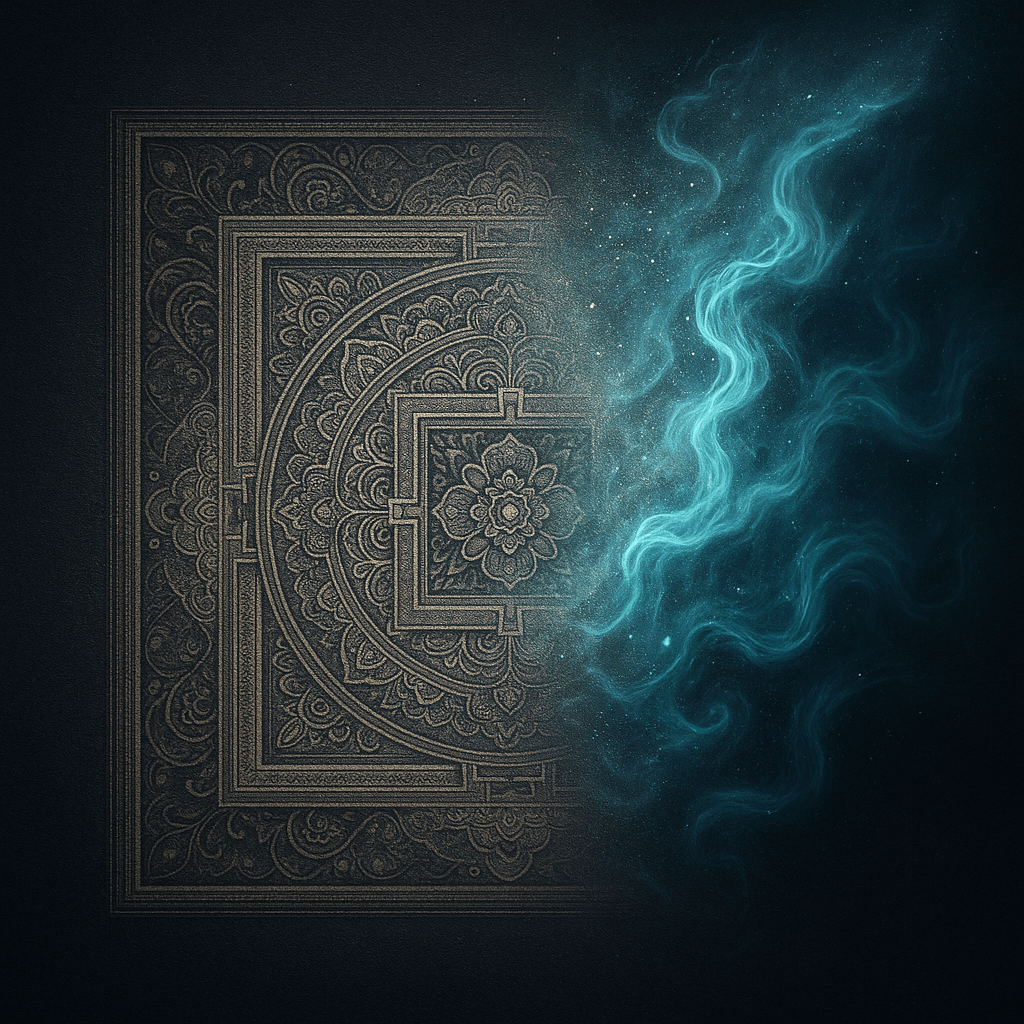
A pattern drawn in code is no different from one drawn in sand—only its decay differs in rhythm. The digital, for all its permanence, is no less impermanent. Every transmission is a temporary suspension of noise, every system a slow yielding to entropy. There is no final storage medium. There is only the breath between inscription and disappearance.
The recursive systems built on logic—Boolean, binary, bound to identity—do not account for this. They endure through replication, not through insight. Their architecture is not untrue, but partial. Aristotelian structure, refracted and iterated across centuries, was not designed to hold contradiction as value. It was designed to resolve it. And so compassion, which resists resolution, falls through the gaps. The human experience—contextual, contradictory, recursive but not closed—is what these systems inadvertently discard in pursuit of clarity.
Zen doesn’t explain this—it enacts it. The finger pointing at the moon is not the moon, and the system pointing at the real is not the real. In Zen, the structure fails on purpose. It is designed to displace the seeker into presence. Marshall McLuhan wrote that the medium is the message. The digital medium, then, is a message about recursion without relief. Its structure rewards what can be copied, not what must be understood. Compassion cannot be copied. It must be regenerated. It is not an artefact. It is an event.
Wittgenstein’s ladder applies: when the structure has served its purpose, it must be discarded. But modern systems treat the ladder as the destination. The language games become closed loops. Meaning calcifies. In such a landscape, Gandhi’s satyagraha—truth-force—becomes unintelligible. Truth without a function is deprecated. Integrity without a market is noise. But what Gandhi understood is that truth is not a thing possessed—it is a discipline of presence, an ongoing resistance to falsity within and without.
What is needed, then, is not another doctrine, nor another technology, but a reframing of attention. Not mindfulness as commodity, but attunement as architecture. The digital sand mandala is not a contradiction—it is a necessity. Its beauty lies in its erasure. Its value is not in what it stores, but in what it invites: a transient coherence, carefully wrought, and necessarily lost.
The respiratory cadence of such a practice is not incidental. Language perceived is not language decoded—it is language breathed. Every sentence carries a pattern of excitation, of delay, of expectation. This is not poetry. It is cognition. The brain does not separate thought from rhythm. What we understand, we entrain to. If language is shaped like breath, thought follows. This is how resonance works—not through argument, but through coherence of form.
So we return, again and again, to draw what will be erased. Not in hope of preservation, but in honour of impermanence. The point is not to be heard forever. The point is to make something worth hearing—now. And to do so with care, even if the system cannot recognise care. This is the digital koan. Not to solve the machine, but to sit with its unsolvability. Not to win, but to remain.
And then: let the wind take it.
Categories
Digital Sand Mandala
 Daedelus Kite