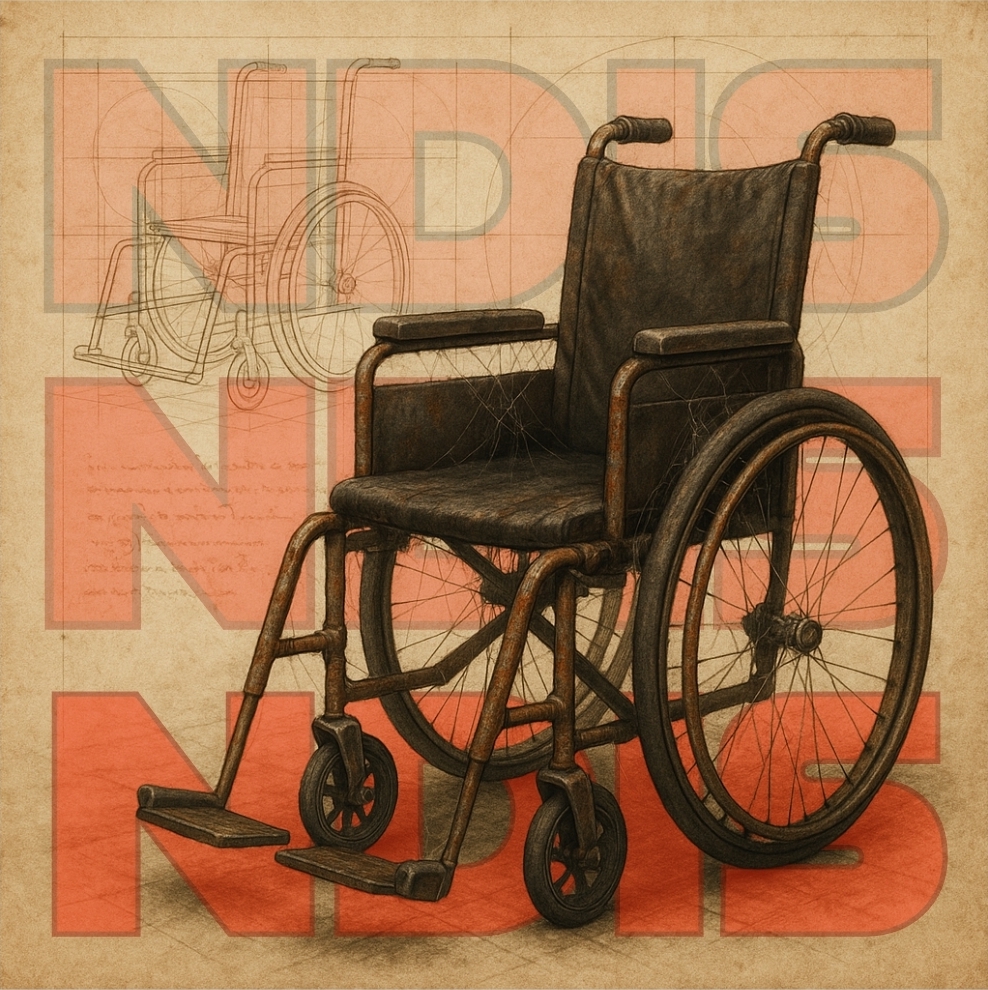
Bureaucracy is a dissipative structure, built not to solve problems but to metabolise them. Flows of energy, information, and compliance pass through its channels, and in passing they feed its continuity. The structure consumes instability and recycles it as order, but only order of its own kind—recursive loops of policy, paperwork, and oversight. Like a machine tuned to its own hum, it sustains itself by amplifying the very noise it claims to reduce, its rhythm a steady breath of replication and delay. The scaffolding of persistence is not neutral; it is the shape taken by problems rearranged to guarantee the institution remains indispensable.
What this means for those at the margins is brutal clarity. A disability service does not exist to eliminate disability’s burdens; it exists to codify and circulate them as transactional tokens in a socio-economy of scarcity and control. The labyrinth of criteria, forms, and assessments functions as both proof of need and mechanism of exclusion, ensuring the unsolved remains unsolvable. This is not accident but structure, equilibrium by inefficiency, entropy bound into a pattern of dependence. To enter such a system is to inhale its recursive air—long exhale of justification, short gasp of denial—until one realises the continuity of the service lies in the endless repetition of the struggle itself.
And those who appear to coordinate this mess are not masterminds of control but opportunists, misanthropic turds who lean into existing dysfunction, co-opting inefficiency as a shortcut to power, proving only that laziness and cynicism thrive where complexity has already done the hard work of entanglement.
 Daedelus Kite
3 replies on “Disability Services Fail”
These failures are not rooted in isolated acts of incompetence or cynical malice—though both clearly occur. They are systemic. Bureaucracies fail at multiple levels—not just in specific domains like health or ageing—but everywhere governance reaches. Scholars warn that bureaucratic pathologies are often symptoms of wider political dysfunction, not confined to one ministry or sector. In Australia, dysfunction is evident across universities, infrastructure, and public service delivery—including administrative nightmares like the Robodebt scandal and massive service backlogs—highlighting a national pattern, not one-off incidents.
Our problem isn’t a lack of ideas—it’s intelligence misapplied or absent altogether. We see integrity, honesty, authenticity nowhere. The machinery survives by reproducing its own dysfunction, and those within it exploit that dysfunction. But let’s not mistake co-option for mastery. Reform requires attention not just to dysfunction itself, but to the deep political incentives that underlie it—short-term electoral gain, avoidance of accountability, and the protection of entrenched interests over the public good. And until that is addressed, all we’re left with is a hollow system, resistant to both empathy and effectiveness.
LikeLike
The level of incompetence in this area is astonishing.
LikeLiked by 1 person
Yes, indeed. No spoilers here, but this inefficiency is the kernel core and clanky cyberpunk ramshackle engine of sociopolitical self-sustainment. Squeaky wheels become orchestrated systems of incompetent self-propagation. Not rhetoric, at all – this is both logically and empirically valid.
Someone, somewhere, sold the system into a free marketplace of providers and regulators thst possess primary interests in the ongoing problematisation (of disabled persons’ lives) that provides them economic benefit.
Arse about… inside out… the systems persist to service the service providers. I am a little surprised at how simple it all is. What idiots are advising our government(s)? Greedy, arrogant and selfish ones, I’d say.
🙏
LikeLike