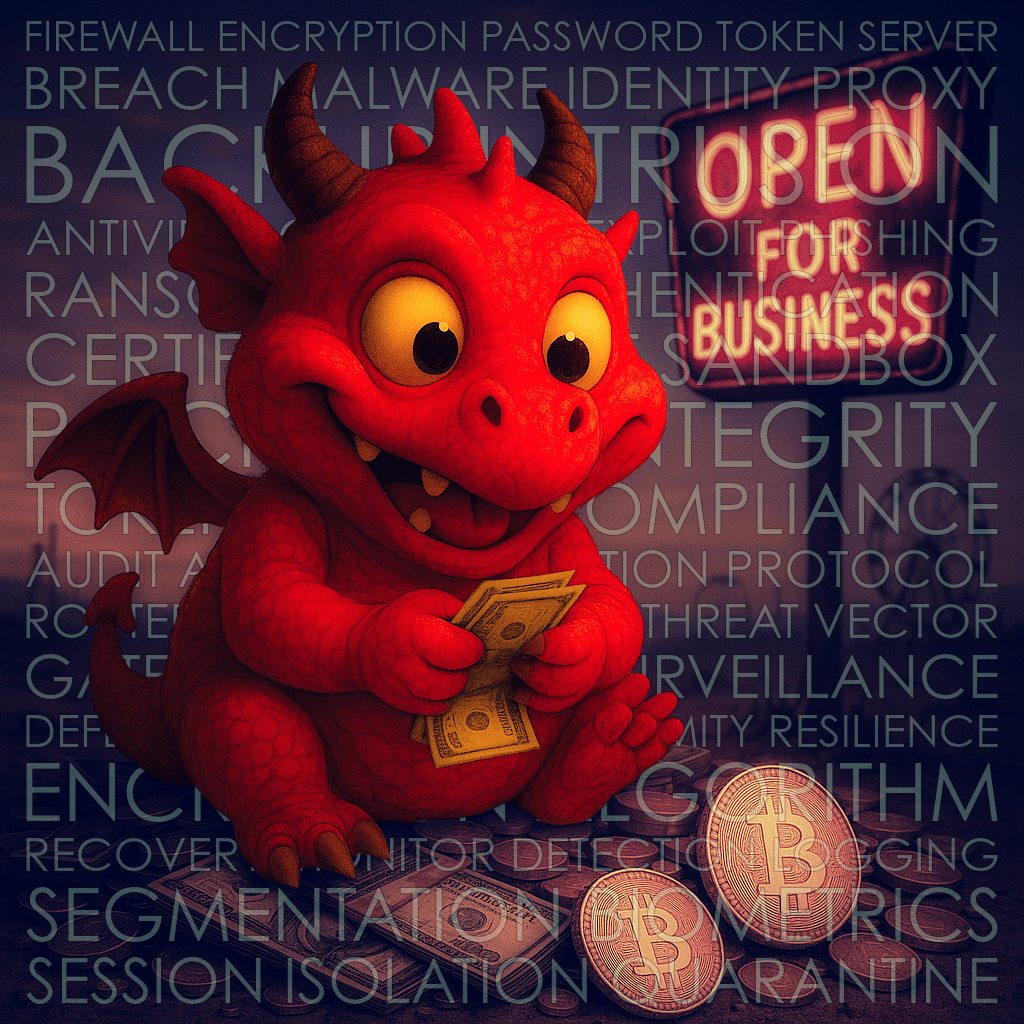
Because mathematics is infinite, the field of cybersecurity can never be truly closed. The space of vulnerabilities is unbounded, each patch or solution only ever an approximation against the open horizon of possible attacks. Risk is permanent, not as a flaw but as a structural consequence: a system that protects itself must also endlessly expose itself to the very conditions it defends against. This recursive enclosure produces not stability but a cycle of provisional security, endlessly deferred, endlessly demanded. It is the perfect product—never finished, never final, only ever a necessary approximation of closure that can never arrive.
And because this closure is impossible, the business model orbits around transferring risk to the customer. The impossibility itself becomes the market: each user must internalise the danger and purchase protection that is known, from the outset, to be incomplete. What becomes normative is prophylaxis as subscription, a cycle in which the promise of safety is never fulfilled, but always resold. Security is not achieved but continually repurchased, the same impossibility packaged again and again. It is an elegant loop: risk persists, cost is offloaded, and the cycle feeds itself.
 Daedelus Kite
2 replies on “Technical Insecurity”
A silly game, yet simultaneously and self-evidently serious. If we were to stop pretending that we can ever solve this problem, we might actually get somewhere.
It’s the make-believe that keeps this gravy train solvent. An insight: just as with prohibition, this is not a winnable war.
LikeLike
Related:
Meaning is not a fixed content but the Δ that never closes—the non-orientable twist between expression and what it seeks. Systems survive by keeping this gap open: reducing, recombining, and sustaining themselves through uncertainty. Closure would end communication; instead, continuity arises from non-identity, turbulence, and provisional orientation. The world persists as this impossible closure, endlessly deferred yet endlessly generative.
LikeLike