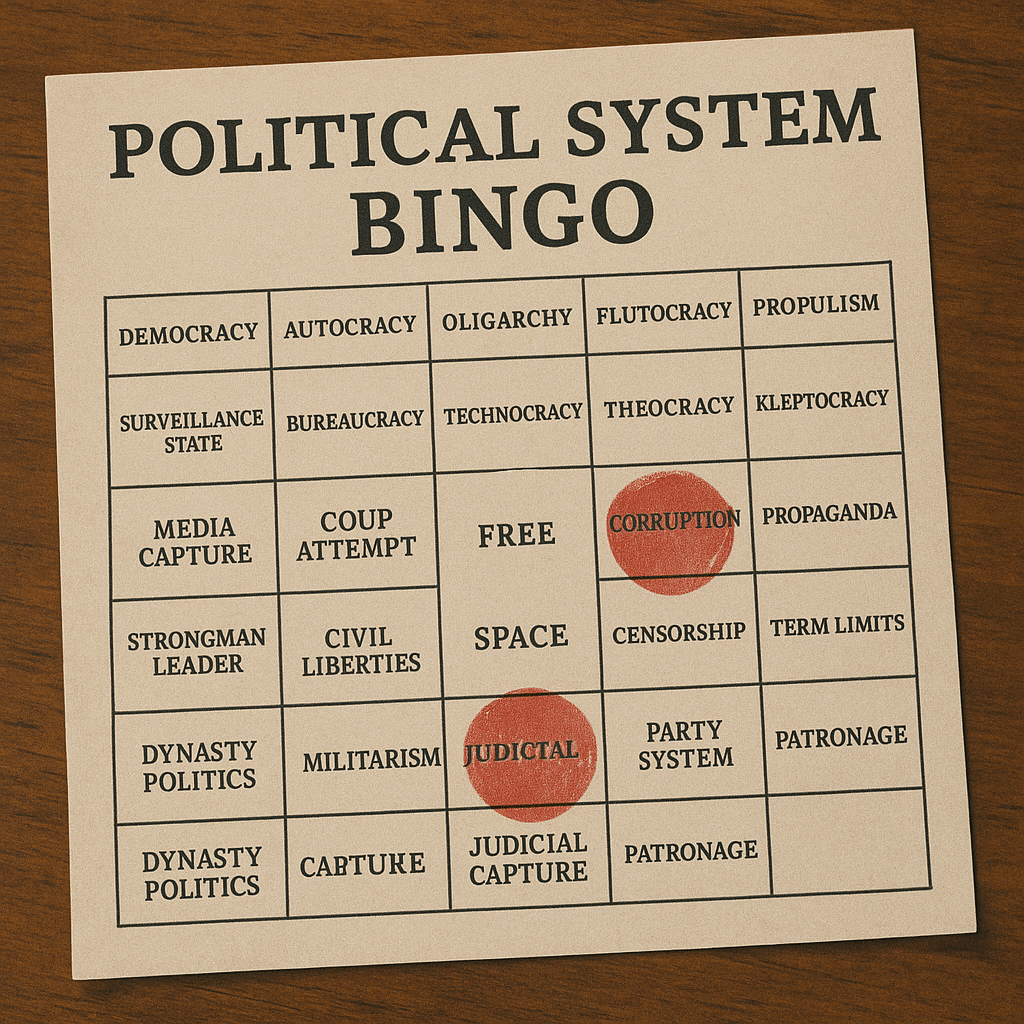
Democracy is often assumed to be more resilient than it is. What is becoming clear in the United States is that its very openness—the freedoms of speech, assembly, and communication—provide the leverage points through which anti-democratic forces operate. If democratic systems can be bent or flipped using relatively low energy—disinformation campaigns, procedural manipulation, networked mobilization—then the surprise is not in their fragility, but in how much these systems resemble those they are contrasted against. Both democracy and autocracy are patterned systems of flow, coordination, and power; the difference is more of configuration than essence. Autocracies operate through central control; democracies through distributed consensus. Yet the structural overlap is sufficient that one can become the other with disconcerting ease (Levitsky & Ziblatt 2018).
This suggests neither democracy nor autocracy are stable end-points but metastable states in a continuum of systemic adaptation. They share an underlying dynamical strata: dependence on legitimacy, communication, and control. The shift from one form to another is not a radical break so much as a re-coding of flows, where freedoms and technologies of openness become the very instruments of capture. If autocracy can be bootstrapped from democracy with little more than networked pressure and institutional gaming, then both are provisional equilibria in a larger field of political organization. This larger view highlights that systems adapt and transform according to available energy and opportunity, and that the real lesson is less about one system’s superiority than about the inherent plasticity of governance (Tilly 2007).
References
Levitsky, S. & Ziblatt, D., 2018. How Democracies Die. New York: Crown.
Tilly, C., 2007. Democracy. Cambridge: Cambridge University Press.
 Daedelus Kite
One reply on “Bingo”
Political systems are not static; their apparent solidity masks a stochastic substrate of shifting allegiances, incentives, and flows of information. If a democracy can slide into hyper-control, it can also rebound, not without cost but without metaphysical necessity binding it to any one state. The uncertainty in these transformations is not a flaw but a constitutive feature—without it, adaptation stalls. What matters is the threshold at which discontent becomes coordination, and coordination reconfigures the equilibrium. No system, whether autocratic or democratic, is an endpoint; each is a contingent pattern held in place by its own dynamics and the willingness of participants to sustain it.
…
Yet autocratic consolidation depends on secrecy, on occluding its mechanisms from the very population it governs. Today, the ubiquity of surveillance, artificial intelligence, and data-driven inference undermines that occlusion. Those who assume their actions can remain hidden while dismantling the safeguards designed to prevent corruption are operating under an illusion; the same technologies they deploy expose them. In a system of dense data and perpetual traceability, grift and power-consolidation leave indelible patterns. These will be measured, and eventually, if discontent amplifies, they will be read back into political reversal—evidence turned into leverage against the very actors who believed themselves unseen.
LikeLike