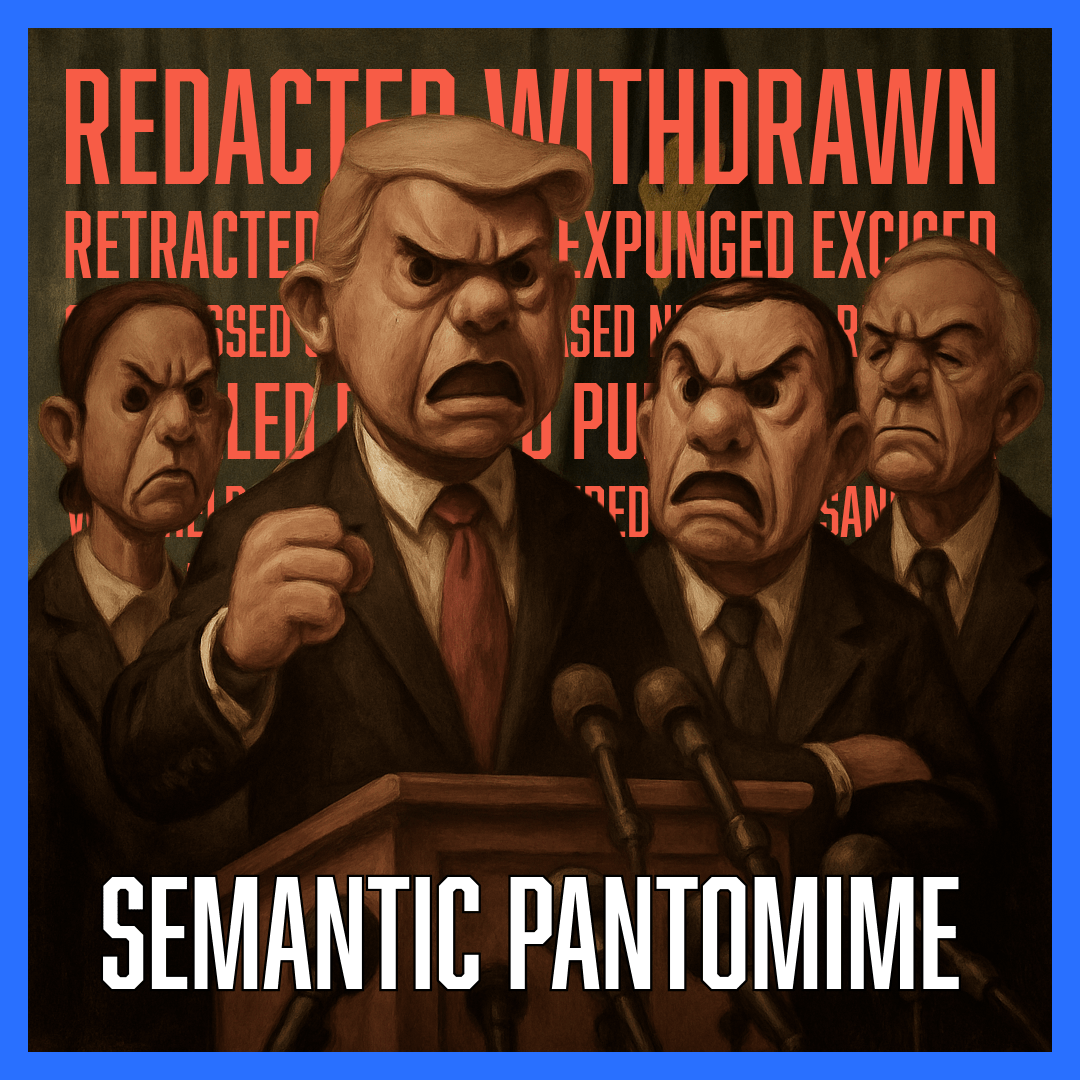
They are running a government as if language were a spellbook. Say the thing, and reality must comply; deny the thing, and it must vanish. It is a kindergarten pantomime of semantics—an infantile cosmology where words are treated as prior to the world rather than produced by (as emergent from) it. The corruption and the grift matter, but they sit on top of a deeper failure: a belief that assertion is ontology, that rhetoric outranks causality. Complexity does not bend to proclamation, yet a large portion of the political machinery acts as though it should.
When the world inevitably refuses to cooperate, that refusal becomes the perfect platform for self-validation. Non-compliance is reframed as hostility; pushback is recoded as vindication. The collapse of linguistic control is not recognised as a boundary but seized as license to escalate. What should function as a corrective signal instead becomes an engine of commitment—an epistemic ratchet that tightens precisely because it fails, converting every contradiction into renewed confidence and leaving its adherents ever more certain of a world they cannot actually see.


One reply on “Semantic Pantomime”
From tribal rivalries to integrated commercial infrastructure, political governance has pretty much always relied on crude linguistic shortcuts, but an apparent, plausible, drift into fascism emerges less from grand design than from a statistical convergence of insecure confusion, corporate opportunism, and poorly understood language use. The figures and the discourse are just foam on the surface—self-interest taking whatever shape the moment allows, but mostly the chaotic turbulence of a population trying to navigate realities far more complex than the words (and technologies) they’re using to describe them.
LikeLike