There is a specific psychological trap that closes once people believe intelligence has been defined. Not improved, not approximated, not extended—but captured. Once intelligence is perceived as a solved object, externalised and perfected elsewhere (in systems, institutions, or machines), the individual cognitive posture changes in a very particular way: curiosity collapses into compliance.
This is not about people becoming less capable. It is about motivation being restructured. When intelligence is framed as something that exists “over there,” already optimised and authoritative, the subjective cost of thinking rises. Why struggle, revise, hesitate, or remain uncertain when the answer is presumed to exist in completed form? What disappears is not reasoning, but epistemic tension—the felt obligation to stay open, provisional, and unfinished.
Psychologically, this resembles learned helplessness crossed with authority transfer. The individual no longer experiences thinking as an active, risky process, but as a retrieval problem: locate the sanctioned output, align with it, repeat it. Belief hardens because doubt is reclassified as inefficiency. Once that shift occurs, intelligence does not merely stagnate; it becomes aversive. Independent thought starts to feel like error.
This is why hype is so dangerous. It does not need to be accurate. It only needs to be convincing enough to persuade people that the hard part is over. The moment intelligence is believed to be solved, intelligence-as-practice dies. People do not notice themselves becoming more stupid because the internal signals that once marked cognitive effort—confusion, friction, uncertainty—are now interpreted as personal failure rather than necessary conditions of thought.
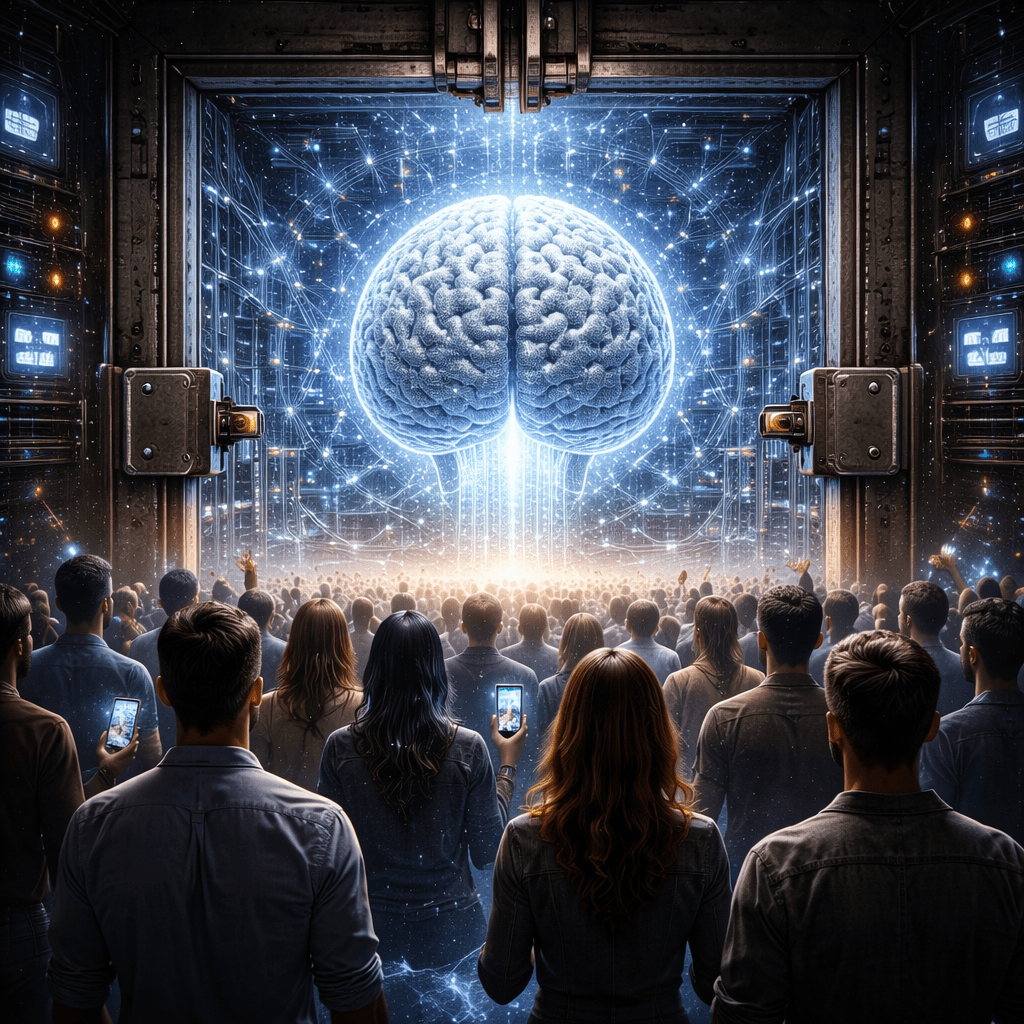
From that point on, the system does the thinking for them, and they experience that surrender as relief. That is the prison door. Not coercion. Not censorship. Finality. Once intelligence is treated as complete, humans are no longer participants in it. They become its audience.
And audiences, over time, do not get smarter.
Categories
Intelligence, Lost
 Daedelus Kite