Karl Weick’s Sensemaking in Organizations emerged from a dissatisfaction with how organisations were typically described: as decision machines, information processors, or rational planners. Weick’s work cut against that grain. Drawing on psychology, sociology, and organisational studies, he focused instead on how people inside organisations actually come to understand what they are doing, usually after they have already done it. The book was written in a period marked by increasing organisational complexity, technological acceleration, and managerial obsession with control. Weick’s intervention was quiet but destabilising. He insisted that meaning does not precede action in organisations. It follows it. Understanding is assembled retrospectively, under conditions of partial information, ambiguity, and delay.
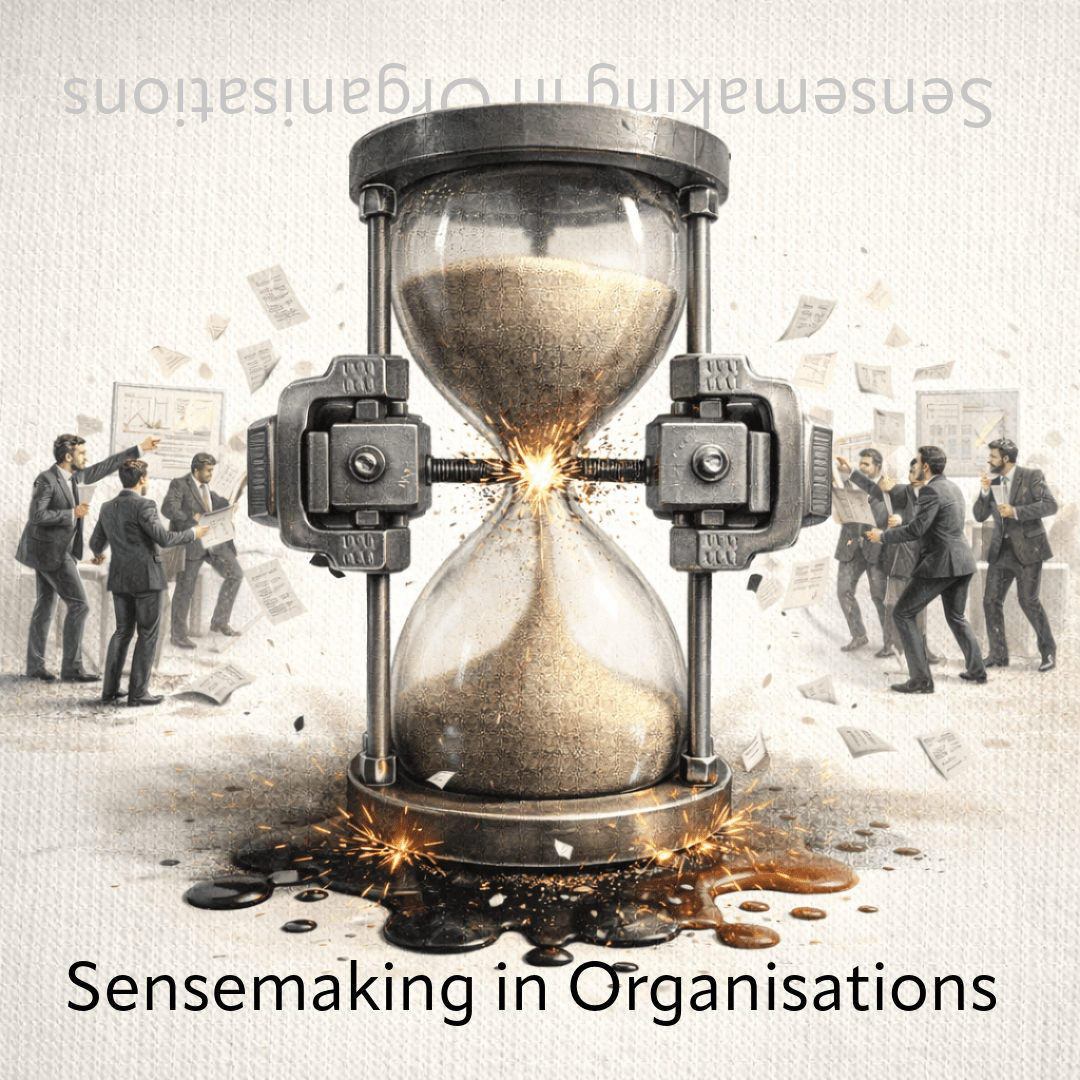
What Weick exposes, structurally, is that organisational coherence depends on temporal spacing. Action and interpretation must not coincide. People act, then look back, then stabilise a story that allows them to continue acting. This lag is not inefficiency. It is the mechanism by which organisations remain adaptive. When that spacing is preserved, errors can be noticed, reframed, and absorbed. When it is compressed, sensemaking collapses into automatic alignment. Action outruns understanding. Signals arrive already interpreted. The organisation gains speed but loses depth. What appears as decisiveness is often the elimination of the very delay that allows learning to occur.
The unresolved implication of Weick’s work is structural rather than moral. As organisations accelerate, automate, and seek tighter coupling between action and response, they systematically erode the conditions under which sensemaking is possible. The result is not chaos but brittleness. Coherence is maintained only so long as the environment remains predictable. When it does not, the organisation cannot adapt because it has lost the internal distance required to register surprise. Weick’s contribution endures because it identifies a general property of organised action: systems that collapse the gap between doing and understanding do not become more intelligent. They become fragile, and they fail precisely because they can no longer make sense of what they are doing.
Categories
Sensemaking in Organisations
 Daedelus Kite