Humanity is caught in a planetary feedback trap. Our technologies, institutions and political systems increasingly reproduce the psychological instability they intend to resolve.

Humanity is caught in a planetary feedback trap. Our technologies, institutions and political systems increasingly reproduce the psychological instability they intend to resolve.

Everyone knows a dickhead. The interesting question is why the conditions that generate them do so, enduringly, and with such uncanny frequency.

The result is a civilisation increasingly confronted by novel problems, yet repeatedly encouraged to admire the elegance with which it preserves the assumptions that produced them.

The defining challenge of this century is no longer building more powerful technologies. It is developing human and institutional capacities capable of understanding, governing, and surviving the systems we have already created.
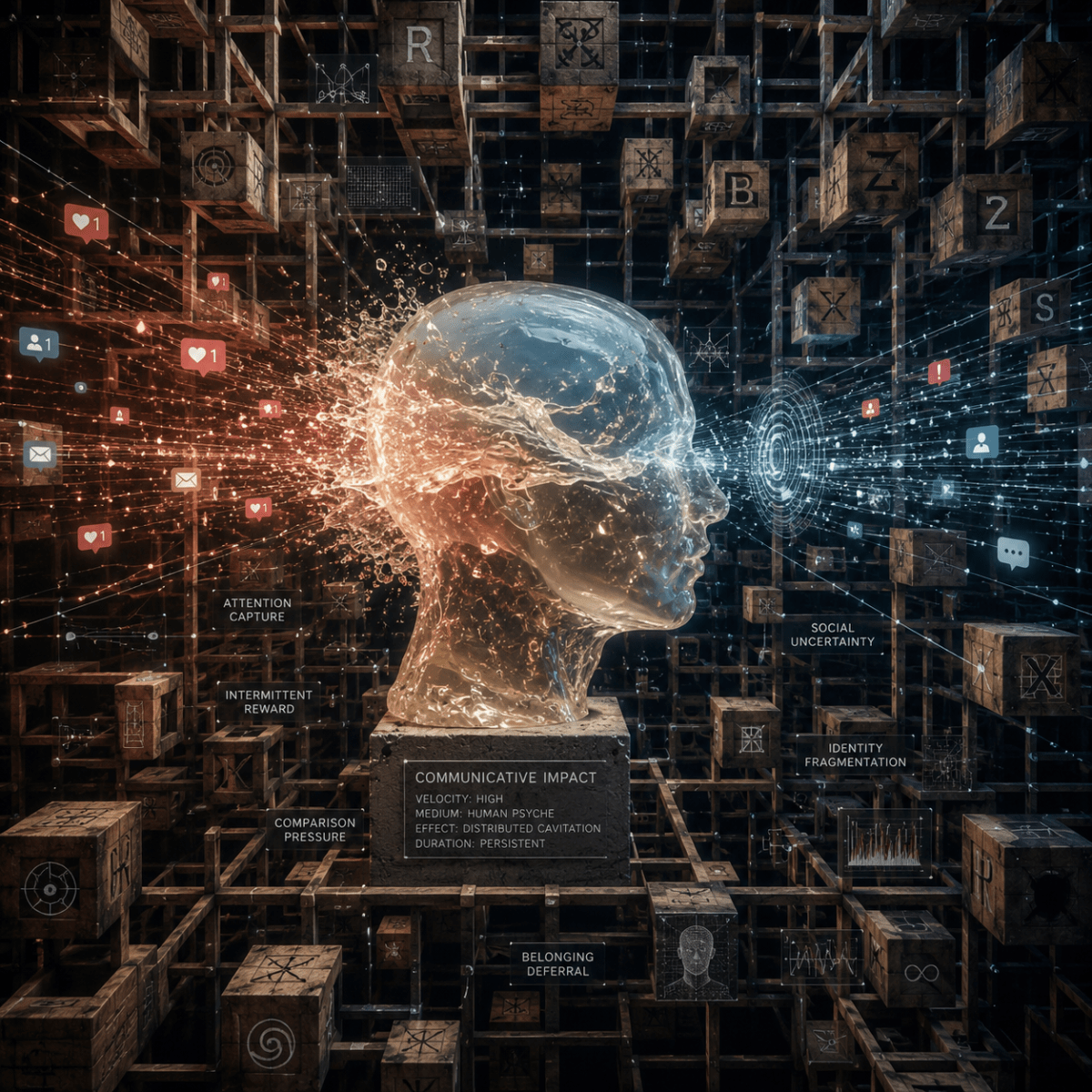
Social media platforms are usually described as communication technologies, but their deeper operational logic is closer to behavioural recurrence management. They do not optimise for resolution, understanding, repair, or psychological settlement. They optimise for continued return. That means the platform is not primarily designed to complete the user’s need, but to make the user come […]
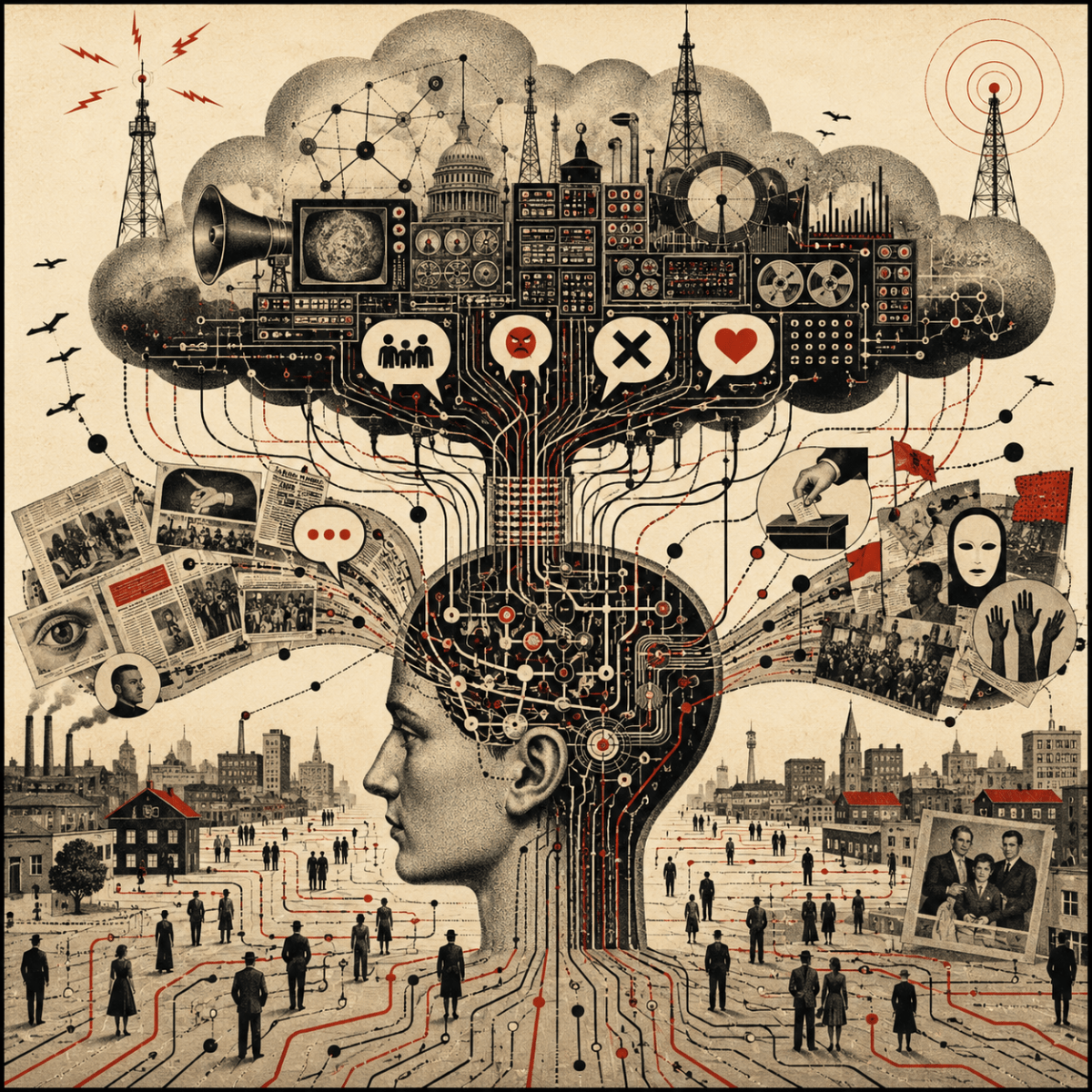
Cognitive bandwidth becomes cultural destiny because the carrying capacity of technologically mediated communication systems exceeds the carrying capacity of the biological minds living inside them.

What is striking here is not merely that the system produced a competent paragraph, nor even that it produced a coherent philosophical reflection from a compressed prompt. The more consequential event is that the generated artifact possesses properties usually associated with accumulated cultural and intellectual maturation: layered symbolism, emotional calibration, historical compression, aesthetic continuity, recursive […]

The strange thing about prolonged conflict is not merely that it destroys. It reorganises perception. After enough cycles of outrage, retaliation, spectacle, counter-spectacle, sanctions, declarations, precision strikes, televised rubble, algorithmic tribalism, and strategic ambiguity, entire populations begin navigating reality through symbolic compression rather than direct experience. The war ceases to be geographically localised and instead […]

Across much of the world, political communication has become increasingly volatile, distrustful, reactive, and emotionally saturated. This is usually interpreted as a moral or ideological failure within populations themselves, yet at least part of the phenomenon may instead arise from the underlying geometry of large-scale communication systems whose structures increasingly reward reproducibility, emotional intensity, and […]

Australia is now so thoroughly wired into digital systems that cyber insecurity has become an ordinary cost of institutional existence and everyday subjectivity, not an abnormal failure skulking out beyond the perimeter. The Australian Signals Directorate received more than 84,700 cybercrime reports in 2024–25, roughly one every six minutes; average self-reported losses rose to $33,000 […]

We have entered an era in which the second-order complexity of ubiquitous information and energy feedback systems has become the new centre of gravity. Not industry alone. Not territory alone. Not even ideology in the older twentieth-century sense. The decisive terrain is now the recursive infrastructure through which signals circulate, stabilise, amplify, and reorganise behaviour […]

Transnational corporate power does not merely strip-mine the material world. That would be amateur hour. It also strip-mines the symbolic order: trust, language, law, legitimacy, attention, aspiration, fear, guilt, hope, all the warm little mammals by which civilisation convinces itself it is not just a spreadsheet wearing perfume. The corporation no longer sells products in […]
Have a WordPress.com account? Log in now.

