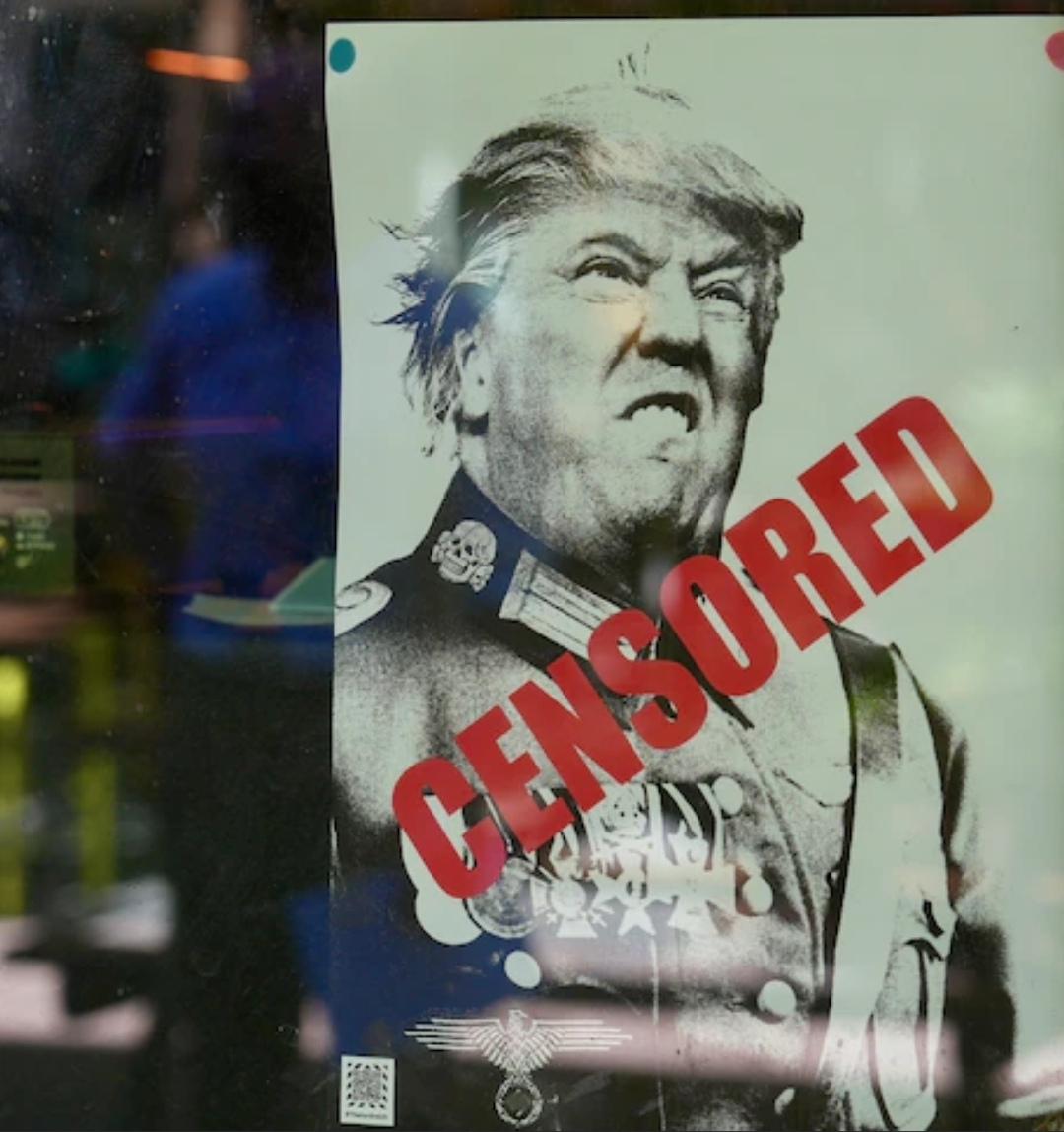
A basic rule of public communication is that attention is not a side effect; it is the medium itself. Attempts to suppress a message therefore carry a predictable risk: suppression becomes the story. In Canberra, police seized posters from the window of a local café and bar following a complaint and temporarily closed the venue while investigating a potential breach of recently enacted Commonwealth hate symbol laws. The posters were described as satirical protest imagery depicting public figures rendered in twentieth-century authoritarian military iconography. After several days of national coverage and online circulation, authorities determined that no charges would be laid and the posters would be returned. The outcome was amplification. A local display became a widely replicated signal, with enforcement action supplying the frame through which it was interpreted, redistributed, and repositioned within a contested communicative field.
The irony is structural rather than partisan. Enforcement regimes are justified as harm-reduction measures, intended to dampen volatility and constrain provocation, yet visible suppression often functions as a high-signal event that intensifies circulation. Once intervention is observable, it invites reinterpretation as evidence that something consequential is being managed or tested, irrespective of intent. Here, reversal did not undo the signal; it completed it. Seizure followed by return formed a closed narrative loop that foregrounded uncertainty at the boundary between hate symbol prohibition and political satire. Political controversy frequently operates this way: not as a process aimed at resolution, but as a metastable system in which disagreement persists because it performs work, and each attempt to end the dispute feeds the next cycle of attention.
Context:
Police will not charge Canberra bar owner after seizing posters under new Commonwealth hate laws
https://www.abc.net.au/news/2026-02-25/police-to-return-posters-after-hate-law-seizures/106387066
Canberra bar declared a crime scene as police seize ‘clearly satirical’ posters under new Commonwealth hate laws
https://www.abc.net.au/news/2026-02-19/canberra-bar-declared-crime-scene-displaying-posters/106361644
 Daedelus Kite
One reply on “Dissent: Amplifying Signals”
Dissent matters because it introduces difference into systems that would otherwise drift toward equilibrium, where coherence is mistaken for health and stability conceals decay. In organic systems, entropy is not simply loss but a persistent invocation of adaptive metamorphosis. Without internal gradients, nothing grows and nothing learns. Dissent functions as a mild disturbance and course correction that keeps the field open, interrupting blindly opaque as rigorously self-confirming repetition and keeping alternatives in play. It slows the freezing of meaning, resists the quiet naturalisation of power, and preserves a system’s capacity to remain alive rather than merely continuous.
Arguments for their own sakes are remedial but do tend to occur. That is what I disagree with. No one seems interested in root cause analysis. Dissent for its own sake is theatrical. Understanding the deeper logical source of all this disagreement, priceless.
LikeLike