From a historical vantage, societies under pressure compress the communicative field in search of clarity, translating complex realities into brittle narratives that promise order and direction, yet implicitly competitive systems rarely stabilise through such closure because control does not remove difference but redistributes it, converting unresolved variability into simplified signals that travel efficiently through institutions, media, and everyday language. These signals behave like low-energy attractors within a turbulent informational environment: cognitively inexpensive, organisationally convenient, emotionally legible. They quiet anxiety briefly while displacing structural tension elsewhere in the system, where it later reappears as distortion, fatigue, or renewed conflict. In this sense partisan polarity is less an accidental disagreement than a patterned asymmetry within the communicative field, a gradient across which signals accelerate and attention concentrates. The familiar swing toward right-wing or other extreme positions therefore often appears not as deliberate strategic design but as a socio-psychological reflex shaped within environments that reward contrast, circulating sharpened signals through social media and infotainment infrastructures until particular forms of grievance and certainty begin to appear ordinary, even inevitable.
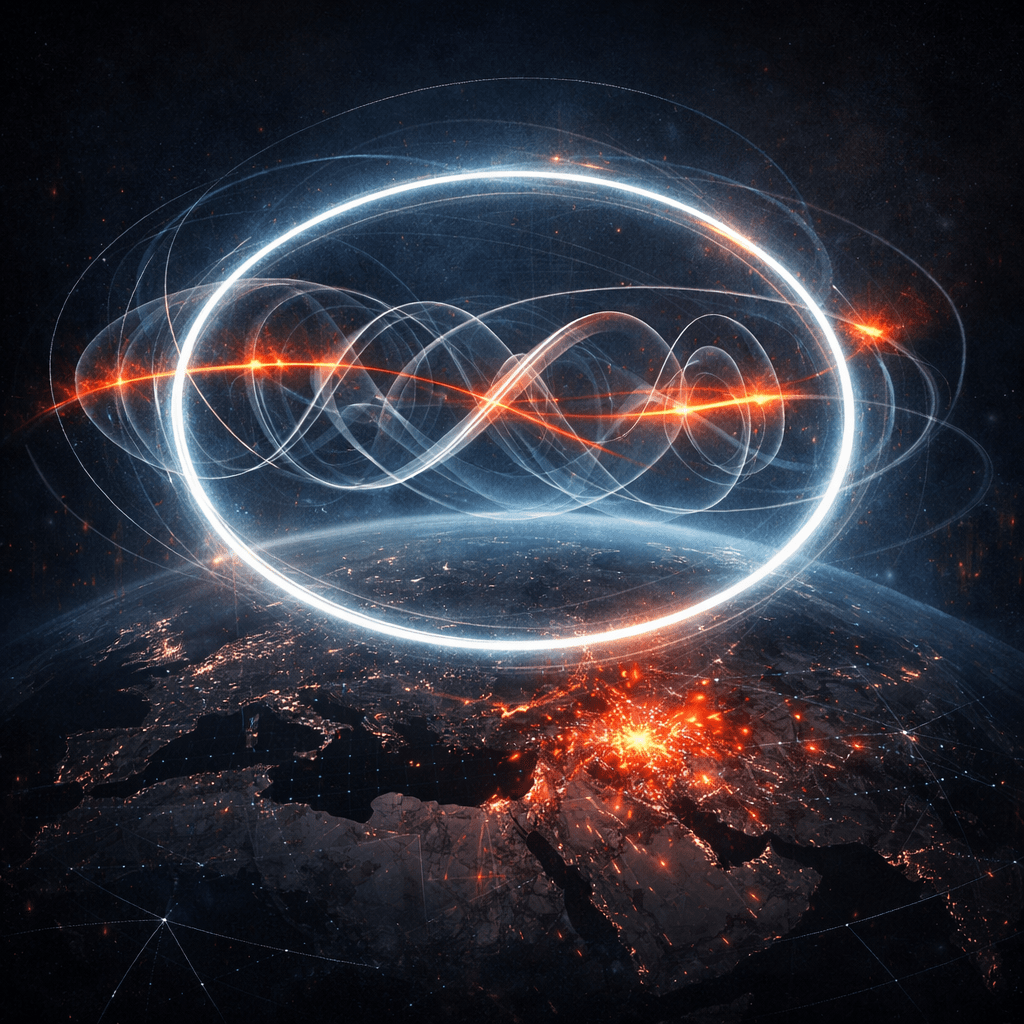
The deeper structure resembles a dynamical system organised not around equilibrium but around phase relations. Social cognition moves within a persistent lag between reality and its description, a delay comparable to interacting waves whose peaks never perfectly coincide yet gradually adjust their rhythm through mutual influence. What holds the system together is therefore not closure but orbit: distinctions arise around an undecidable centre, a generative unity that cannot be resolved yet continually produces differentiation. Language, institutions, and collective perception behave like coupled oscillators, achieving temporary coherence through partial synchronisation while their underlying phase differences remain.
Seen from this higher dimensional perspective the field itself is effectively non-orientable. No single narrative direction defines the system because meaning circulates through crossings, reversals, and reinterpretations that continually reconfigure the apparent surface of events. Technologically extended cognition now distributes this dynamic across planetary networks, transforming communication into a resonant medium where signals propagate, interfere, and reinforce one another at scale. Under these conditions political behaviour increasingly resembles turbulence within a coupled system rather than deliberate design: feedback compresses interpretation cycles, signals amplify signals, and asymmetries that begin as narrative contrasts can evolve into geopolitical friction, policy improvisation, and strategic theatre. Even powerful governments therefore appear less as sovereign architects of events than as participants moving within the circulating dynamics of the communicative field itself, where patterned asymmetry quietly performs a generative function, sustaining motion by preventing the system from ever fully arriving at the coherence it continually seeks.
Categories
Partisan Pattern and Generative Asymmetry
 Daedelus Kite
9 replies on “Partisan Pattern and Generative Asymmetry”
LikeLike
LikeLike
LikeLike
LikeLike
LikeLike
LikeLike
LikeLike
LikeLike
LikeLike