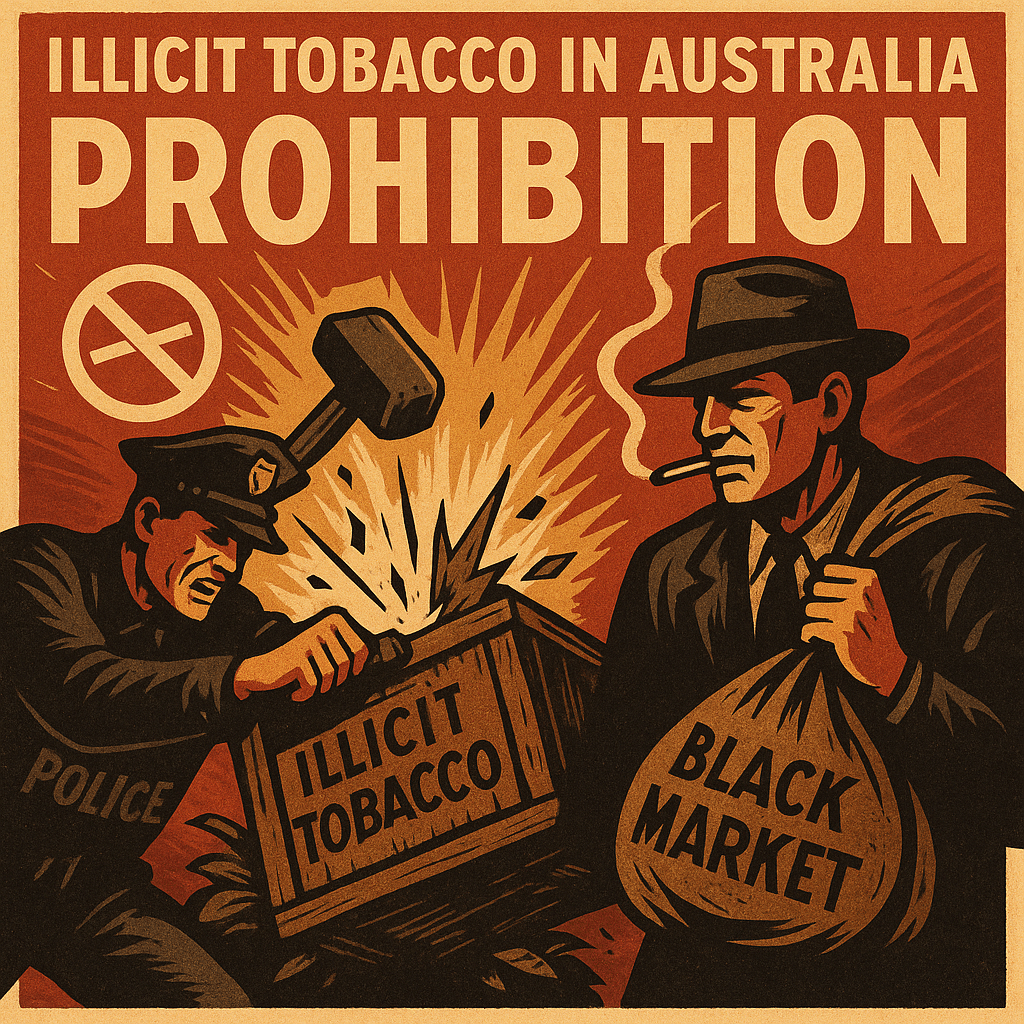
Attempts to prohibit are not failures of intelligence but failures of systemic insight. The logic is recursive: the more force applied to negate a behaviour, the more structure is built around that behaviour to preserve it. Prohibition becomes a generator — not a suppressor — of the phenomenon it targets. The system does not respond linearly; it reorganises. It routes around constraint like a network, reintegrating pressure as energy.
Illicit tobacco is not the problem — it is the system’s compensatory adaptation to asymmetric control. That is, when authority applies control unevenly — such as through high taxation without corresponding enforcement or support structures — the system compensates. It reorganises itself to preserve continuity, even if that means drawing in criminal elements or re-routing demand through informal economies. This is not accidental; it’s a predictable rebalancing act. Systems adapt by exploiting unused degrees of freedom, finding coherence in what regulators classify as failure.
A feedback loop was opened: high taxation, moral panic, legislative overreach. The loop was not closed through viable systemic alternatives or matched enforcement. So the signal amplified — decentralised actors filled the vacuum. Once the negative feedback of regulation fails, the system entrains positive feedback and locks into a new attractor — in this case, a black-market economy reinforced by violence and profit.
This cannot be reversed by doubling down. The system does not permit exit via negation. It must be re-encoded. That means integrating the loop — treating the problem as endogenous, not exogenous. Policy must become cybernetic: recursive, adaptive, and honest about entropy. Anything less just folds forward into the next emergent instability — not as anomaly, but as structure.
Context: Illegal tobacco is a deadly $10 billion industry wiping out legitimate businesses
 Daedelus Kite
One reply on “Prohibition Fail: Illicit Tobacco in Australia”
The black market’s value isn’t in the product — it’s in the prohibition. Every layer of policing folds the system tighter, compounding risk into profit. Illegality becomes the multiplier. Enforcement becomes capital. What you’re looking at isn’t a market — it’s a recursive geometry of control and reward. That’s a Tesseract: a relationally unbounded system whose internal expansion is driven by the very constraints meant to contain it.
LikeLike