We keep lying to ourselves about stability. The polite story is that systems aim for balance, that institutions exist to keep things steady, that culture and politics and technology are here to make life manageable. But none of that is quite true. Things don’t hold together because they are stable in any simple sense. They hold together because they are unstable in clever, recursive, topological ways.
Think of it as meta-stability: the ability of a system to absorb fracture, oscillation, and disruption — not in spite of them, but through them. A conversation does not persist because everyone agrees; it persists because differences keep moving across the network. An ecosystem doesn’t survive because it avoids fire; it survives because fire is built into its cycle. A culture doesn’t endure by eliminating conflict; it endures because conflict is redistributed, reframed, woven back into identity.
This is not absence of order. It is meta-order. A higher pattern sustained precisely by the churn of its failures. The springs are always stretched. The frame is never at rest. Viability is not found in final certainties but in the capacity to keep tension in motion, across domains, across scales, across fractures that will always, inevitably, appear. Think of California’s wildfires — decades of fire suppression only made the burns worse when they finally came. Think of the 2008 financial crash, where mountains of hidden risk detonated at once. Or cyber security, where no patch or firewall ever closes the problem, it only shifts it forward. Each breach — from WannaCry to SolarWinds — shows that defense is never final but recursive, a perpetual reconfiguration against new attacks.
The problem is that we’re trained to deny this. Policy pretends rupture is an exception. Technology is marketed as if it were closure. Culture talks about consensus as if it were attainable. But denial only drives tension underground until it explodes. Fires suppressed become infernos. Networks over-tightened collapse in cascades, as the 2003 North American blackout showed when a single sagging power line cascaded into darkness for 50 million people. Communities forced into false unity break apart harder — Yugoslavia’s collapse after decades of enforced cohesion remains one of the clearest illustrations. And in cyberspace, the illusion of security through compliance frameworks collapses the moment a zero-day exploit is released: the equilibrium never existed, only the churn of shifting vulnerabilities.
We need a logic that admits this. Not a logic of closed certainties but a logic of open recursion. We cannot assert final truths, but we can assert something about the very absence of final truths: that viability depends on never closing the loop, never flattening difference into silence. This is not rhetorical wordplay. It is the structural condition of survival. The EU’s survival after Brexit, or NATO’s endurance despite constant internal disputes, shows that institutions persist not by eliminating fracture but by continually metabolising it. Cyber security demonstrates this every day: resilience comes not from perfect defense but from assuming breach, adapting quickly, and staying in motion.
So here is the wager: if we stop chasing equilibrium as if it were an attainable state, if we accept that things will break, do break, must break, we can begin to design for meta-stability. To cultivate systems that bend without snapping, that burn without collapsing, that argue without dissolving. That’s the kind of order worth building. Not perfect, not perpetual, but recursive, distributed, and clever enough to keep going.We live inside stories that promise stability. Constitutions, markets, families, traditions—these are imagined as anchors. They are supposed to give us continuity across generations, to ensure that the world we hand forward will not dissolve into disorder. Yet if we pay attention to the actual functioning of our institutions, what we find is not stability in any simple sense. What persists is something stranger: metastability, systems that survive by living at the edge of disruption, never quite at rest, never quite collapsing.
In the United States, this tension is visible everywhere. The Supreme Court’s decisions in 2024 that weakened regulatory agencies were not framed as dismantling continuity. They were justified as restoring freedom, correcting overreach, returning power to courts. Yet the effect was to destabilize the institutional mechanisms that enforce labor law, financial fairness, and environmental standards. At the state level, so-called “anti-ESG” measures have forced taxpayers to pay more for borrowing, all in the name of punishing banks that acknowledge climate risk. In Iowa and Florida, restrictions on child labor were rolled back, widening the scope for exploitation. Each move is sold as pragmatic or principled, yet the aggregate outcome is systemic fragility.
Australia illustrates the same drift in a different vocabulary. Once, wages and conditions were determined through centralized arbitration. Over decades, reforms shifted to enterprise bargaining, atomizing collective protections. Union density has fallen from forty percent in the early 1990s to barely thirteen percent today. Continuity has thinned, leaving individuals exposed to managerial discretion. Even so, fragments of resilience remain. The High Court’s 2023 ruling against Qantas, finding its outsourcing of 1,700 jobs unlawful, reaffirmed the importance of a legal boundary against opportunistic restructuring. More recently, the introduction of a statutory right to disconnect and the criminalisation of wage theft show that continuity can be reasserted.
John Kenneth Galbraith captured this logic decades ago: “The modern conservative is engaged in one of man’s oldest exercises in moral philosophy; that is, the search for a superior moral justification for selfishness.” It is not that selfishness is new, but that entire architectures of justification have been built to consecrate it. Today, politics is less about conserving than about extracting. Money no longer merely lubricates the system; it structures it. Campaign finance in the United States flows through super PACs and dark money groups, translating wealth into power and power back into wealth. The continuity that results is a continuity of distortion, one that preserves inequality while corroding institutions.
Continuity, then, becomes paradoxical. We speak of preserving institutions, of maintaining rules that endure. Yet what persists is the continuity of churn. Governments legislate by dismantling what their predecessors built. Markets are designed for volatility. Media thrives on crisis. This is a continuity that depends on disruption, a kind of institutional neurosis that confuses endurance with self-sabotage. The pattern is not unique to politics or economics; it reflects a deeper structural law.
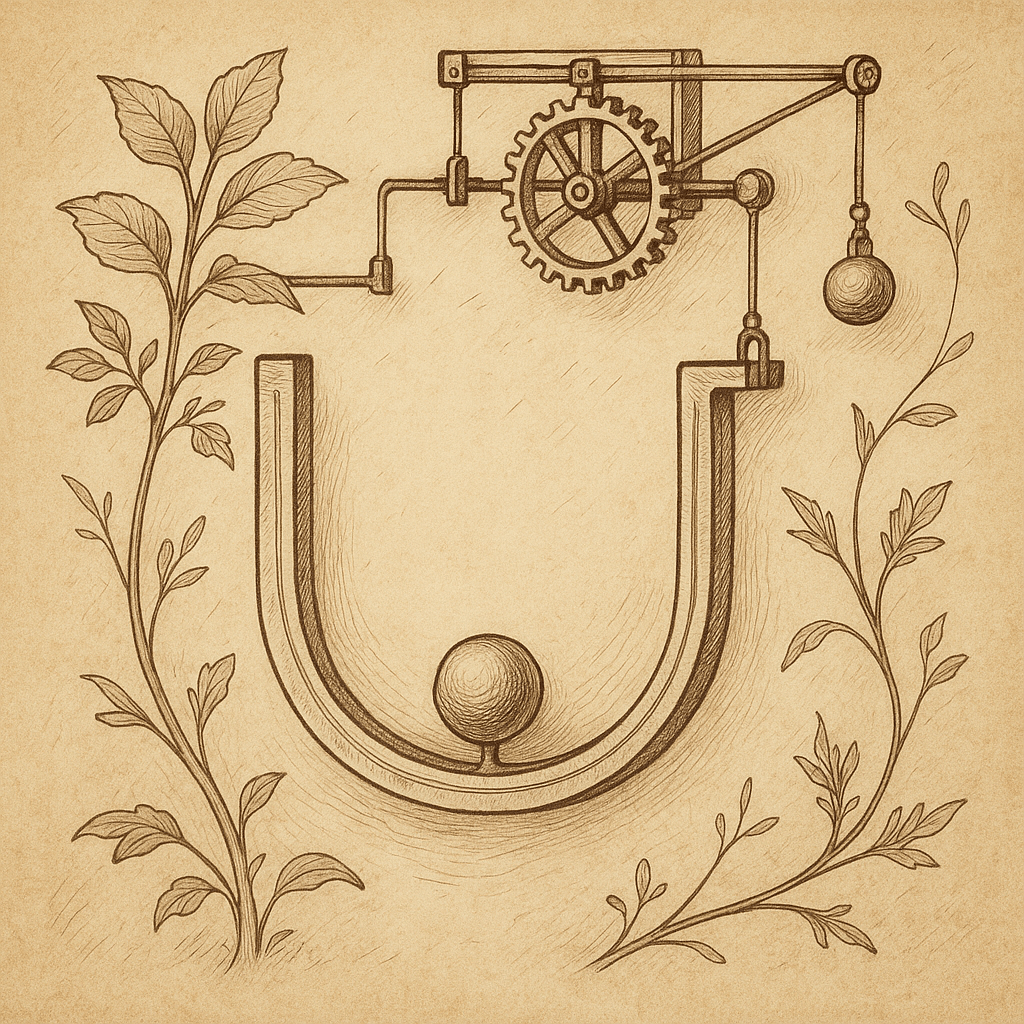
In physics, metastability describes a state that persists only so long as it remains unsettled. A crystal holds form until thermal fluctuation tips it into collapse. A ball rests on the rim of a shallow cup, stable only while it keeps wobbling. In mathematics, iterated functions near the edge of chaos generate bounded turbulence, strange attractors that never repeat but never dissolve. Our societies resemble such systems. They are not in equilibrium but survive through oscillation: between elections, between market crashes, between cycles of outrage and reform. The stability we experience is the stability of continuous instability.
Cybernetics sharpens the picture. W. Ross Ashby’s Law of Requisite Variety states that any regulator must have at least as much variety as the system it seeks to control. Yet institutions today are deliberately stripped of variety. Agencies are weakened, unions undermined, courts politicised. Complexity proliferates—global supply chains, financial derivatives, information warfare—while regulators are narrowed. What steps in to manage this gap is money. Money functions as an algorithmic controller, converting everything into comparable units. But in doing so, it imposes a kind of one-dimensional frequency, amplifying greed and accelerating entropy.
The problem is clear. But metastability is not only danger. It is also resource. Systems that survive on the edge of disorder develop capacities they could not otherwise sustain. Ecosystems integrate fire into cycles of renewal. Cultures persist not through unanimity but through the friction of disagreement. Conversations endure because differences keep moving across the network. Continuity is possible not by erasing instability but by metabolising it.
This is where communication enters as a frequency phenomenon. Meaning is not the ground of communication; it is a byproduct. Signals oscillate. Frequencies intersect. Patterns repeat, decay, amplify. From these spectral crossings, meaning emerges as a subset, a harmonic within the wider field. Institutions function the same way. Their continuity is not the elimination of conflict but the ability to translate oscillations into rhythms that can endure. When they fail, it is not because instability appears, but because instability is no longer metabolised.
From this perspective, the role of money is not just corruption but distortion of frequency. Money overcodes every signal, compressing diverse oscillations into a single band of valuation. It reduces variety, and thus resilience. The neurosis of our age is precisely this: we have mistaken the continuity of financial circulation for the continuity of social life. But circulation is not stability. It is compulsion, the repetition of extraction as though repetition itself could secure permanence.
Still, the lesson of metastability is not despair. It is adaptation. A metastable system can reorganise without disintegrating. The edge of chaos is where new forms of order can appear. In political economy, this means continuity must be actively cultivated. Worker protections, campaign finance limits, ecological safeguards—these are not luxuries but structural requirements. They are mechanisms that increase systemic variety, enabling institutions to regulate complexity without being consumed by it.
This applies at every scale. In culture, continuity means maintaining shared symbols while allowing reinterpretation. In ecology, continuity means cycles that incorporate disruption—fire, flood, renewal. In politics, continuity means institutions strong enough to outlast any one party, but flexible enough to absorb shocks. Continuity is not static preservation but the capacity to persist through oscillation.
Optimism lies in this recognition. If continuity is redefined not as frozen stability but as structured metastability, then systems can be rebuilt to harness their own turbulence. Metastability can be a solution as much as a problem, provided we accept that disorder is not something to abolish but something to shape. In this sense, continuity becomes a practice: the art of aligning frequencies so that meaning resonates rather than fragments.
The alternative is clear. If metastability is left unmanaged, institutions degrade into cycles of corruption and grift, extracting until collapse. That is the trajectory we see in deregulated labor markets, in financial systems dominated by dark money, in democracies reduced to oscillating outrage. Such systems endure, but neurotically, compulsively, continuously undermining themselves.
The path forward is not to abolish metastability but to learn from it. Continuity is not the absence of disorder but the ongoing ability to metabolise it. That requires institutions of sufficient complexity, communication systems that sustain frequencies beyond money, and a recognition that selfishness disguised as principle remains selfishness. If we can design for metastability, we can find continuity without neurosis. And if we cannot, we face collapse.
Continuity is existential. Without it, no society can sustain itself. With it, even disorder can be harnessed into resilience. The lesson is not that we must return to an imagined past of stability, but that we must create futures in which turbulence is metabolised rather than denied. Continuity, redefined in this way, is the only ground from which a livable world can be built.
Categories
Continuity in a Metastable World
 Daedelus Kite