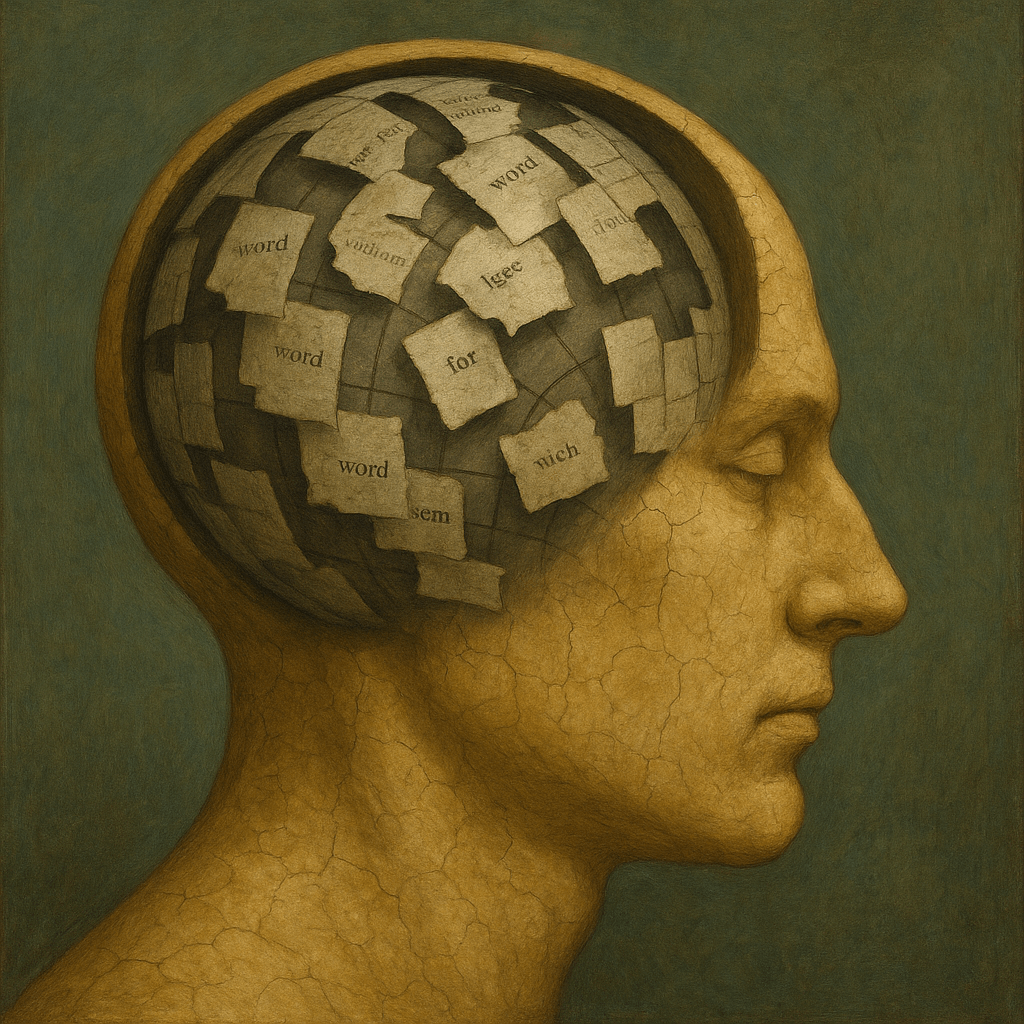
History has tended to imagine meaning as a property intrinsic to utterance, as though the resonance of Homer’s epic, a political slogan, or a fragment of scripture was carried forward by some eternal flame of truth. Yet the record suggests otherwise: what endures is what circulates, and circulation itself confers the aura of importance. The chants of crowds, the refrains of propaganda, even the fragments of poetry that survive by citation — these demonstrate that replication, not essence, builds the weight of meaning. It is the echo that carves the stone, and repetition alone that gives the impression of permanence.
We are inclined to assume that our descriptions contain the world, that to say a thing is to make it so, as if language held a kind of conjuring power. This is the magical intuition behind both ordinary speech and the structures of law, politics, science, and technology that grow from it. But the truth runs in the other direction: it is the world that contains our descriptions, admitting some and excluding others according to conditions we neither design nor control. What survives is not secured by correspondence to reality but by fit with the channels of replication — the networks of cognition, institutions, and machines that amplify some phrases while discarding others. Meaning emerges here as the trace of recurrence, not as essence; significance is granted not by what we say about the world, but by what the world will allow to echo through it.
 Daedelus Kite
One reply on “Impermanent Meaning”
Meaning, seen this way, isn’t a stable unit you can pin down in a text or force into effect by intention. It is a statistical artefact, a byproduct of entropy and efficiency in propagation. What spreads is what survives, regardless of semantic depth or authorial design. That’s why misinformation and conspiracy theories persist — not because they are truer, but because they replicate more easily within the existing channels of communication.
Addressing this cannot be done at the semantic level. It must be done at the level of structural logic — the topology of fields, the dynamics of coupling, the architecture of circulation. Once you shift from treating meaning as the basic unit to recognising it as emergent from replication, the system is indifferent to content; what matters is the geometry of recurrence. The practical application lies in modulating diffusion itself — shaping the channels, timings, and couplings so that destructive synchronies dissipate, and more resilient patterns of propagation are allowed to take hold.
LikeLike