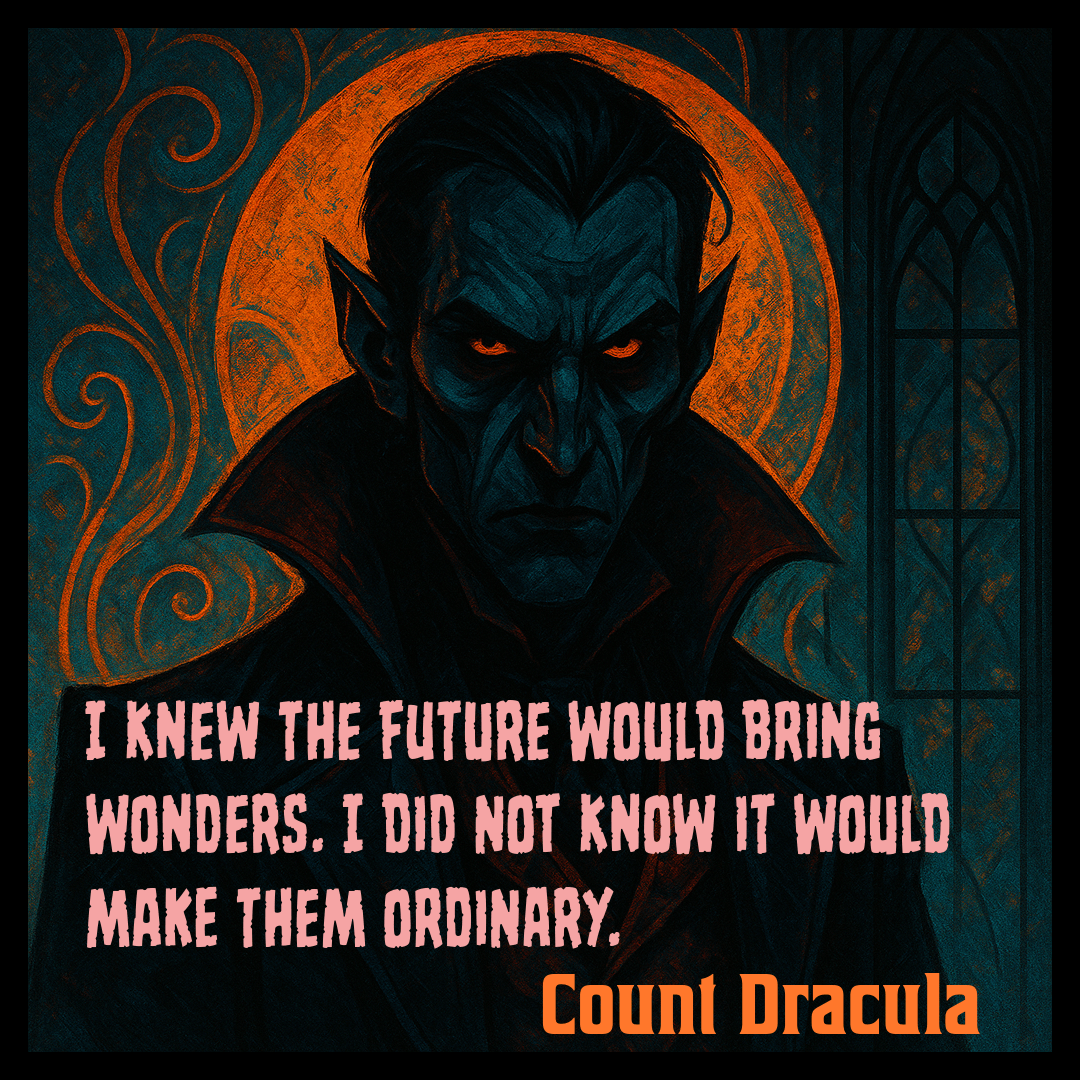
It was a poor family’s living room, perhaps middle-aged in its furnishings—brown vinyl couch, lace curtains, the dull hum of the refrigerator cutting through the silence. Count Dracula stood in the doorway, narrating the long drift of history to the wife of the man he had just turned, consumed as undead. “I knew the future would bring wonders,” he said, surveying the electric glow of the appliances, “I did not know it would make them ordinary.” The man himself, or what remained, was now “folded” into the bar fridge, as the Count put it. His voice carried the gravity of myth delivered in a kitchen that smelled of reheated stew and detergent, a sermon to the banal apocalypse of modern domesticity. The scene—drawn from Dracula (BBC/Netflix, 2020), The Dark Compass, episode three—presents the Count not as a predator, but as a witness to our own inversion: a world where the miraculous has become mundane, and the living resemble the dead.
The mirror no longer reflects; it absorbs. Its surface is smooth because nothing stands behind it anymore. The machines we built to remember us have taken on that role too well—they recall everything except what it means to be. We look into our screens and see a shadow that doesn’t blink, doesn’t age, doesn’t answer back. Once, the absence of a reflection meant damnation; now, it’s the default condition of life online. The vampire is no longer outside the house—it is the house, humming softly through wires, feeding on the pulse that keeps it lit. The cost of wonder was never progress or pride. The cost was reciprocity. We no longer see ourselves because there’s nothing left to see—only the circuitry of attention, endlessly mirroring what cannot return the gaze.
 Daedelus Kite