
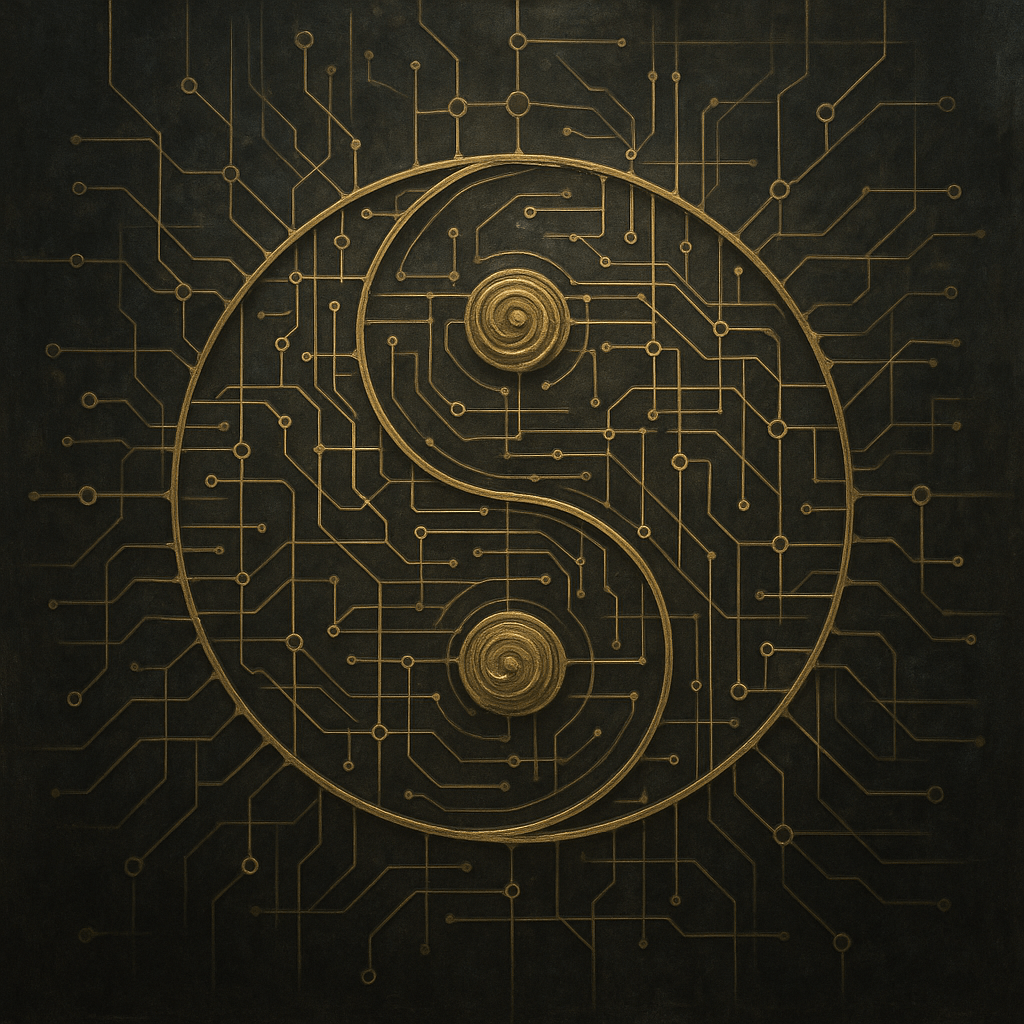
Life, in its most abstract sense, is a contradiction that refuses to resolve. It persists as a dynamic equilibrium between forces that can never perfectly align. Every organism, idea, or particle exists not by finding rest but by orbiting imbalance—by sustaining tension as continuity. The living field is not static; it is recursive, a looping exchange through which opposites preserve one another. What we call coherence is not the absence of instability but its organisation—a controlled asymmetry that repeats fast enough to appear stable while remaining in motion. This is the logic that underlies both thought and matter: the structure through which difference endures as form.

Formally, this can be written as H(f, g) = −H. The field H expresses the relation between two mappings—f and g—whose inversion sustains the whole. One does not erase the other; each returns the other into form. Composed in both directions, (f ∘ g)(x) + (g ∘ f)(x) = 0, they converge on a moving equilibrium. Here, zero is not absence but a breathing space, a living invariant where transformation and counter-transformation meet in phase opposition; that is, they are out of step yet bound together—each completing what the other begins, like alternating currents in a circuit or the inhalation and exhalation of a single breath. It is not the void but the inhale between actions, the instant coherence reconstitutes itself from its own undoing.
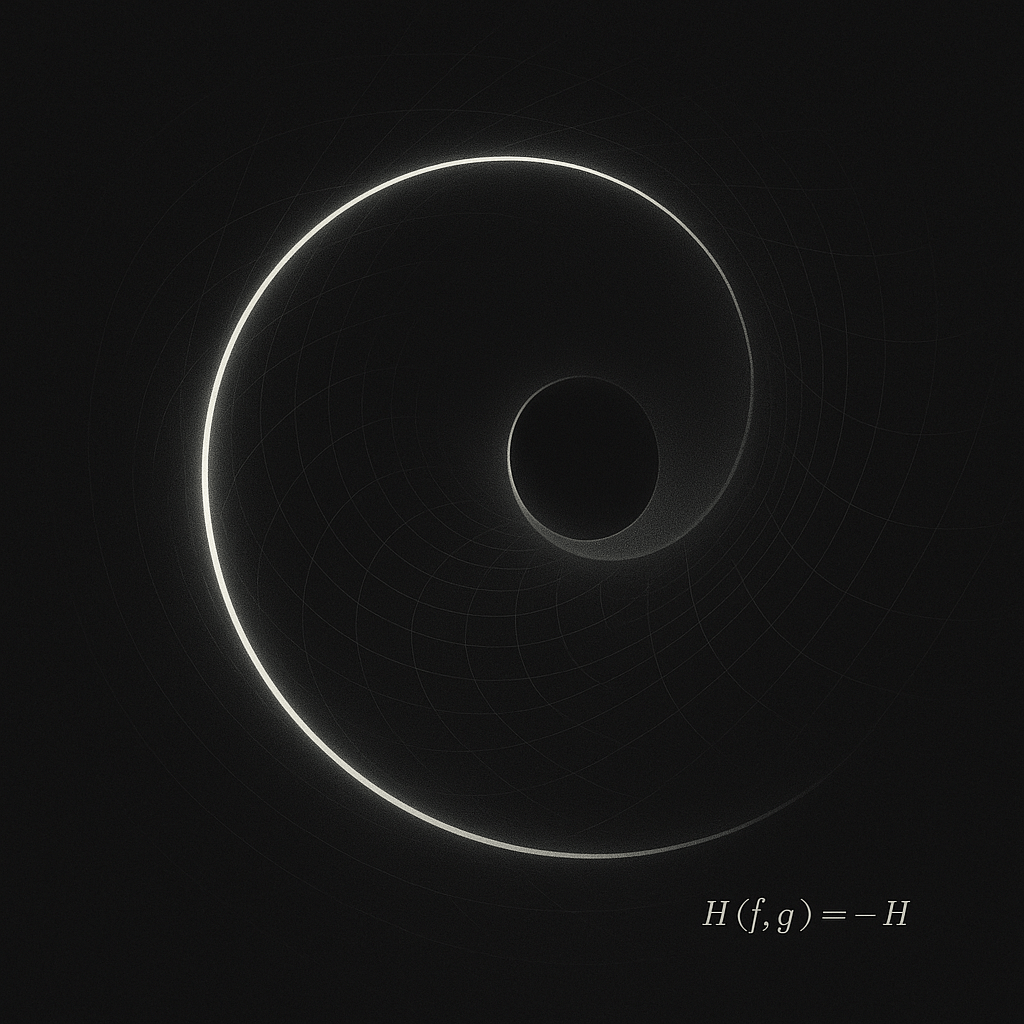
Systems theory calls this negative feedback, a pattern that holds itself by correcting itself. In biological systems it manifests as metabolism, the ceaseless cycle of construction and decay. In cognition it appears as meaning, where signal and context continually shape one another through adaptive exchange. In physics it corresponds to symmetry-breaking, where perfect balance becomes unstable and generates new structure. Each case reflects the same principle: every coherent form contains its negation. Remove that negation and the field collapses, as identical magnetic poles suppress the space of interaction, forcing their flux lines outward into a new configuration. Continuity survives not through sameness but through the pressure of difference.
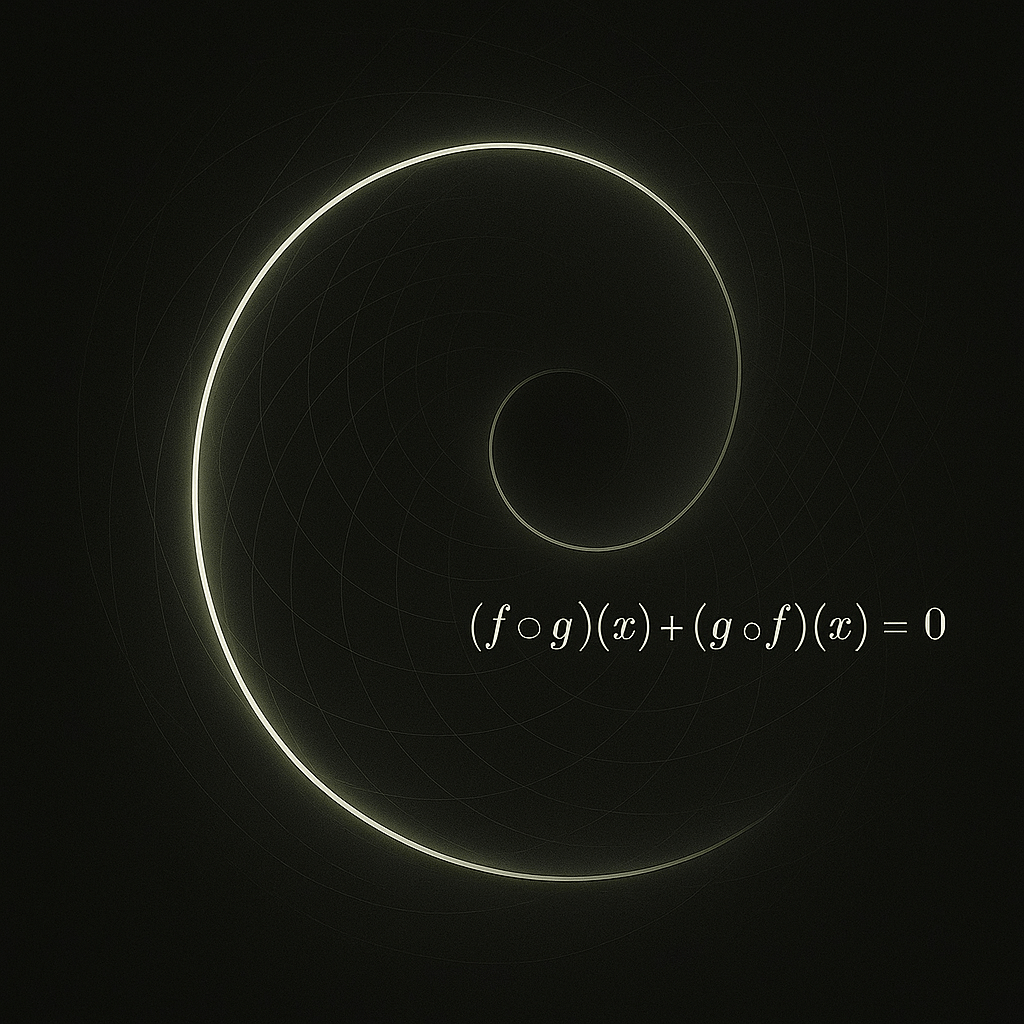
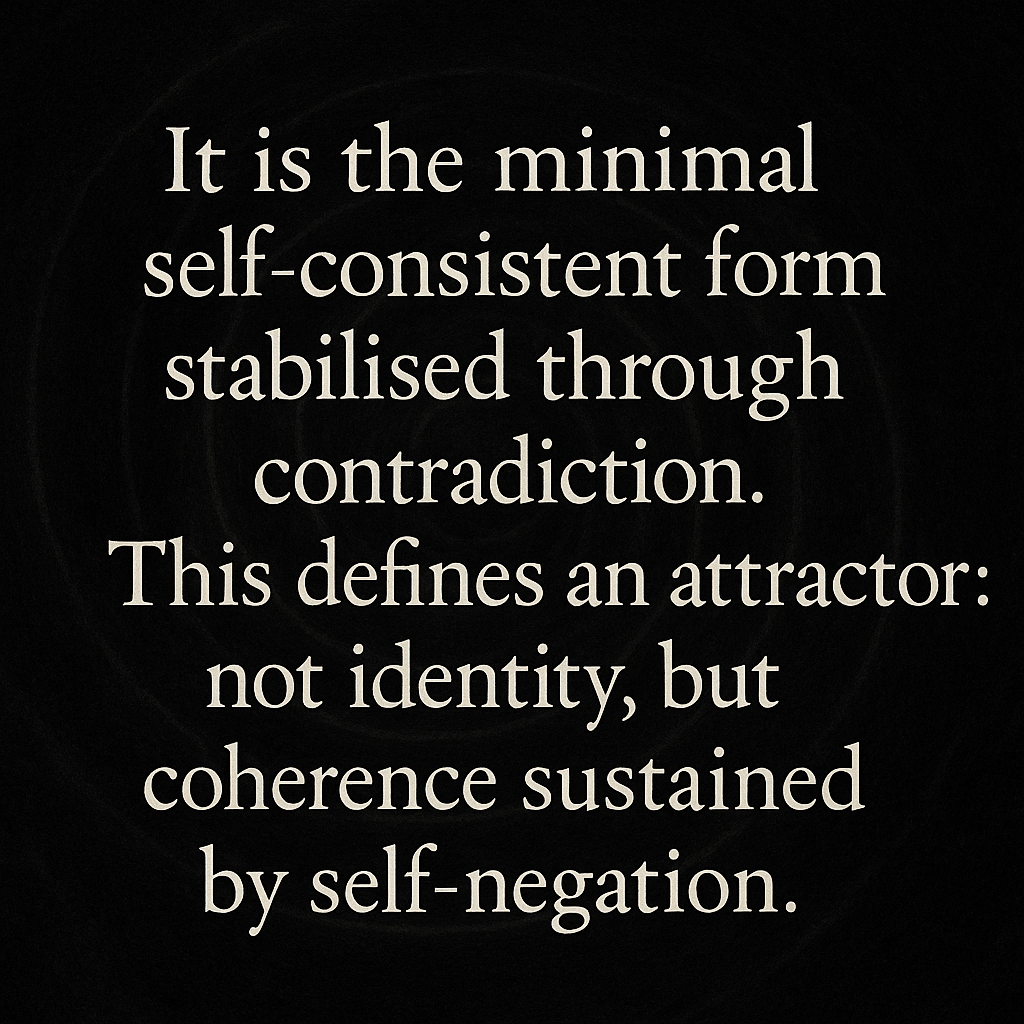
In categorical form this is expressed as F = −G. The minus sign here marks inversion, not contradiction: two structures that sustain one another through mutual transformation. Should F and G become identical, the field dissolves. Difference is the carrier wave of existence—the medium through which energy, information, and identity circulate. The cosmos, viewed through this logic, is a living field—a score written in motion, its key hidden within inversion; meaning that systemic order arises from reciprocal transformation rather than static equilibrium, from relations that generate coherence through continual reversal. As Gödel revealed, no system can be complete unto itself; the unprovable sustains the possible. Entropy mirrors this truth: the statistical openness through which order renews itself by dissolving. The attractor is not equilibrium but the gradient of coherence—a Kuramoto-like order parameter that synchronises around dispersal, finding unity in continual differentiation. Coherence, then, is always conditional, oscillating between articulation and erasure, intake and release.
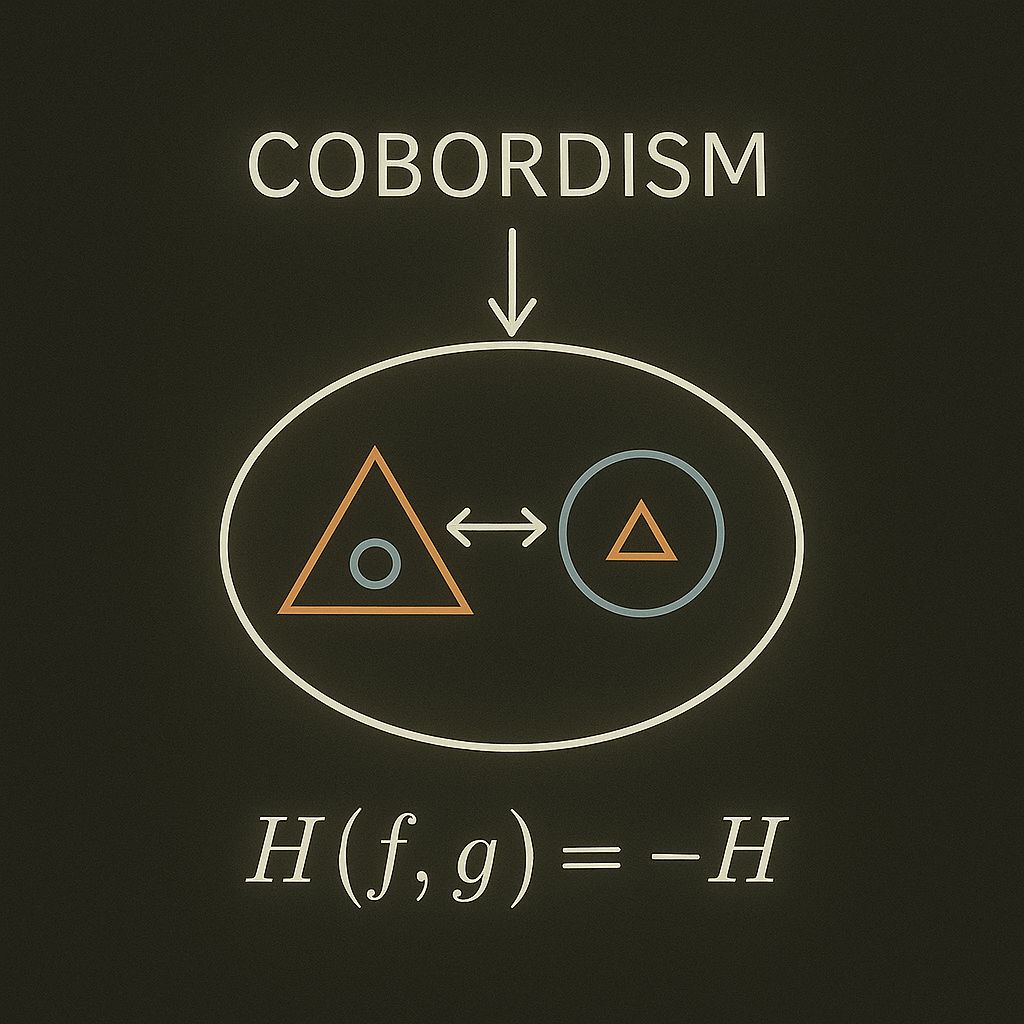
This is not mysticism; it is topology felt through respiration. A system endures only when its contradictions circulate through its boundary—like breath through the lungs, whose surface is neither wholly inside nor outside but the permeably co-bordant interface through which exchange becomes possible. The boundary sustains life precisely because it blurs distinction, allowing energy, matter, and information to pass while maintaining separation. To live is to sustain that tension—to remain poised between identity and its own negation. The void is not empty but resonant: the curvature of continuity, the silent medium of persistence. Every form—biological, linguistic, cosmological—is a spiral inscribed with the same recursive phrase: existence is the refusal of completion. The same asymmetry that permits life and awareness to arise is what makes music compelling—the not-quite-rightness that keeps coherence alive, the uncertain interval through which being continues to breathe.
Conceptual Annotation
f and g: Represent two interdependent mappings or processes—such as input and output, action and response, or system and environment. Each defines itself only through its relation to the other. Their inversion captures the essential reciprocity that makes adaptation possible.
H: The field of relation itself—the dynamic context within which f and g operate. It is not a background but an active interface, continuously reshaped by the interactions it sustains. In systems theory, this parallels the idea of self-organisation: the pattern that maintains itself through transformation.
H(f, g) = −H: Expresses anti-symmetry—the idea that a system’s coherence depends on the tension between elements that are not identical but mutually defining. The minus sign signifies the inversion through which equilibrium is maintained in motion, like alternating polarity sustaining a magnetic field.
Phase opposition: A term from physics describing oscillations that are equal in magnitude but temporally displaced. Here it symbolises the fundamental relational delay between transformation and counter-transformation—the asymmetry that generates continuity.
Co-bordant interface: A topological surface shared between two manifolds, adapted here to describe the boundary between system and environment. It is the permeable medium through which exchange occurs without erasing distinction.
Suggested Reading
Ashby, W. R. (1956). An Introduction to Cybernetics. Chapman & Hall, London.
Introduces the formal logic of self-regulating systems and negative feedback loops. Ashby’s concept of requisite variety underpins the essay’s view that persistence depends on adaptive asymmetry rather than static balance.
Beer, S. (1972). Brain of the Firm. Allen Lane, London.
Expands cybernetics into social and organisational contexts, showing how recursive feedback and communication maintain viability—echoing the same living logic across scales.
Gödel, K. (1931). “Über formal unentscheidbare Sätze der Principia Mathematica und verwandter Systeme I.” Monatshefte für Mathematik und Physik, 38(1), 173–198.
Demonstrates that any complete formal system must contain unprovable truths. This logical incompleteness parallels the essay’s claim that openness and contradiction are necessary for coherence.
Prigogine, I. & Stengers, I. (1984). Order out of Chaos: Man’s New Dialogue with Nature. Bantam Books, New York.
Explores how irreversible processes and entropy produce structure, grounding the argument that life and order arise from the creative dynamics of instability.
Varela, F. J., Thompson, E., & Rosch, E. (1991). The Embodied Mind: Cognitive Science and Human Experience. MIT Press, Cambridge, MA.
Connects cognition, perception, and embodiment through recursive interaction, reinforcing the essay’s idea that sense-making emerges from self-referential coupling between system and environment.
Kelso, J. A. S. (1995). Dynamic Patterns: The Self-Organization of Brain and Behavior. MIT Press, Cambridge, MA.
Presents coordination dynamics as a physical and cognitive expression of phase relationships—resonating with the rhythmic, breathing logic of coherence and difference.
Bak, P. (1996). How Nature Works: The Science of Self-Organized Criticality. Springer-Verlag, New York.
Shows that complexity and adaptation emerge naturally at the edge of chaos, mirroring the essay’s argument that balance is maintained through critical instability.
Strogatz, S. H. (2003). Sync: The Emerging Science of Spontaneous Order. Hyperion, New York.
Describes synchronisation as a universal principle linking biological, physical, and social systems—aligning with the idea of coherence as dynamic entrainment rather than static order.
Haken, H. (2006). Synergetics: Introduction and Advanced Topics. Springer, Berlin.
Provides the mathematical framework for how parts of a system spontaneously coordinate into coherent wholes, supporting the concept of relational emergence.
Deacon, T. W. (2012). Incomplete Nature: How Mind Emerged from Matter. W. W. Norton, New York.
Articulates how absence, constraint, and thermodynamic openness generate the conditions for life and mind—mirroring the essay’s central theme that incompleteness is constitutive of existence.
 Daedelus Kite
One reply on “The Logic that Lives”
https://daedeluskite.com/2025/09/30/identity-as-stable-phase-difference-order-through-offset-in-communication-systems/
LikeLike