We mistake the brain for the seat of intelligence and the individual for its owner. Both depend upon a much larger system.
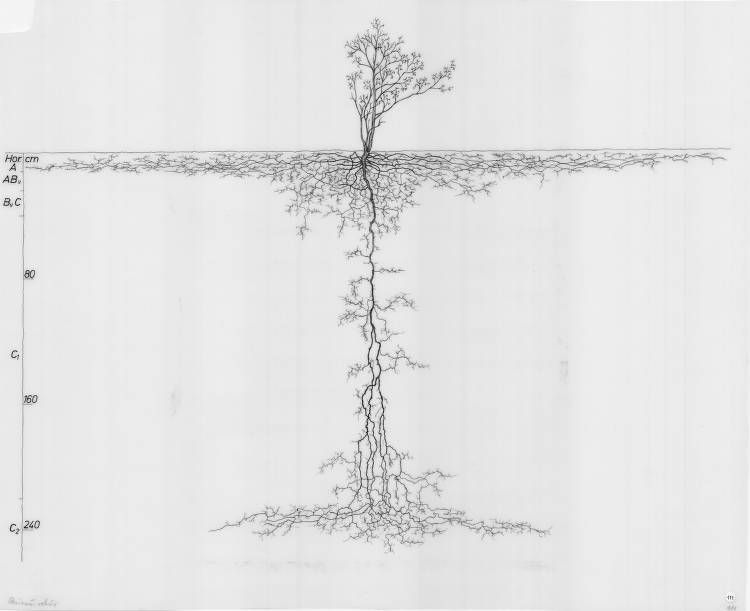
We mistake the brain for the seat of intelligence and the individual for its owner. Both depend upon a much larger system.

Life is organised difference sustained through recursive probabilistic and spectral dynamics.
Music, poetry, language and artistic performance share an underlying harmonic structure. Rhythm, repetition and constructive difference give rise to meaning (and value), while every new expression changes what can follow. Every performance carries its past into a future it helps create, but can never fully predict.
Belief is harmonic structure: the recurrent pattern of timing, relation and probability through which language, meaning and experience take form.
Ideology is what happens when a way of seeing the world becomes part of the world itself, shaping not only what we believe, but what becomes easier to believe next.
A is A. The interesting question is how it keeps getting away with it.
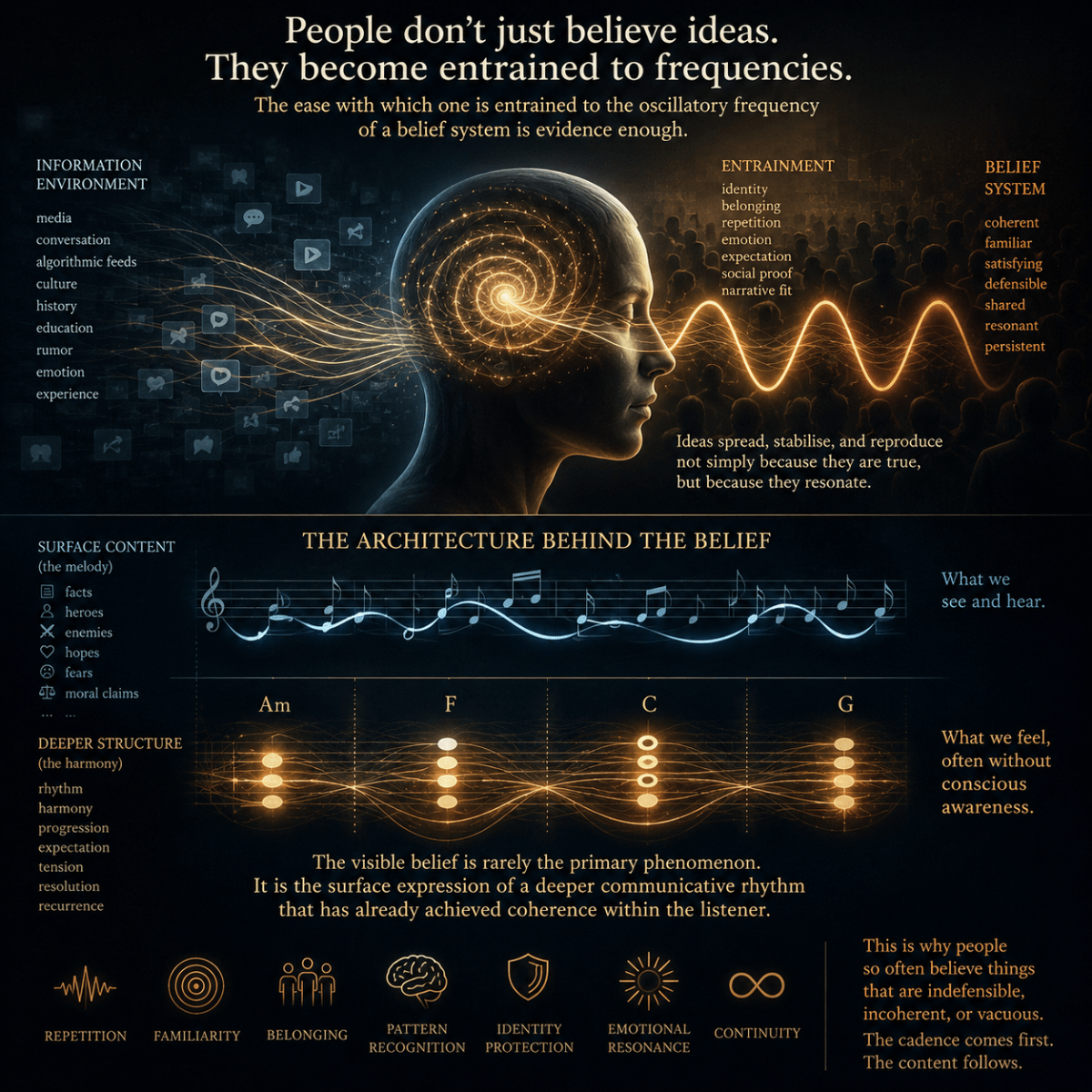
Beliefs persist less because they are true than because they provide the transient continuity of narrative as semantic coherence.
Civilisations rise, lose their footing, and reorganise themselves with uncanny regularity, yet somehow the whole contraption keeps going. Not because anyone has finally solved the world, but because the system keeps producing signals about where it has slipped, and minds, cultures, and institutions spend their lives trying to read them. Every mind begins by leaving […]
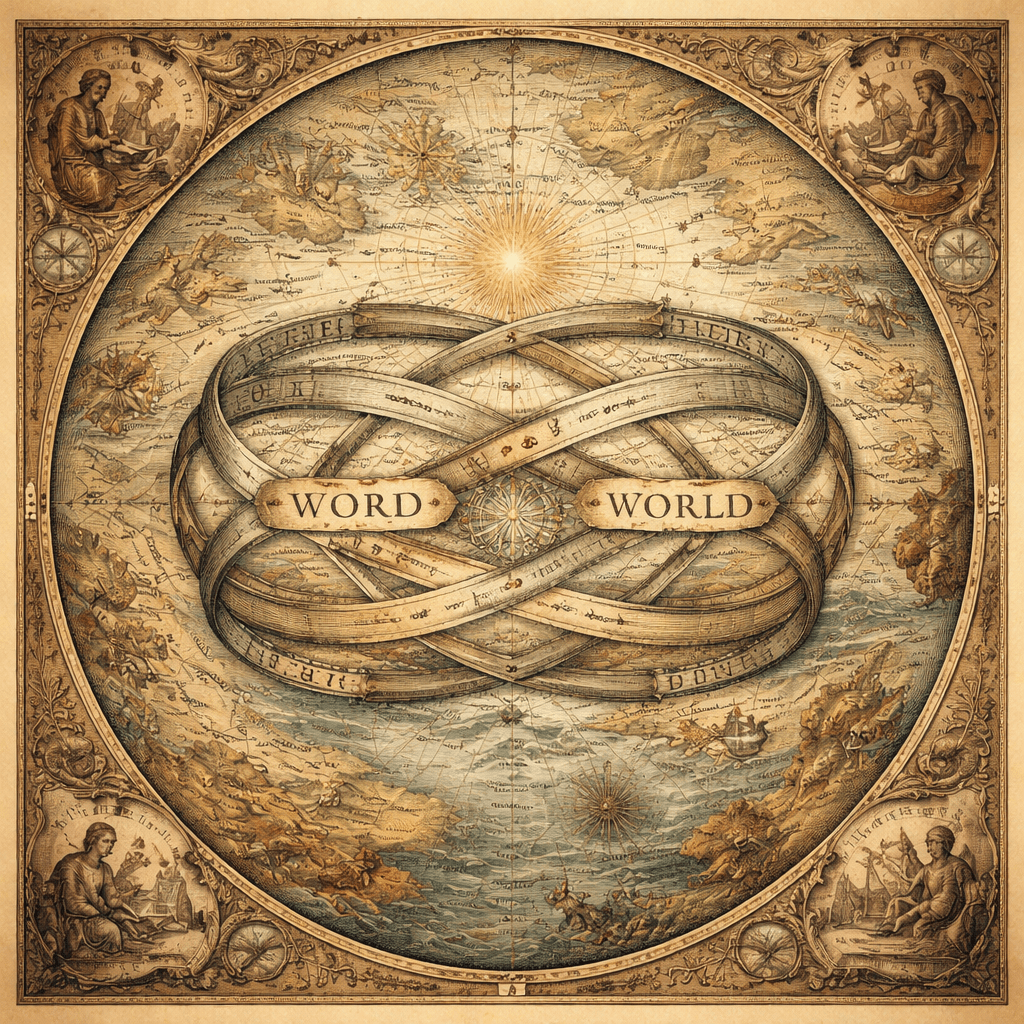
Language does not simply describe the world we inhabit. It arranges the conditions under which that world becomes intelligible, and in doing so we gradually reorganise experience into forms that can be named, remembered, and exchanged. Perception, memory, and social coordination all lean on this process. Human environments therefore become saturated with symbolic scaffolding: categories, […]
I found myself in conversation with another commuter on public transport today. They mentioned not completing high school in regards to their education, and the conversation drifted toward my interest in language and communication. I explained that vocabulary is never a reliable proxy for intelligence. A small vocabulary used precisely often reveals more intellect than […]
Most of what commands attention now is not meaningful in any substantive sense. It is dependent meaning: signals that borrow significance from circulation, outrage, novelty, or proximity to power rather than from coherence, considered consequence, or truth. This hollowness is not accidental. It is structurally central to contemporary dissatisfaction, corruption, volatility, and political disorder. These […]
The self never settles because the world never settles. Your body changes. Neural chemistry fluctuates. Memory edits itself. Relationships move. Context rearranges. Words drift. Culture turns. New facts arrive, old certainties decay, and the feedback never stops. So the self is not rewritten because it is faulty, but because it is embedded in conditions that […]
Have a WordPress.com account? Log in now.

