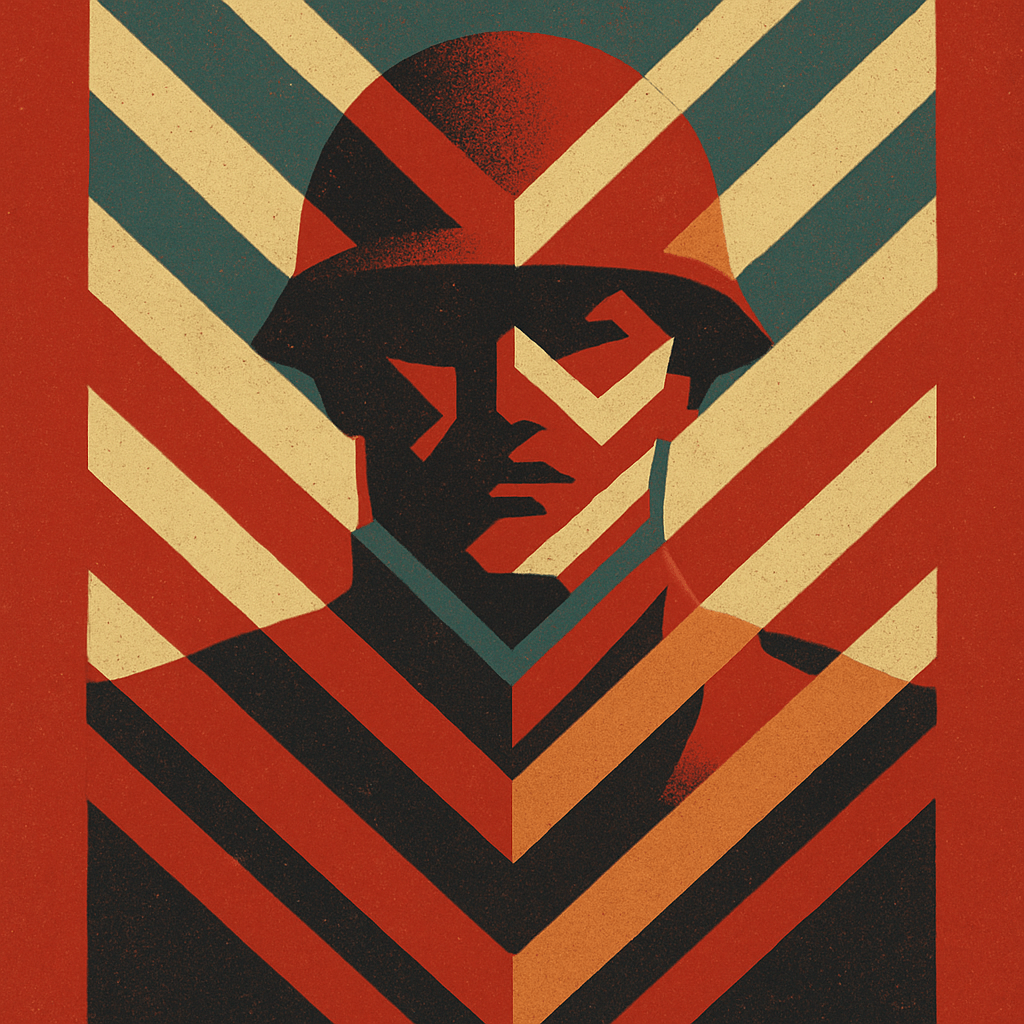
History shows a stable pattern: societies primed by threat return to it. Empires on the edge of famine, cities rattled by panic, alliances strained by distrust — once a population’s autonomic systems are pushed into vigilance, they begin to synchronise. Cortisol-charged attention, restricted horizons, and defensive postures propagate through rumours, media, and crowd behaviour. High-tension states reduce interpretive freedom, and the loop repeats: threat generates coherence, and that coherence reproduces the next threat.
Across eras, people have tried to make sense of this drift. Philosophers pointed to fear as the scaffolding of order; poets treated conflict as a fever that overtakes whole peoples; strategists saw tension as a resource; peace activists recognised it as a wound mistaken for strength. Analysts, musicians, engineers — all, in different ways, noticed that groups in distress move toward whatever binds them, even when what binds them is danger. Leadership quality rarely interrupts the cycle. In anxious systems, incompetence is not the anomaly but the phenotype: the figure who rises is the one whose internal noise already resonates with the collective field.
Conflict is never only two sides. It is the tightening band that forms between them, the contour of expectation that draws both into alignment and seeks continuation. Once that structure appears, it behaves like a rotating frame: it shapes anticipation, constrains movement, transmits vigilance, and pulls the ensemble back into the same arc of escalation. Leadership failure is the downstream effect of a system tuned to tension. And war, when it returns, is the system collapsing into the only configuration that feels, for a moment, like coherence, meaning, purpose, truth.
 Daedelus Kite
3 replies on “Conflicted”
Are communities, cultures, cognitive systems, commercial (and/or strategic) communications networks inadvertently yet irrevocably bound by bad memories more than by good ones?
Asking for a friend…
LikeLike
https://daedeluskite.com/2024/10/02/mnemosyne/
LikeLike
LikeLike