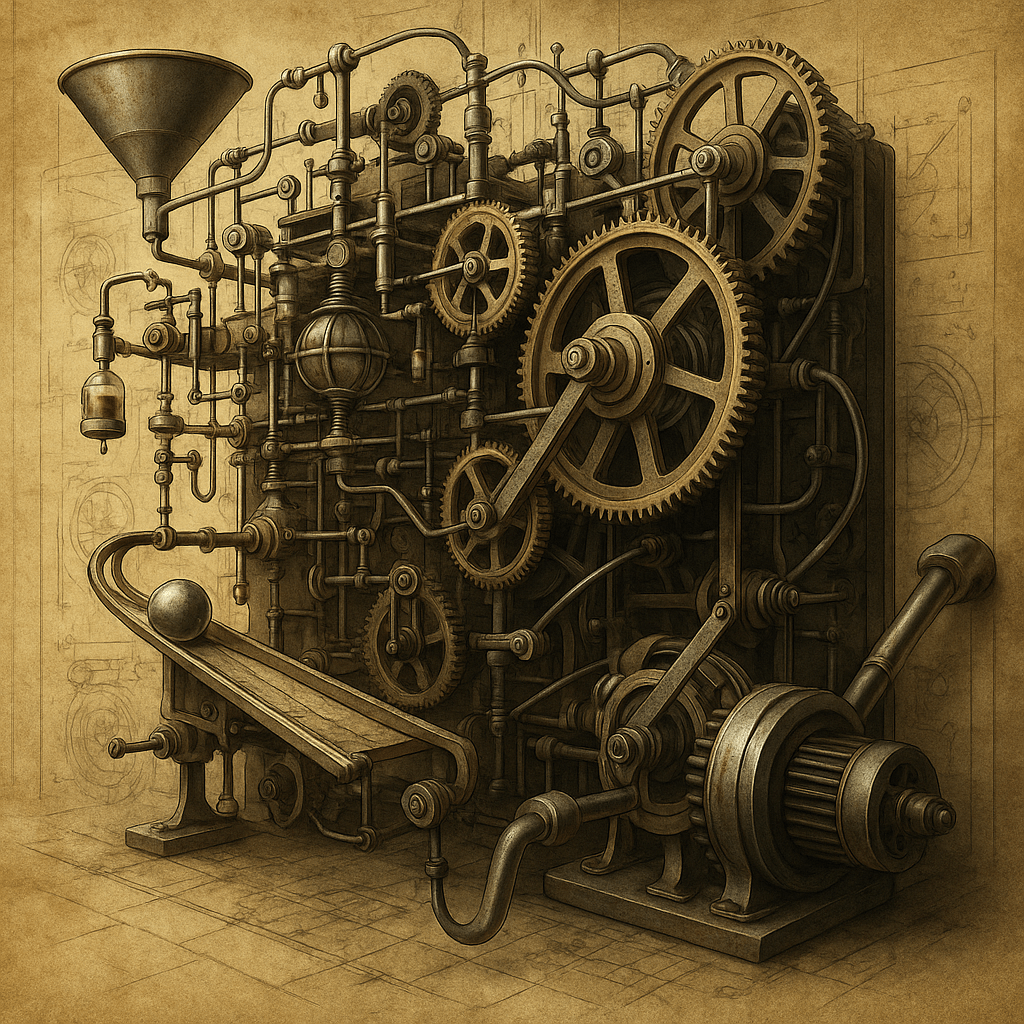
Large power systems — empires, blocs, security states, even global institutions — have never truly stabilised themselves by removing uncertainty. They stabilise by circulating it. Their administrative, legal, economic, and military structures function less as closures than as distribution networks for tension. Centre and periphery. Insider and outsider. Stability and threat. These are not failures of design. They are gradients the system uses to remain legible and active. When such systems have attempted to fully suppress ambiguity, to erase opposition rather than structure it, they have historically become brittle, overextended, and prone to sudden fragmentation. The pressure they refuse to metabolise does not vanish. It migrates, accumulates, and returns through economic shocks, internal paranoia, external conflict, or systemic collapse. Stability, in this sense, is not achieved by reducing tension, but by keeping it patterned and productive.
In field terms, the system is rotating around a delta it cannot close. That delta is not just a local conflict or ideological inconsistency. It is a global torsion running through the whole structure, the necessary misalignment between what it claims and what it can ever actually achieve. This torsion is its order parameter: the abstract pressure that organises its visible form. Remove the misalignment and the system loses its vector, its reason to move, its internal coherence. So it does not resolve the gap. It reproduces it. Over and over. Communication systems, ideologies, and institutional identities all operate this way. They persist not by arriving at meaning, but by orbiting it. What looks like domination is often just the maintenance of distance. What feels like coherence is the managed circulation of unresolved difference. The logic is not moral. It is structural. And we live inside it.
 Daedelus Kite