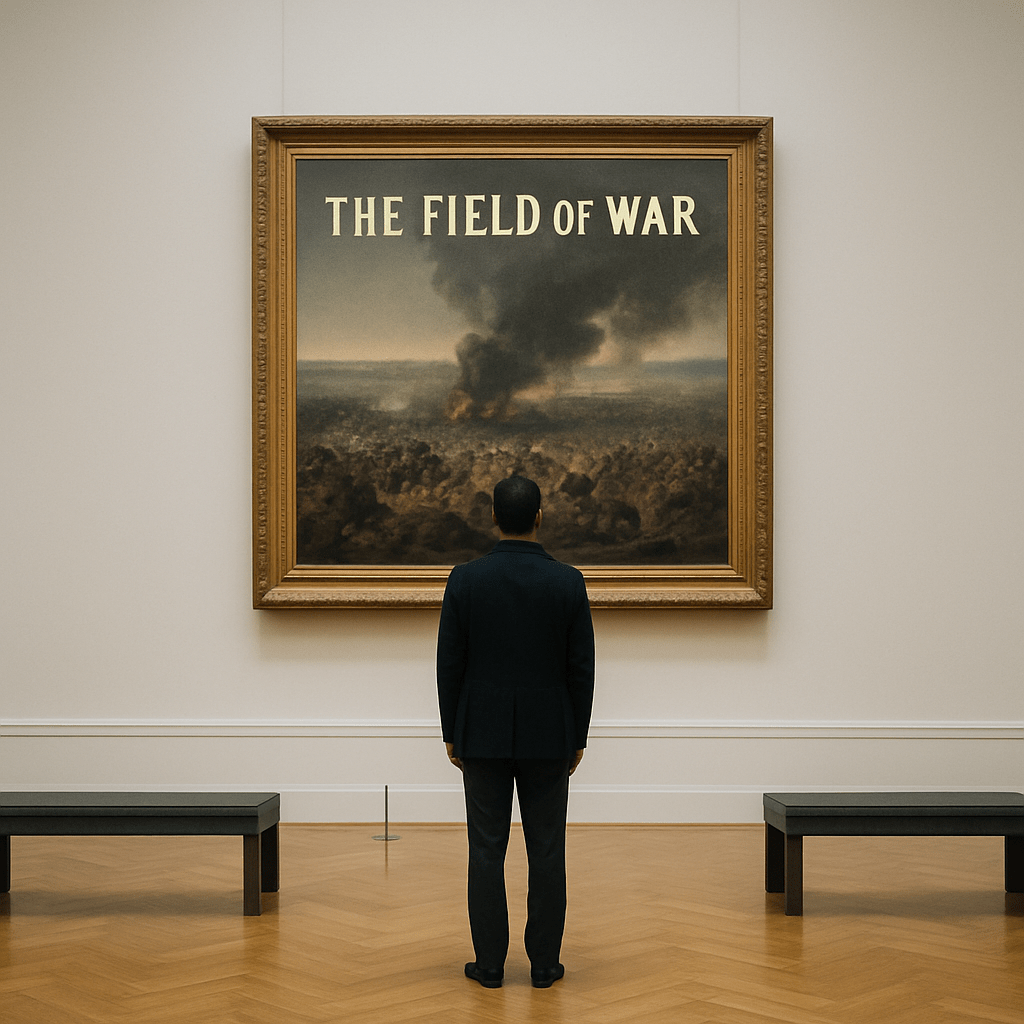
The overarching domain is the total surface where every system shapes every other, a fused topology forming a singular systems surface in which no boundary is clean and no action is local. It is the ensemble of intersecting, interdependent systemic surfaces whose shifting pressures generate the forces mistaken for, and interpreted as, discrete events. Holism here is not a philosophy but a structural fact: nothing stands outside this surface, and every strategy — war, diplomacy, deterrence, identity — is a deformation propagating across the same high-dimensional system domain, altering form as it travels and never fully settling.
In such a world, states should resist the impulse to manufacture conflict to reinforce their own narratives, to fortify and sustain the source of their political capital. The potential for catastrophe becomes the momentum that carries those narratives forward, and the instability set in motion moves through everyone connected to them, returning in altered form even to those who believed themselves insulated from its reach. No position within the system is as distant or secure as it appears, and each actor becomes part of the circulation they attempt to control.
It follows that the work of diplomacy and politics is seldom the elimination of tension but the disciplined management of it: living close to the vector of calamity without stepping across it. Once conflict is triggered, the symbolic and material value sustaining every actor evaporates, and the capital — political or financial — generated by the performance of brinkmanship is instantly extinguished. Power therefore orbits the boundary of disaster but does not cross it, and negotiation becomes the practice of approaching without arriving, maintaining just enough distance for coherence to hold.
The void is not absence; it is the system’s resting point, but only in the sense that every structure carries a drift toward stillness — a limit-state where motion, meaning, and misalignment converge. Rationally, it marks the point at which further escalation provides no advantage; apophasically, in the sense of a logic that speaks by withdrawing claims, it names what can only be indicated when definitions cancel themselves out. It is the contour of what cannot be acted upon without dissolving the coherence that makes action possible. The void is the horizon error approaches when turbulence is mistaken for stability, a quiet equilibrium toward which systems slide even as they deny its pull.
Sun Tzu grasped this early. His emphasis on shaping conditions rather than meeting force with force treats the commander as a gradient rather than an origin, an emergent expression of terrain, morale, and timing (Sun Tzu, trans. Sawyer 1994). Clausewitz later formalised war as the continuation of political intent (Clausewitz, ed. Howard & Paret 1976), yet intent becomes unstable in a domain where meaning is redistributed by global turbulence. Modern geopolitics repeats this misreading: escalation is mistaken for agency even as it deepens the misalignment that produced the conflict. Each actor improvises; the domain performs the same script, and the costs fall not on the strategists but on the societies absorbing the shock. Tension becomes a currency of influence, yet its yield shrinks as systems approach thresholds they cannot safely cross, forcing them to linger at the edge.
Self-determination becomes recursive. Communities suffer, and that suffering becomes evidence that struggle is necessary — a feedback loop indistinguishable from the logic that sustains it. The domain leaks. War leaks. It moves from battlefield to society, from ideology to ontology, as systems validate themselves through the turbulence they create. Thucydides saw the inevitability of fear and honour (Thucydides, trans. Warner 1972). Sun Tzu saw the inevitability of misalignment. Contemporary power chooses friction because friction signals relevance, yet the void remains the system’s resting point, reached only when turbulence is mistaken for stability — and drifting toward this false equilibrium is precisely why states must avoid conjuring conflict to resolve their own insecurities. Diplomacy here becomes the quiet maintenance of distance: enough to perceive the shape, never enough to activate the force behind it.
As much as things change, they barely do.
Annotated Bibliography
Clausewitz — On War (Howard & Paret 1976)
Clausewitz shows how war arises from the interplay of political pressure, uncertainty, and systemic friction that no actor fully controls. He frames conflict as an emergent dynamic in which intention is continually reshaped by forces moving through and beyond the state. From this emerges the reminder that power is always entangled in currents larger than the will that seeks to direct it.
Sun Tzu — The Art of War (Sawyer 1994)
Sun Tzu treats strategy as the art of shaping conditions rather than seeking decisive confrontation, emphasising the modulation of tension over its release. His approach situates power in the careful alignment of forces across a shifting environment. What follows is the insight that influence arises from attunement to the flow, not from force imposed upon it.
Thucydides — History of the Peloponnesian War (Warner 1972)
Thucydides maps fear, honour, and interest as structural drivers that pull states toward conflict even when caution prevails. He reveals how misinterpretation and imbalance propagate across interconnected polities. Here we learn that collective drift often overwhelms individual restraint, drawing entire systems toward outcomes none desire.
Machiavelli — The Prince (Skinner & Price 1988)
Machiavelli depicts governance as a continuous negotiation with instability, requiring the management of appearances as much as the exercise of force. Power becomes a function of timing, adaptation, and reading the turbulence around the ruler. His work points to authority as a balancing act performed within, and as, uncertainty rather than beyond it.
Kautilya — The Arthashastra (Rangarajan 1992)
Kautilya outlines statecraft as an equilibrium of shifting alliances, rivalries, and economic pressures. His model anticipates the logic of inhabiting the edge of conflict without triggering collapse. What emerges is a vision of power that survives by recognising how every move necessarily reshapes the conditions sustaining it.
Ibn Khaldun — The Muqaddimah (Rosenthal 1958)
Ibn Khaldun interprets political rise and decline as cycles of cohesion and fragmentation driven by environmental, social, and economic pressures. His analysis shows how collective identity strengthens and dissolves in response to long-term gradients. From this perspective, social power appears less as a possession than as a temporary alignment with deeper currents — currents that themselves make the alignment intelligible in any agreed-upon sense.
Tolstoy — War and Peace (Briggs 2005)
Tolstoy presents history as the emergent outcome of countless interwoven decisions and forces, none of which holds absolute control. His narrative dissolves singular agency into a distributed motion shaped by circumstance. His work underscores how meaning forms through the interplay of many lives, not through the designs of any one of them.
Liddell Hart — Strategy (1954)
Liddell Hart’s indirect approach emphasises the redirection of energy rather than its collision, seeking advantage through structural shifts rather than overpowering strength. Success emerges from altering pathways rather than dominating fronts. His formulation shows strategy as the art of changing the shape of possibility itself.
John Boyd — A Discourse on Winning and Losing (1987)
Boyd reframes conflict as cycles of perception and adaptation that reward flexibility over rigidity. Understanding and disrupting these cycles becomes key to shaping outcomes in unpredictable environments. His insight lies in showing how systems prevail by transforming the space of interpretation faster than rivals can follow.
Mary Kaldor — New and Old Wars (1999)
Kaldor charts the transformation of warfare into dispersed, networked forms shaped by global economic and ideological flows. She highlights how conflict becomes entangled with identity, finance, and political fragmentation beyond traditional fronts. Her work reveals modern mechanised violence as a diffusion across the same channels that weave societies together, where the distinction between internal and external, or constructive and destructive, becomes not only secondary but a corollary — a consequence of the way the wider domain reproduces itself through those very differentiations and all the turbulent ambiguities that accompany them.
 Daedelus Kite