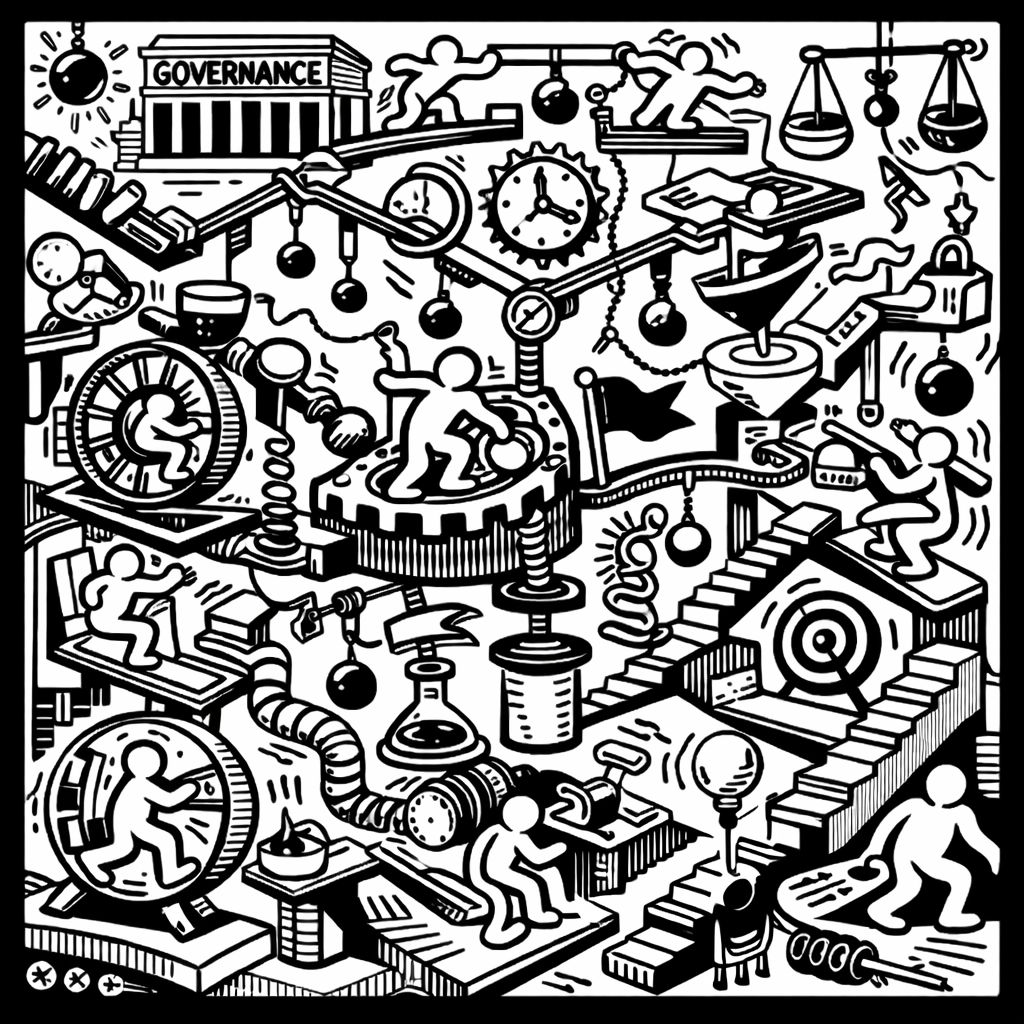
University systems are not simply organised around knowledge, discovery, or intellectual community. Those are decorative claims. The real game is status. Universities function as credential factories and hierarchy-maintenance machines, where prestige, funding position, and reputational insulation matter far more than whether anything true, useful, or unsettling is learned.
This is predatory opportunism in institutional form. The system feeds on aspiration. It attracts people with the promise of meaning, insight, and contribution, then quietly reroutes their energy into compliance, metric production, and risk avoidance. Research is welcomed so long as it does not disturb existing arrangements. Discovery is acceptable only when it changes nothing that matters.
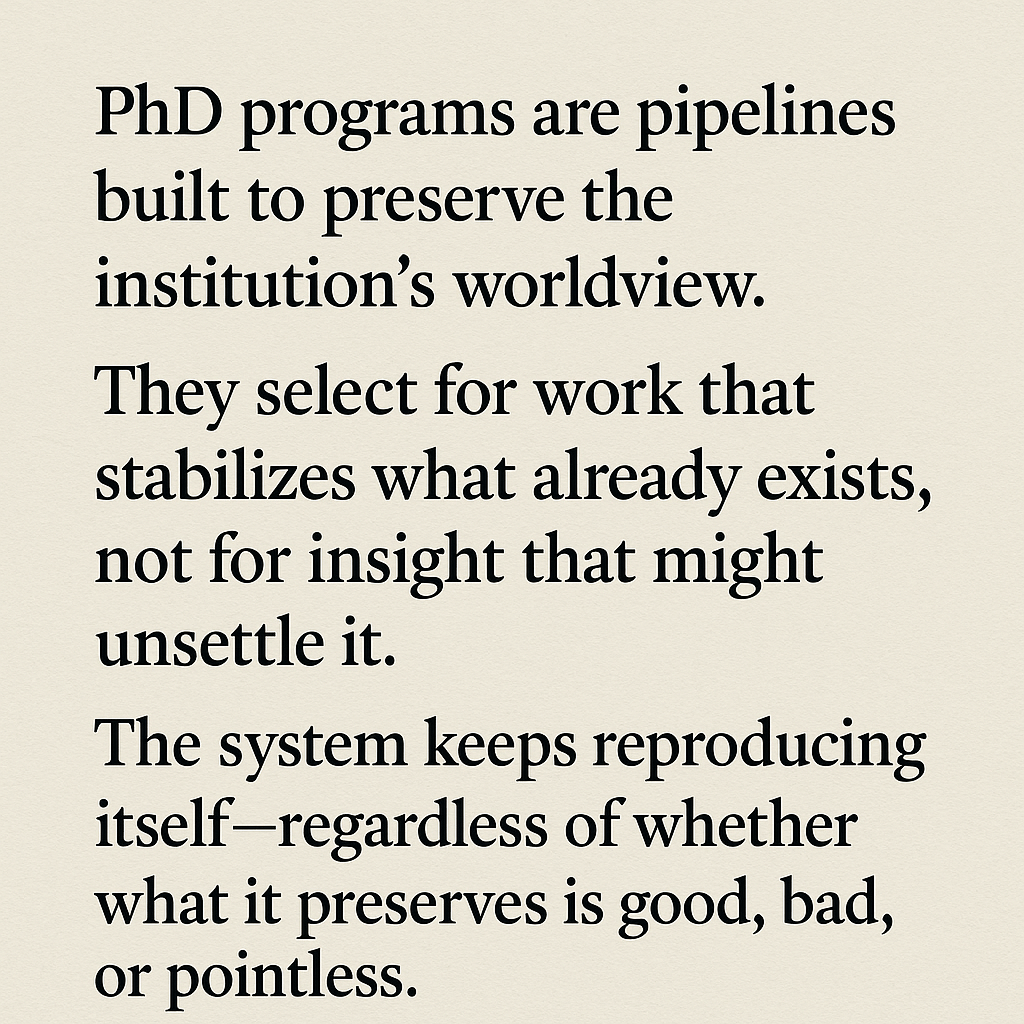
Among PhD candidates, this becomes apparent quickly. Many are not there because they are seized by questions they cannot abandon, but because the degree appears to offer leverage: income prospects, status buffering, or career insulation, however fragile. The system selects for those who treat scholarship as a strategic investment rather than an encounter with uncertainty. Intellectual courage is not rewarded. It is a liability.
No conspiracy is required. Supervisors adapt to survive by producing safe students. Departments adapt by protecting grants, rankings, and internal hierarchies. Institutions adapt by selling prestige while minimising epistemic risk. Knowledge becomes performance. Inquiry becomes theatre. The university remains in motion by ensuring nothing actually moves.
What results is stagnation disguised as productivity. Endless micro-contributions clustered at the edges of established frames. Innovation constrained to spaces where it cannot disrupt funding, reputation, or authority. Motion without change. Output without consequence. The system reproduces itself while mistaking replication for progress.
Over time, this behaviour hollows the institution out. It renders the university unsustainably corruptible, as has happened to many other large systems organised around status preservation rather than purpose. What remains is not a site of discovery or learning, but a transmission medium for whatever ideological, bureaucratic, or managerial frame happens to be ascendant, reproducing it efficiently while mistaking that reproduction for thought.
 Daedelus Kite
One reply on “Predatory Opportunism in University Systems”
This is not all that universities are. It is a shared organisational abstraction, globally distributed as in some sense the scaffolding of status hierarchies. Like most large institutions, they develop these dynamics as a psychosocial and affective response to underlying complexity they do not know how to face directly. When the maths gets hard, when the system becomes too nonlinear, too delayed, too entangled, abstraction steps in as a sedative. This is the ugly side of almost every organisation and every communication system now. Everything, everywhere, all at once, smoothing itself into something manageable and quietly wrong.
Universities matter. They still carry real intellectual weight. But they are making the same technologically driven, abstraction-first mistakes as everyone else. There is no coherent counter-grounding in place, and there should be. Instead, critique is displaced by process, novelty by metrics, and risk by career hygiene. This is not a local failure or a moral one. It is systemic. And the refusal to engage with that holistically is precisely what allows the rot described above to reproduce itself, cleanly, politely, and at scale.
LikeLike