Dynamical structure reveals itself through the propagation of signals. We do not encounter systems first as finished objects and only later as processes; we encounter them through motion, response, transmission, lag, and constraint. Signals move through fields and never arrive instantly. Delay is therefore not an imperfection added to an otherwise complete world. It is part of the condition under which structure becomes visible at all. Physical systems, informational systems, institutional systems, geopolitical systems, and even the analytic frameworks describing them all operate through signals that propagate across time. What we perceive as structure is inseparable from the timing relations through which those signals move, and from the recursive tensions that arise as each response enters a world already altered by earlier responses.
Even the most basic invariants of physics illustrate this principle. The finite speed at which signals propagate, most famously expressed through the invariant speed of light, does not merely constrain motion; it makes structure possible. Events remain distinct because influence takes time to travel. Causality, separation, and persistence all depend on this delay. In that sense the finite speed of propagation can be understood not only as a limit imposed on the world but as a structural consequence of the same dynamical condition: signals require time to move through fields, and the world acquires shape through that requirement.
Once signals propagate with delay, different parts of a system fall out of phase with one another. That misalignment begins organising behaviour. Responses arrive slightly late and enter conditions already altered by earlier responses. Actors begin reacting not only to events but to the reactions those events have already produced. Feedback forms. Circulation forms. What appears as instability is often the visible geometry of delayed interaction inside a coupled field. Vortices in fluids, drift in institutions, conflict in human systems, and turbulence in communication networks are different expressions of the same dynamical pattern: phase differences accumulate, circulation tightens, and the system begins reproducing the delays through which it is organised.
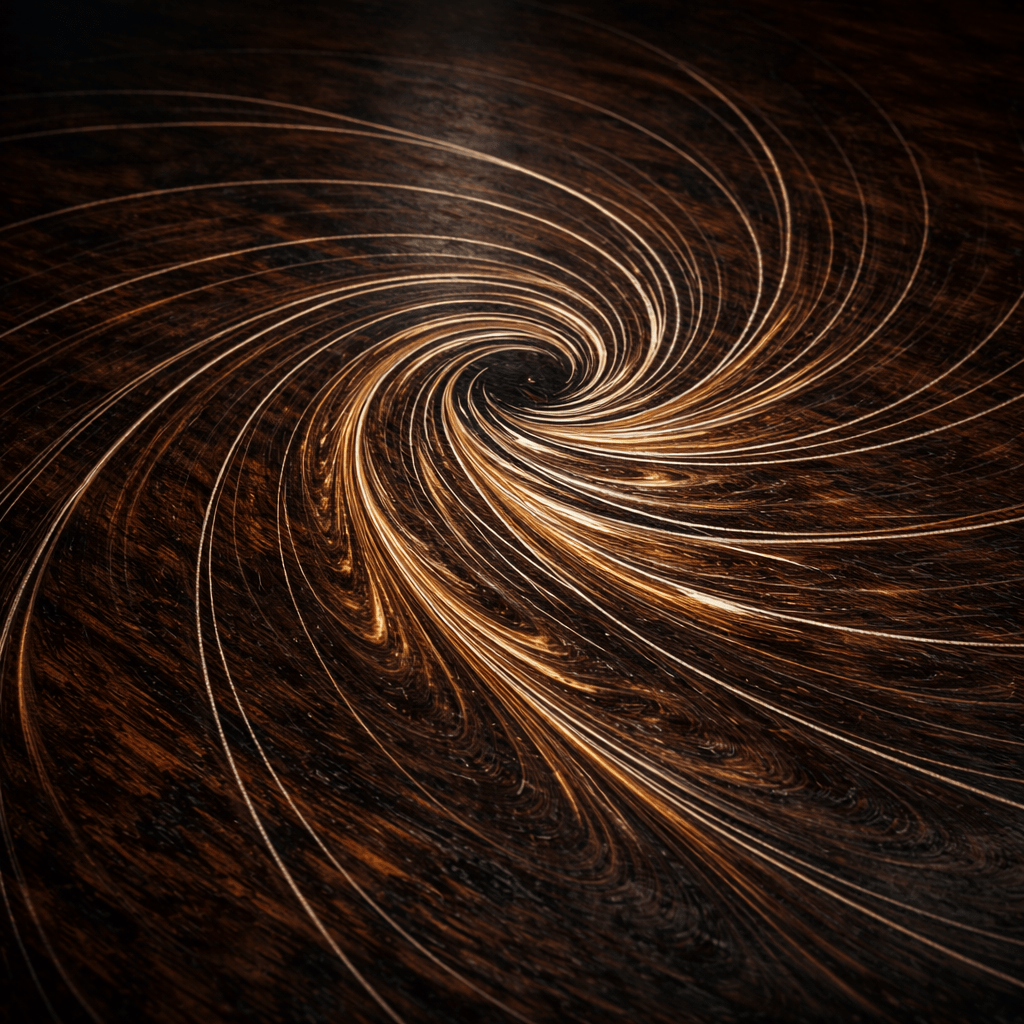
Within that circulation a characteristic relation appears. Motion tightens inward along one axis while propagating outward along another. Acceleration toward the centre corresponds to dispersion and deceleration elsewhere. The pattern resembles orbital motion more than linear causation. Inward recursion and outward propagation are not opposites but the same process viewed from different positions within the field. The centre is not a solid cause but a timing relation distributed across the system itself. Signals compress toward it while effects radiate away from it, sustaining a dynamic tension through which the system both stabilises and transforms.
The same condition applies to the systems through which we attempt to describe these dynamics. Analysis, modelling, policy language, and media interpretation are themselves signals moving through the field with delay. They arrive after the conditions they describe have already begun to change and therefore participate in the same circulation they attempt to explain. Description never stands outside the system it observes. It becomes part of the feedback through which interpretation, decision, and reaction continue to propagate, adjusting its alignment with the system over time rather than capturing it once and for all.
Conflict emerges naturally within such conditions. The informational field within which signals circulate is never complete. Ambiguity persists. Interpretation arrives with delay. Meanings remain contested. Expectations about the future diverge. These conditions create gradients across the field, drawing attention, reaction, and strategic movement toward zones of unresolved understanding. What appears as turbulence is often the visible pattern produced as actors attempt to navigate these gradients while operating on signals that are always slightly out of phase with the conditions they describe.
In this sense the turbulence itself becomes part of the system’s organisation. Circulation does not merely occur; it is reproduced. Coherence and incoherence remain coupled, each shaping the other through the timing relations that bind the system together. The gradients produced by ambiguity, delay, and disagreement generate the very motion through which the system sustains itself. What appears as disorder may therefore also be the process through which complex systems explore, stabilise, and transform the conditions of their own existence.
Categories
Time, Delay and Systems Theory: Vortex Dynamics
 Daedelus Kite