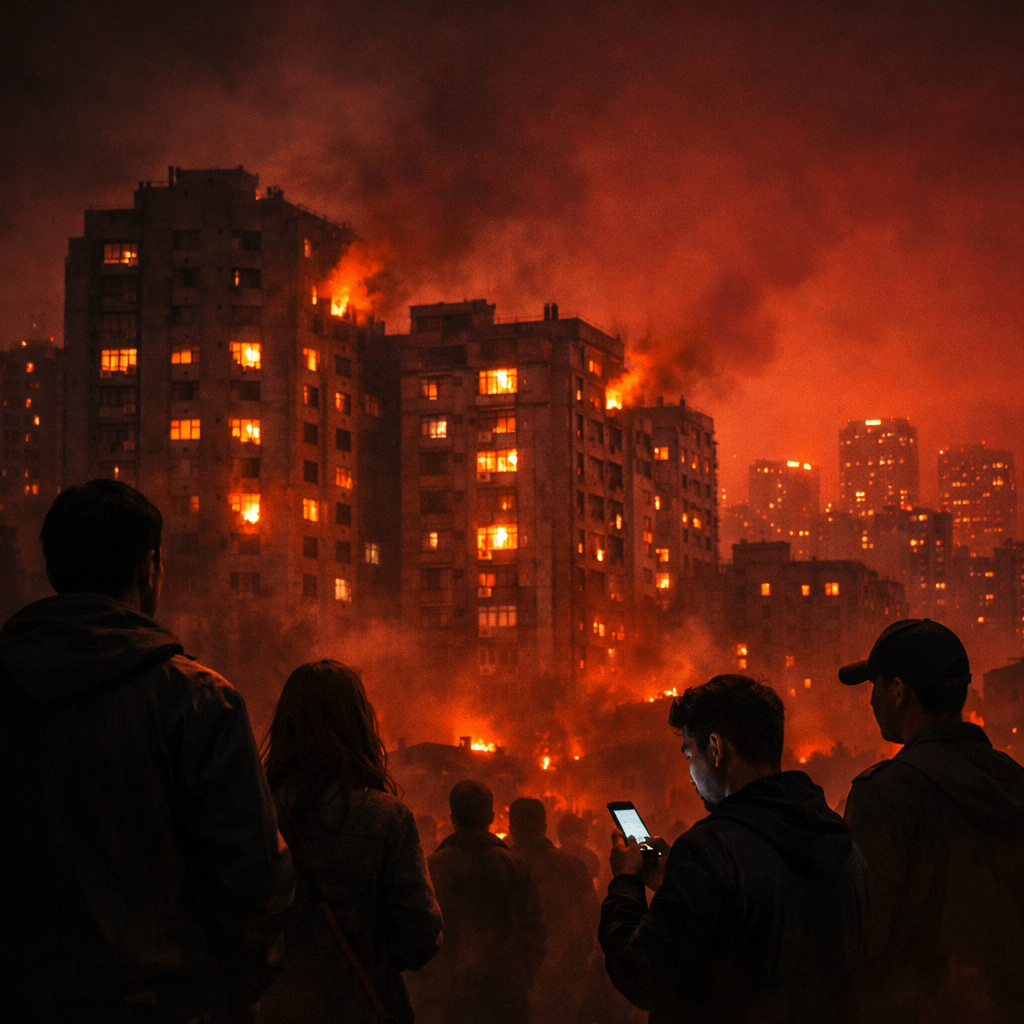
When Jimi Hendrix released House Burning Down on Electric Ladyland, American cities were already unstable. The assassinations of Martin Luther King Jr. and Robert F. Kennedy ignited unrest across neighbourhoods shaped by segregation, economic decline, and deteriorating apartment blocks. Buildings burned in riots, but also through opportunism. Some landlords torched failing properties for insurance. Some criminal groups exploited disorder. Some fires spread through neglect and overcrowding. Protest, profit, desperation, and decay merged into one indistinct horizon. The sky turned red, and no one could quite separate grievance from opportunism, collapse from calculation.
Hendrix captured that ambiguity with unsettling calm. Buildings burn while people watch. No clear explanation. No tidy moral frame. Just hesitation, speculation, and distance. Humanity observing itself in crisis, unsure whether it is witnessing injustice, opportunism, or both at once. The song reflects a deeper pattern: instability becomes an ecosystem. The fire is not only destruction. It is also incentive. The breakdown itself becomes something that can be used, leveraged, and, in quiet ways, engineered.
That logic feels familiar now. Economic insecurity, political identity, technological amplification, and institutional fragility create an environment where tension becomes valuable. Outrage drives engagement. Fear drives consumption. Division drives loyalty. Instability becomes profitable. Systems reward those who amplify conflict, not those who resolve it. Humanity has, in this sense, made an art out of exploiting itself, transforming insecurity into fuel for attention, power, and economic gain.
The song remains relevant because it captures this eerie condition. The buildings burn, and people watch, some afraid, some calculating, some uncertain. No single cause, no single actor, just overlapping incentives and quiet opportunism within social decay. The sky turns red again, not only from fire but from accumulated tension, and the deeper pattern emerges: humanity is not only vulnerable to crisis. It has learned, slowly and counter-intuitively, how to live off the heat.
 Daedelus Kite