Our political and commercial systems profit from the crises they perpetuate, rendering meaningful dissent unintelligible and civilisational failure commercially indispensable.

Our political and commercial systems profit from the crises they perpetuate, rendering meaningful dissent unintelligible and civilisational failure commercially indispensable.
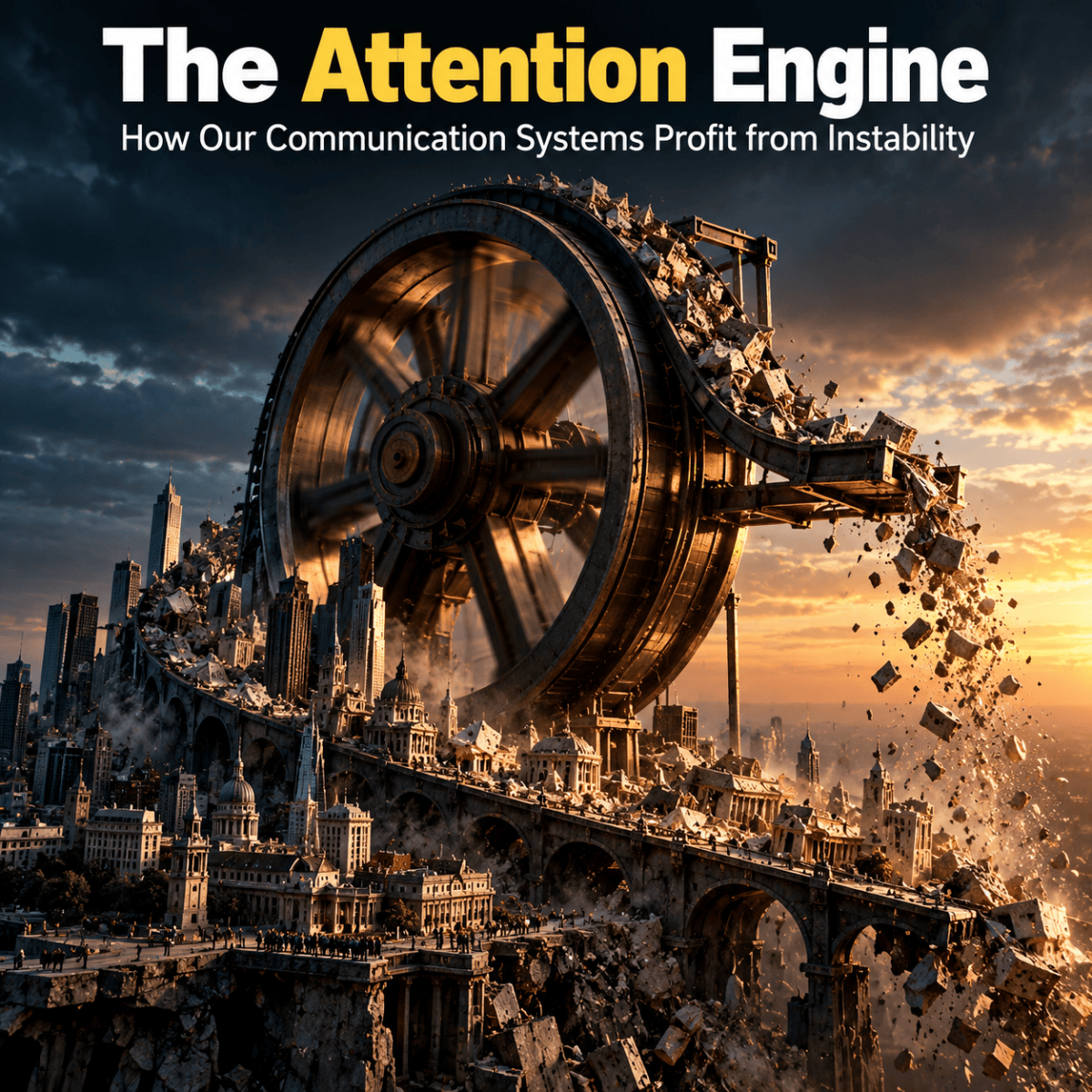
Civilisations have collapsed before. What distinguishes ours is a communications economy that profits from accelerating the disturbances society must then struggle to absorb. The danger lies in a recursive feedback system that rewards instability while transferring its consequences to everyone else.

As the world approaches catastrophic conflict, wealth and power remain invested in preserving the arrangements driving instability. Asking for peace has become almost absurd, while preparing for destruction is considered perfectly sensible.
Humanity is caught in a planetary feedback trap. Our technologies, institutions and political systems increasingly reproduce the psychological instability they intend to resolve.

The Mad King is usually treated as a personality problem. History supplies familiar figures. Erratic rulers, impulsive leaders, volatile decision makers whose behaviour appears to bend events. Yet this framing may be backwards. Instability at the top of power hierarchies may emerge not from individual psychology but from the structure of complex social systems themselves, […]

When Jimi Hendrix released House Burning Down on Electric Ladyland, American cities were already unstable. The assassinations of Martin Luther King Jr. and Robert F. Kennedy ignited unrest across neighbourhoods shaped by segregation, economic decline, and deteriorating apartment blocks. Buildings burned in riots, but also through opportunism. Some landlords torched failing properties for insurance. Some […]

Large populations have, at various points in history, rallied behind loud, simple, certainty-projecting figures who promise restoration, strength, or clarity amid confusion, even as those same movements steadily erode the very conditions upon which stability and shared reality depend, the quiet alignment between what people say, what they do, and what the world allows to […]

There is a structural limit to populist dynamics that is often missed. Populist themes require an antithesis to remain coherent. Without an opposing force to push against, they do not stabilise or mature; they turn inward. Like fascism in its later stages, the movement begins to consume its own distinctions, purging nuance, then difference, then […]

What we are seeing does not require villains of unusual intelligence. Systems theory already explains it. Given enough time, scale, and communicative density, a field that rewards information throughput over stability will drift toward political decay. When wealth, power, and cultivated ignorance align inside technologically mediated communicative systems, destructive behaviour does not need intent or […]

Field logic approaches complex systems as relational fields sustained by difference over time, not as collections of discrete components governed by linear causation. It is most relevant where systems are fast, tightly coupled, and vulnerable to runaway self-reinforcement, as in contemporary technological, media, and political environments. In these regimes prediction does not mean forecasting specific […]
Have a WordPress.com account? Log in now.

