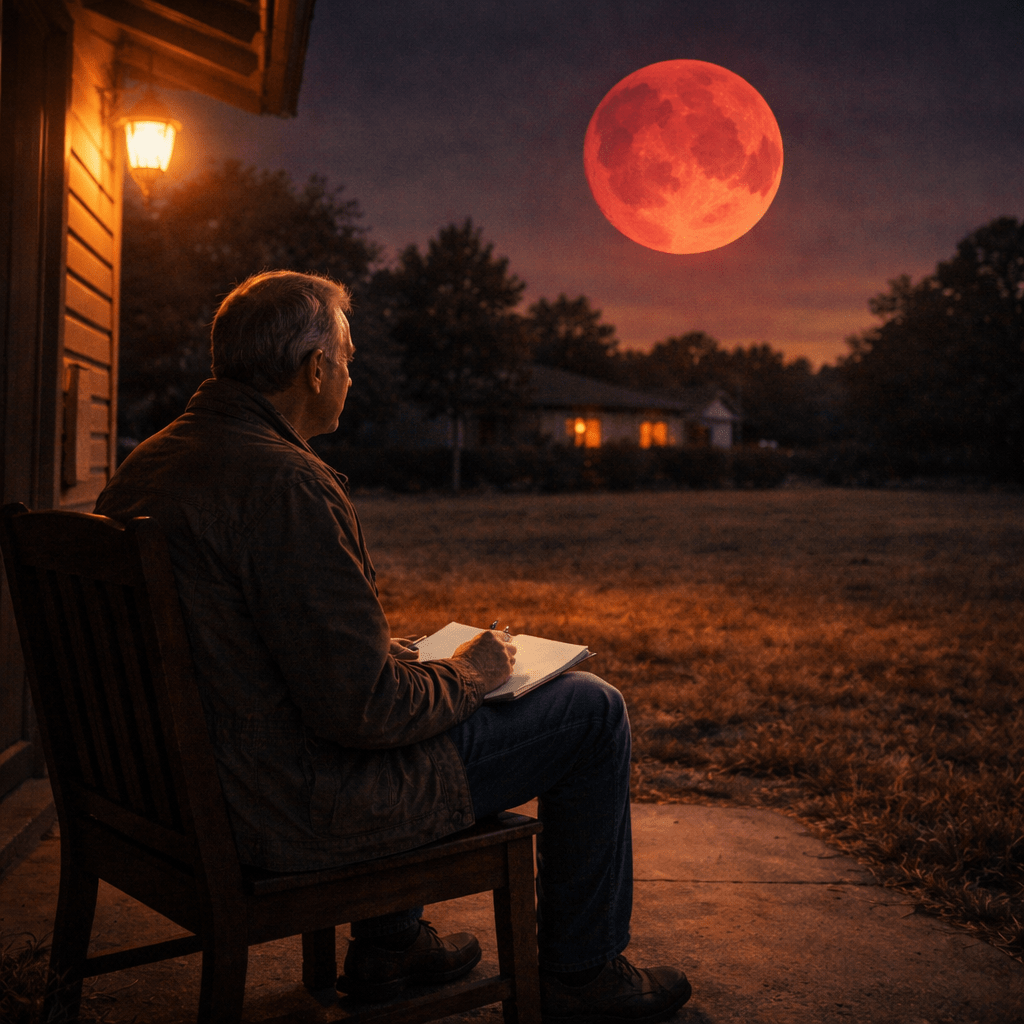
He noticed it first in the rhythm of things.
Not the temperature, which always wandered, but the timing. Winter arrived on the calendar and not in the soil. Rain came hard and left quickly, as if it had somewhere else to be. Summer stretched, then stretched again, like a conversation that had lost its point but refused to end. It was not dramatic. That was the trouble. Complex systems rarely announce themselves. They drift. Then they reorganise.
The moon kept its schedule.
The seasons did not.
He still had the old weather notebook.
It lived in the shed beneath a box of policy papers and conference folders. Yellowed pages. Careful handwriting. Rainfall totals. First frost. Wind direction. He had kept it during his early career, back when local measurements still felt like a meaningful act. He had stopped using it years ago, when satellite data replaced backyard observation. Now he opened it again and wrote a single line.
Warm night. No wind. Late season.
It was not remarkable. That was the point.
He realised, leafing back through the pages, that he had once recorded frost dates carefully. The last time he had written frost in the notebook was years ago. He could not remember when he had last scraped ice from a windscreen. The absence felt larger than the thing itself.
He had spent forty years inside the environmental machinery. Reports, panels, advisory boards, quiet negotiations in carpeted rooms where the air-conditioning hummed and people spoke about planetary heating beneath fluorescent lights. The facts had never been hidden. Carbon dioxide rising beyond the range that had supported agriculture and cities for millennia. Oceans absorbing most of the excess heat, quietly storing consequence. Arctic warming accelerating, weakening the temperature gradients that organise atmospheric flow. The jet stream slowing, wandering, stalling. Heat lingering. Forests drying. Fires burning longer. Carbon rising again.
It was never one thing.
It was always relation.
We knew this.
We waited anyway.
He remembered the first fire season that frightened him. Decades ago. The models had suggested a longer burn window under warming scenarios. That year, the fires ran weeks beyond historical patterns. Not catastrophic. Just unusual. He remembered mentioning it in a briefing. Someone nodded politely. The report language softened the implication. Variability. Emerging trend. Monitoring recommended.
Professional caution.
He remembered thinking then that caution might become complicity if stretched too far. He did not say that out loud. No one did. Calm voices were rewarded. Calm voices bought time.
Time filled quietly.
Greed was not loud in those rooms. It rarely is. It appeared as practicality. Growth targets. Competitive positioning. Avoiding economic disruption. Ego arrived as leadership. No nation wanted to slow first. No corporation wanted to shrink. No electorate wanted sacrifice without visible reward. Each decision made sense locally. Together they formed drift.
We were clever enough to see the cliff.
Vain enough to keep accelerating.
Civilisation optimised for continuation, not coherence.
He walked along the coast one afternoon and saw the tide markers repainted higher. No announcement. Just a quiet adjustment. A year later, insurance premiums shifted. A neighbour mentioned difficulty renewing coverage. Farmers inland moved planting dates again. Fire planning extended earlier into the year. These things did not feel like crisis. They felt procedural.
Accommodation is how reorganisation begins.
The news carried fragments. Marine heatwaves. Boreal fires. Antarctic instability. Weakening ocean circulation. Each report technical, manageable, easy to fold into background noise. But he had spent too long watching systems to mistake fragments for independence.
The ocean warmed.
Rainfall shifted.
Forests thinned.
Carbon rose.
The system remembered.
He remembered the conferences, the applause after ambitious declarations, the quiet revisions that followed. Targets adjusted. Timelines extended. Markets reassured. It had felt like progress. In retrospect it looked like delay. Not heroic delay. Just the slow comfort of postponement.
Delay stores consequence.
At the supermarket he noticed seasonal produce arriving out of season, then not arriving at all. Prices moved more often. Supply interruptions appeared, resolved, then appeared again. No collapse. Just volatility. Agriculture depends on distributed stability. One region fails, another compensates. But as the climate reorganised, independence shrank. Heatwaves overlapped. Rainfall shifted across continents. Buffers narrowed.
Civilisation prefers stability.
The planet withdraws it slowly.
Greed did not end.
It adapted.
Ego did not retreat.
It hardened.
He sat outside in the evening with the notebook open. The insects were still there, but fewer. The air held warmth longer. The soil smelled dry in a way that belonged to later in the season. The windscreen of his car, once crowded with insects after long drives, stayed mostly clean now. He had not noticed when that began.
Small absences accumulate.
He wrote another line.
Warm again.
Still no wind.
He thought about the early meetings, the cautious optimism, the belief that knowledge might bend behaviour. He remembered colleagues who retired early, who grew tired of explaining feedback loops to audiences already searching for reassurance. Some stopped speaking about tipping points altogether. The word had begun to sound impolite.
Hope faded gradually.
Like winter.
Somewhere far away, ice thinned. Currents shifted. Forests adjusted. The changes were not visible here, but he knew they were connected. Complex systems move through relation, through quiet alignment, through phase.
The moon rose, unchanged.
The world beneath it had slipped.
The atmosphere recorded.
The oceans remembered.
Ice responded.
Forests adjusted.
Civilisation followed, slowly at first.
Then, a little faster.
The sky darkened without drama. Cars passed. Lights came on. A dog barked. Nothing urgent. Nothing theatrical. Just the quiet arithmetic of physics unfolding across a planet already moving into another phase.
We had licked ourselves into it with appetite and self-importance, with the small vanities of clever creatures convinced consequence would arrive somewhere else. But somewhere else had dissolved. Later had arrived.
The planet did not rage.
It adjusted.
Another phase of the same moon.
A different world beneath it.
The rhythm had changed.
And no one would remember exactly when it began.
 Daedelus Kite