A system that discourages difference eventually undermines its own capacity to learn, adapt and survive.

A system that discourages difference eventually undermines its own capacity to learn, adapt and survive.

Climate change is not occurring inside a stable planetary system. It is altering the persistent structure of relations among climatic states, variables and phases, changing the conditions under which subsequent states become possible and probable.

Climate change is not a problem inside a stable planetary system. This text indicates how it is reorganising the relations through which planetary stability itself is reproduced.

The climate is not obliged to change at a pace convenient to those living within it.

We have constructed a civilisation in which recognising existential risk has become another reason to continue producing it.

The greatest trick concentrated capitalism ever pulled was convincing the world that its own most destructive tendencies belonged exclusively to communism.

The world is not merely broken. Too many people are paid to keep it that way.

Every system sends the bill somewhere else until there’s nowhere left to send it.

It is worth remembering that civilisation persists by unacknowledged permission of the planetary systems that sustain it.

We require forms of language capable of representing continuity without losing the ability to act locally within it, models capable of preserving the relationship between part and whole without reducing one to the other.
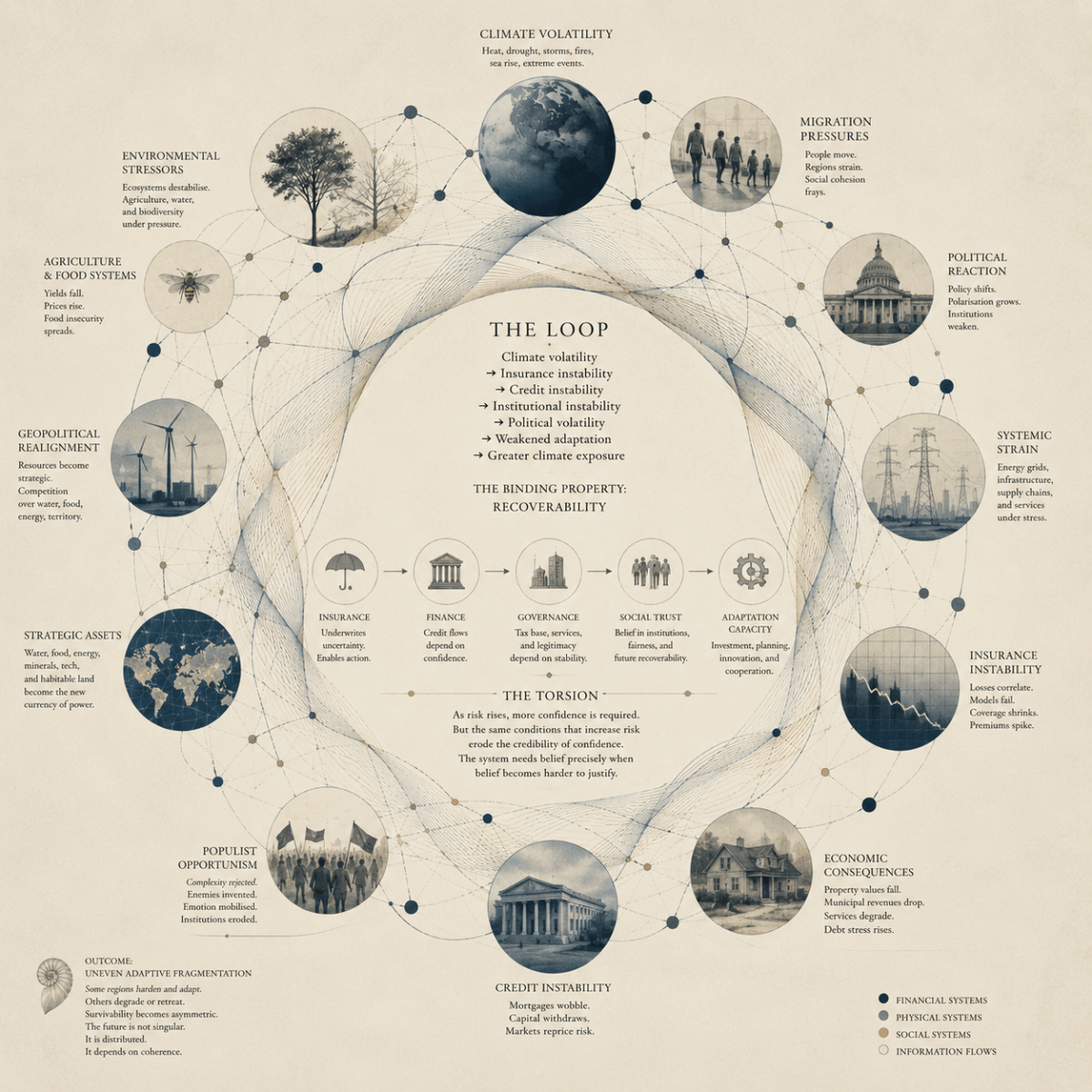
Climate change becomes civilisational risk when insurance can no longer translate catastrophe into recoverable cost.
The central risk of climate change is not gradual warming. It is reorganisation. The Earth system may be approaching, or may already be entering, a phase transition. Complex systems rarely fail all at once. They drift, they desynchronise, and then they reorganise. The shift is rarely theatrical. It emerges from relations, from accumulated imbalance, from […]
Have a WordPress.com account? Log in now.

