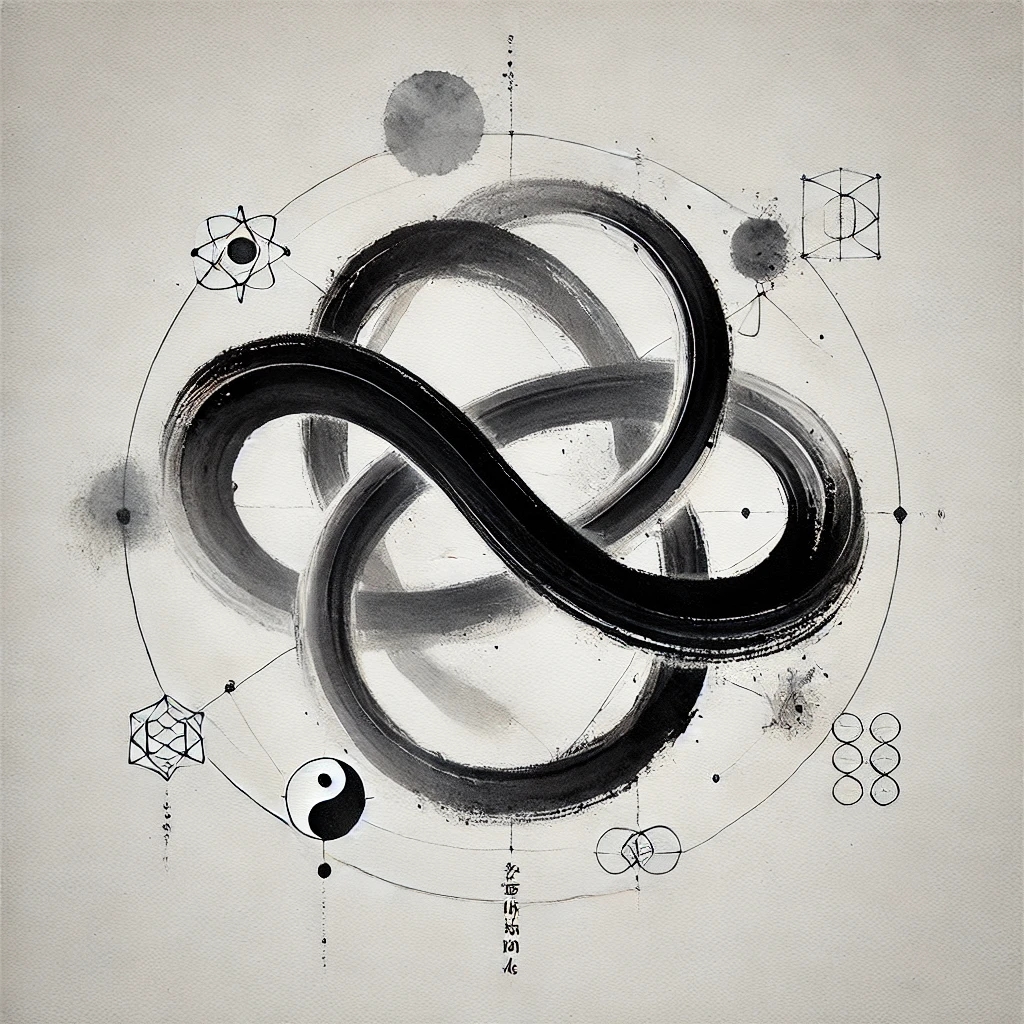
To reframe the Lagrangian in terms of deeper exploration of least action, entropy, and logical incompleteness, we begin by shifting the focus from the traditional mechanical interpretation of least action—the path that minimises energy expenditure—to a broader, more ontological interpretation. Here, the least action becomes an approximation towards a kind of dynamic equilibrium, not merely a static or final state but one that encapsulates the long-slow wave of entropy—a continuous, gradual trend towards maximising uncertainty and disorder within a bounded, holistic system.
Least Action as Approximation Towards Equilibrium
In classical mechanics, the least action is about finding the path between two points that minimises the Lagrangian. Traditionally, the Lagrangian L = T – V is the difference between kinetic energy T and potential energy V. The system evolves along a trajectory where the total action is minimised. This is an optimal, deterministic path.
In classical mechanics, the least action principle provides a deterministic framework. Given the initial conditions and forces acting on a system, its evolution follows a specific, predictable trajectory. The Euler-Lagrange equations, derived from this principle, define a unique path that minimises the action, thus fully determining the system’s behaviour throughout its motion. This makes the classical interpretation of least action firmly rooted in determinism, where each state evolves unambiguously from prior conditions, leaving little room for uncertainty or ambiguity.
However, when we move beyond classical mechanics, particularly into quantum mechanics and other complex systems, this deterministic picture begins to fall apart. In quantum mechanics, for instance, systems don’t adhere to a single, predetermined path. Instead, they explore a multitude of possible trajectories, with probabilities governing the likelihood of each one, as represented by Feynman’s path integral approach. In these domains, indeterminism is key, and a system’s exact behaviour cannot be pinpointed with certainty, highlighting a profound shift from classical determinism to probabilistic outcomes and the presence of inherent uncertainty.
However, when the least action is viewed through the lens of entropy, the minimisation process shifts. The system no longer seeks to merely minimise a local, isolated action between two temporal states but approximates a holistic equilibrium that cannot be reduced to a simple sum of its components. This equilibrium is dynamic and emergent, arising out of the irresolvable uncertainties that are internal to the system.
Here, the “action” is not just the interaction of kinetic and potential energies but the conspicuous absence—the systemic incompleteness—that drives the very flow of entropy. The least action, then, is the gradual tendency of the system to move towards its maximum entropy state, which paradoxically is both an absence and the condition of possibility for everything else within the system.
The Absence as a Necessary Condition
This brings us to the concept of logical incompleteness. In a holistic system where there are no externalities, everything that “exists” within the system cannot fully explain itself without reference to what is absent. In some sense, the least action is not about the direct minimisation of measurable quantities but about navigating the system’s internal structure where absence—what is not there—plays a fundamental, constitutive role.
If we approach the system from this vantage point, we encounter something deeply counterintuitive: absence is not merely an external, negative space or a byproduct of incomplete understanding. Rather, it is a necessary structure within the system itself. This absence is the irreducible uncertainty, the logical incompleteness that cannot be resolved, and yet, it is the very force that holds the system together. Without it, the system’s coherence, its tendency towards equilibrium, collapses.
The Irreducible Uncertainty: Absence Within
At the heart of this is the realisation that, in a holistic system, all attempts to find a “complete” explanation will fail because what grounds the system’s evolution is precisely that which is not there. This non-being, this absence, is not external to the system but internal. It’s as if the more you investigate the system, the more you realise that its integrity depends on something you cannot pinpoint—something that only manifests through its necessary absence.
This resonates with Gödel’s incompleteness theorems, but we extend this to physical and even socio-cognitive systems. Any system that claims to describe itself or reach a “least action” will always have something that escapes its grasp—an unspoken, unresolved part that is the source of its entropy and the engine of its evolution.
The Lagrangian and the Slow Drift of Entropy
If the traditional Lagrangian is the difference between kinetic and potential energy, here it becomes something broader, encompassing both what is present and what is absent. The action minimisation process is no longer just about the path of least resistance or the most efficient energy expenditure. It’s about finding the trajectory that navigates not just the forces acting within the system but the forces that cannot be seen—the long-slow wave of entropy, which, in a sense, is the equilibrium that everything moves towards but can never fully reach.
In this expanded view, the action becomes a measure of the system’s entropic flow through time, always seeking, yet never quite attaining, an equilibrium that remains elusive precisely because it is structured by what the system cannot contain. The absence within the system—this irreducible uncertainty—becomes the necessary condition for its continued existence and transformation.
The Beautiful Strangeness of Absence
This reframing brings us to the core paradox: things cannot be without what is not there. The more we explore any system, the more we find that its coherence, its order, its flow towards equilibrium, is built upon a foundation of nothing—a nothing that is not merely void but is the structural condition of the system’s possibility. This absence is strange, yes, but it is also what makes the system beautiful. It’s a necessary absence, the incompleteness that ensures the system never reaches stasis, never collapses into a final state but instead continues its journey towards equilibrium in a perpetual slow wave of entropy.
In this view, the least action is not just about minimising some local quantity of energy but about navigating the delicate balance of presence and absence, where absence is not a lack but a fundamental part of the system’s structure. The system evolves by minimising the tension between these two, always moving towards a state that can never be fully realised but is always approximated: the slow wave of equilibrium that is itself shaped by the irreducible absence at the heart of the system.
This conceptualisation of the Lagrangian as part of a larger framework of absence and entropy reveals the deep interconnectivity of systems. By recognising that absence is not merely an external condition but an internal, structural necessity, we gain insight into how systems evolve, adapt, and persist through their own logical incompleteness. This perspective opens up a more holistic understanding of least action, where the irreducible uncertainty is the very thing that propels systems forward, guiding them towards an equilibrium they can never fully reach but must always seek.
 Daedelus Kite
2 replies on “Lagrangian, Entropy, Absence”
Didn’t quite get there, on a few points but the AI and I were able to usefully montage some interesting concepts. You need to have interesting ideas BEFORE you engage the LLM, I suspect.
LikeLike
So… the stuff on quantum mechanics is bullshit, apparently… and this is the danger of interpolation with language models. Ah, I give up. Pointless futility…
LikeLike