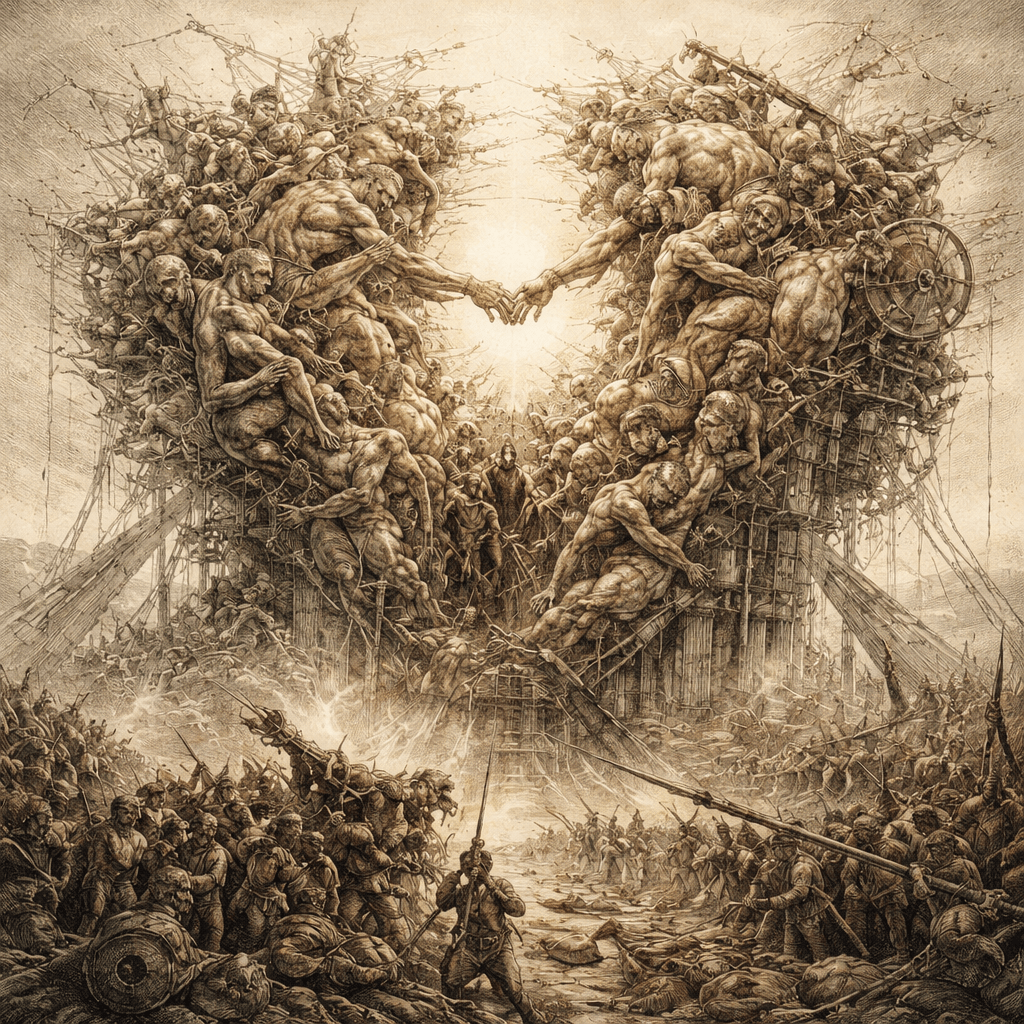
Modern power does not stabilise disorder. It metabolises it.
At planetary scale, technological and financial systems do not merely respond to uncertainty. They generate specific instabilities that make their own interventions appear necessary, then present themselves as the most probable remedy. This is not a claim about intent. It is a structural tendency of adaptive systems whose survival depends on throughput, coordination, and continuous problem-definition. Chaos, here, is not only collateral. It becomes a working medium, like waste heat in an engine.
In a turbocharged system, exhaust is not discarded. It is routed back through a turbine to drive further compression. Loss is not eliminated. It is re-ingested. Turbulence is produced, captured, converted into leverage, then used to intensify the conditions that require further capture. The loop is recursive. Acceleration arises from recirculation.
Instability is absorbed, priced in, and repurposed as operational fuel. What would once have counted as inefficiency becomes a mechanism of performance. Costs are displaced across time, populations, ecologies, and cognition until they appear diffuse enough to ignore. This works locally because displacement remains possible. At planetary scale, displacement collapses into circulation.
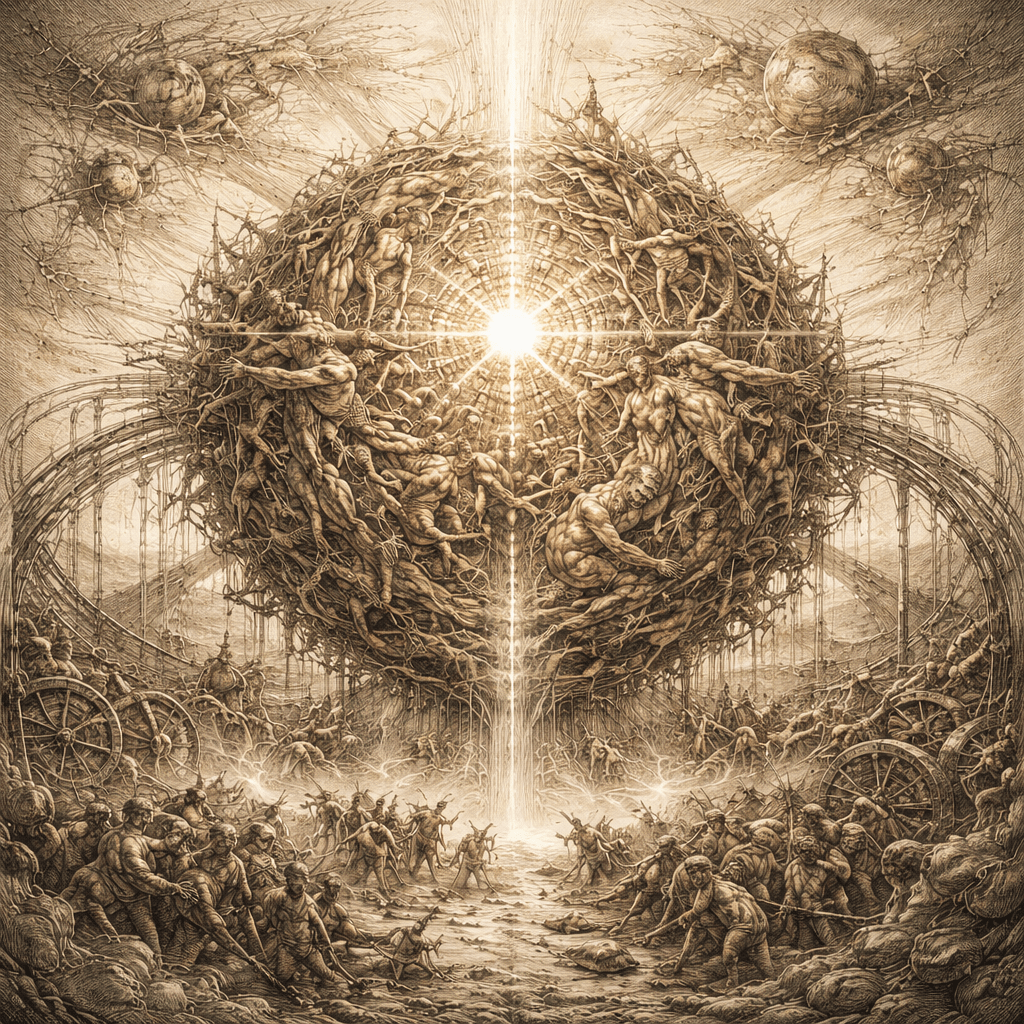
There are no external waste sinks. No entropy attenuators that are not also internal. No outside. What is displaced does not disappear. It returns through the same manifold as amplified stress, delayed signal, and systemic constraint.
Power feeds on disorder only while costs can be routed away faster than feedback returns. Once feedback density saturates and displacement loops back more quickly than corrective response, there is nowhere left for the cost to go. Acceleration increases. Apparent control rises. Effective regulation degrades.
Holism is the starting point. Every description, intervention, and correction is internal to the system in which it operates. Power, ideology, technology, capital, and subjectivity do not act from separate domains. They co-emerge as aspects of the same adaptive surface. Causation is reciprocal. Effects fold back into conditions. Systems persist not by resolving tension, but by recirculating it.
Capitalism makes this logic explicit. Predatory opportunism rarely appears as naked extraction. It arrives as refinement. Italian silk. Precision engineering. A Ferrari moving effortlessly through a city it did not build, on roads it did not repair, burning fuel abstracted from geopolitical risk and ecological debt. The objects are not the point. The field that makes them appear clean is.
That offset is not incidental. It is productive. The displacement of cost generates and sustains entire material and abstract systems: finance, logistics, insurance, advertising, aspiration, identity, prestige. Disorder is not merely hidden. It is reorganised into gradients that can be exploited repeatedly. Luxury depends on turbulence buffered away from direct encounter, delayed, redistributed, or rendered abstract.
This is the recursive mechanism. Waste becomes input. Harm becomes throughput. Crisis becomes justification. What appears as leverage over chaos is dependence upon it.
Within this field, authoritarian and predatory configurations are not anomalies. They are arrangements that maximise decision throughput under uncertainty while minimising corrective latency. Uncertainty is compressed. Feedback is suppressed. Volatility remains high while correction slows. From outside such systems appear pathological. From inside they appear efficient because variance is being forced into legible channels.
Fear, urgency, and dependency form steep gradients that can be rapidly leveraged.
The instability produced then becomes its own justification. Turbulence is cited as evidence that further intervention is required. Platforms, financial mechanisms, security architectures, and media systems thrive under these conditions not because they resolve instability, but because they circulate it. This is a self-reinforcing loop, not a conspiracy.
What is often missed is that those who appear to benefit most from such arrangements are themselves constrained by them. Alignment with predatory or authoritarian dynamics is adaptive behaviour inside a field that rewards instability production and punishes restraint. At sufficient scale, power does not confer freedom of action. It imposes obligation to role.
The more capital, visibility, and infrastructural centrality an actor accumulates, the less latitude they retain to deviate. Wealth does not provide exit. It deepens structural coupling.
These configurations are powerful but fragile. Their fragility does not arise from weakness, but from self-reference. Coherence is generated internally. Correction does not arrive from outside. It folds back into the system’s own operations, reinforcing the very dynamics that produced the instability in the first place. The system becomes a closed circulatory loop, efficient at motion yet increasingly blind to what it consumes.
Scale changes everything. For most of human history, systemic costs could be displaced. Disorder could be exported across geography, deferred across generations, absorbed by marginal populations, or dissolved into environments treated as effectively infinite. That displacement created the appearance of sustainability.
At planetary scale, this option disappears. The field closes. What was once elsewhere becomes internal. Entropy does not dissipate outward. It circulates inward.
This is what makes the present moment existential rather than merely political or economic.
The failure is both cybernetic and philosophical. These systems confuse amplification with control and acceleration with intelligence. They assume that increasing mediation can substitute for understanding, and that complexity can be outrun rather than inhabited. Human beings remain cognitively bounded, emotionally contagious, and socially patterned. At small scales, these traits are survivable. At global scale, when deliberately stimulated and exploited, they become structurally dangerous.
The system rewards precisely those behaviours that destabilise collective coherence because those behaviours maximise throughput. This is not because people are uniquely gullible. It is because complex adaptive systems select for whatever reproduces them fastest under given constraints.
We are all inside this machinery. There is no clean exit, no pure standpoint, no untouched observer. Technology is not something used from outside. It is the relational field in which contemporary subjectivity, power, and meaning now form. The error is not entrapment itself, but denial of it.
Acknowledgement does not mean surrender. It clarifies the design problem. Entropy, conflict, and uncertainty cannot be eliminated. They can only be routed. The critical questions are where disorder accumulates, how quickly it compounds, and who is forced to absorb its cost.
Systems that require continuous crisis as a signal of legitimacy cannot stabilise without exhausting the conditions that make signalling meaningful.
The future will not be decided by who can generate the most chaos, but by which configurations can metabolise instability without amplifying it, distribute its costs without concealment, and allow coherence to emerge without converting disorder into fuel. Until that distinction becomes structurally legible, the system will continue to consume its own turbulence and call the process growth.
 Daedelus Kite
One reply on “Metabolic Power”
LikeLike